

Most visitors walk through one gate at Shaniwar Wada — the main Delhi Darwaza — take their photos, and move on. They miss four more gates, each with its own design philosophy, its own story, and its own place in the larger narrative of the Peshwa era.
This is a complete walk through all five gates of Shaniwar Wada, in the order most visitors would naturally encounter them, with the history, architecture, and stories behind each one.
📍 Planning your visit? See our Complete Visitor Guide to Shaniwar Wada for timings, entry fee and how to reach.
The Fortification System — An Overview
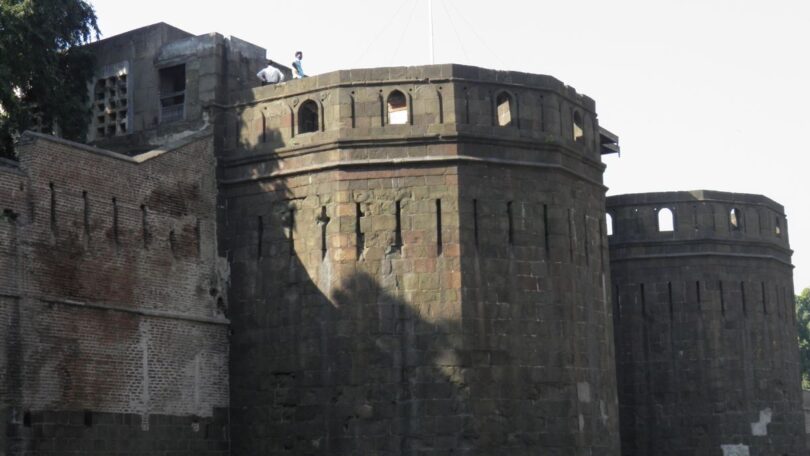
Before walking through the individual gates, it’s worth understanding the defensive logic of the entire complex. Shaniwar Wada’s outer perimeter consisted of fortification walls enclosing the full palace compound, reinforced by nine bastions (defensive towers) positioned at strategic points around the perimeter. The five gates were each positioned to serve a specific function — military defence, ceremonial entry, domestic access, or religious significance.
This was not simply a palace with doors. It was a fortified seat of imperial power, designed by an architect named Kashiwadi, brought specifically from Rajasthan for his expertise in defensive palace architecture — a sign of how seriously the Peshwas took the security of their new capital.
1. Delhi Darwaza — The Main Gate
Location: North side, main entrance
Height: 21 feet
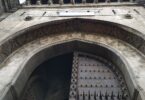
The Delhi Darwaza is the gate every visitor enters through today, and it was designed from the outset to be the most imposing structure in the entire complex. At 21 feet tall, it dwarfs a human visitor standing beneath it — exactly the psychological effect intended for any 18th-century visitor approaching the seat of Maratha power.
The Name
The gate’s name reflects Bajirao I’s most audacious ambition: the conquest of Delhi, the seat of Mughal imperial power. He never captured the city outright, but in 1737 his cavalry advanced close enough to the Mughal capital that the Emperor reportedly barricaded himself inside the Red Fort — a humiliation that confirmed, even without formal conquest, where real power in northern India now lay. The gate’s name was a permanent, daily reminder of that ambition to everyone who walked through it.
The Defensive Engineering
The most striking feature of the Delhi Darwaza is its 72 iron spikes, each approximately 12 inches long, studded across the gate’s surface at the height of a charging elephant’s forehead. This was not decorative. War elephants were used throughout South Asian military history as living battering rams against fortified gates. The spikes were specifically engineered to injure and deter an elephant attempting to ram the door — a defensive technology repeated across major fortifications throughout the Deccan.
Stand close to the gate and examine the spike pattern — you can see how systematically they cover the surface at exactly the height an elephant’s head would strike.
2. Mastani Darwaza — The Gate of Love and Controversy
Location: North side, near the Delhi Darwaza
Smaller and more ornate than the Delhi Darwaza, the Mastani Darwaza carries the most emotionally charged name of the five gates. It is traditionally understood to have been the entrance used by Mastani — Bajirao I’s companion, whose relationship with the Peshwa became one of the most debated and dramatised love stories in Maratha history.
Who Was Mastani?
Mastani was the daughter of the Hindu ruler of Bundelkhand and a Persian Muslim mother — making her a figure who, by the social conventions of the 1730s Maratha court, occupied a deeply contested position. She was, by all contemporary accounts, extraordinarily accomplished: a skilled warrior, an exceptional dancer and musician, and a woman of considerable political intelligence.
Bajirao I’s relationship with Mastani — whom he treated as his second wife despite fierce opposition from his family and the Brahmin establishment in Pune — became one of the most controversial aspects of his personal life. His first wife, Kashibai, and the broader Peshwa family deeply resented Mastani’s position. The conflict was severe enough that Mastani was, at various points, effectively kept separate from the main palace and Bajirao’s first family.
The gate that bears her name is a quiet but permanent acknowledgement of her place in the palace’s history — regardless of how contested that place was during her own lifetime. For the complete story of their relationship and what really happened: Bajirao Mastani — The Real Story at Shaniwar Wada.
3. Khidki Darwaza — The Window Gate
Location: East side
The smallest and least architecturally dramatic of the five gates, the Khidki Darwaza (“window gate” in Marathi) served as a practical, functional entrance — primarily used by domestic staff, suppliers, and the day-to-day traffic of running a palace complex that housed hundreds of people.
What makes the Khidki Darwaza worth visiting is precisely its modesty. Standing at this gate after seeing the grandeur of the Delhi Darwaza gives you a visceral sense of the social hierarchy embedded into the very architecture of the palace — grand entrances for state occasions and honoured guests, modest entrances for the people whose labour actually kept the palace running.
4. Ganesh Darwaza — The Gate of Faith and Tragedy
Location: Southeast side
Named for its proximity to the Ganpati Rang Mahal — the dedicated hall within the original palace used for religious ceremonies honouring Lord Ganesha — the Ganesh Darwaza carries deep religious significance in a city that, even today, holds Ganesh worship at the centre of its cultural identity.
But the Ganesh Darwaza is equally significant for darker reasons. This is the gate near which Peshwa Narayan Rao was caught and killed by assassins on the night of August 30, 1773 — the murder at the heart of Shaniwar Wada’s enduring haunted legend. Full story: The Haunted Story of Narayan Rao.
The juxtaposition is significant: a gate named for one of Hinduism’s most beloved deities, also marked by one of the most violent episodes in the palace’s history. Standing here, both stories are present simultaneously.
5. Narayan Darwaza — The Gate That Remembers
Location: South side
The fifth and final gate is named directly after the murdered Peshwa — a permanent memorial built into the very fabric of the fort. Unlike the other gates, whose names reflect ambition (Delhi), romance (Mastani), function (Khidki), or faith (Ganesh), the Narayan Darwaza exists specifically to remember a tragedy.
There is something quietly significant about this. The Maratha court could have chosen to erase or minimise the memory of Narayan Rao’s murder — a deeply embarrassing episode of internal betrayal at the highest level of the empire. Instead, his name was permanently inscribed into the architecture itself. Whatever the political motivations behind this decision (and historians debate them), the effect is that visitors today cannot walk through Shaniwar Wada without encountering his memory.
The Nine Bastions
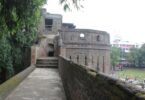
Beyond the five gates, the fortification perimeter included nine bastions — defensive towers positioned at intervals along the walls, designed to give defenders elevated firing positions and overlapping fields of view across the approach to the palace. Few of these survive in complete form today, but their foundations can still be traced along sections of the remaining walls.
How to See All Five Gates in One Visit
Most visitors enter through the Delhi Darwaza and don’t realise the other four gates are accessible and worth a dedicated walk. With 1.5–2 hours at the site, here’s how to see all five:
- Enter through Delhi Darwaza (north) — examine the 72 spikes closely, take photos from both inside and outside the gate
- Walk toward Mastani Darwaza (also north side, nearby) — pause here if you know the Bajirao-Mastani story; it adds real weight to the visit
- Continue along the perimeter to Khidki Darwaza (east) — notice the contrast in scale and ornamentation compared to the main gates
- Move to Ganesh Darwaza (southeast) — this is where the Narayan Rao murder occurred; many visitors find this the most affecting stop on the walk
- Finish at Narayan Darwaza (south) — the memorial gate, completing the historical and emotional arc of the visit
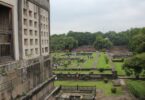
This walking order takes approximately 45 minutes to an hour if you spend time at each gate reading any posted information and taking photographs, leaving time afterward for the central garden, the Hazari Karanje fountain, and the Nagarkhana.
FAQs
How many gates does Shaniwar Wada have?
Five gates: Delhi Darwaza (main entrance, north), Mastani Darwaza (north), Khidki Darwaza (east), Ganesh Darwaza (southeast), and Narayan Darwaza (south).
What are the spikes on Delhi Darwaza for?
The 72 iron spikes, each 12 inches long, were defensive engineering designed to injure and deter war elephants from ramming the gate — a common military tactic used against fortified entrances throughout South Asian history.
Which gate is associated with Mastani?
The Mastani Darwaza, located on the north side near the main Delhi Darwaza, is traditionally believed to have been the entrance used by Mastani, companion of Peshwa Bajirao I.
Where was Narayan Rao murdered at Shaniwar Wada?
Historical accounts place his death near the Ganesh Darwaza, on the southeast side of the fort.
Also read:
→ Complete History of Shaniwar Wada
→ The Haunted Story of Narayan Rao
→ Bajirao Mastani — The Real Story
→ Shaniwar Wada Visitor Guide