
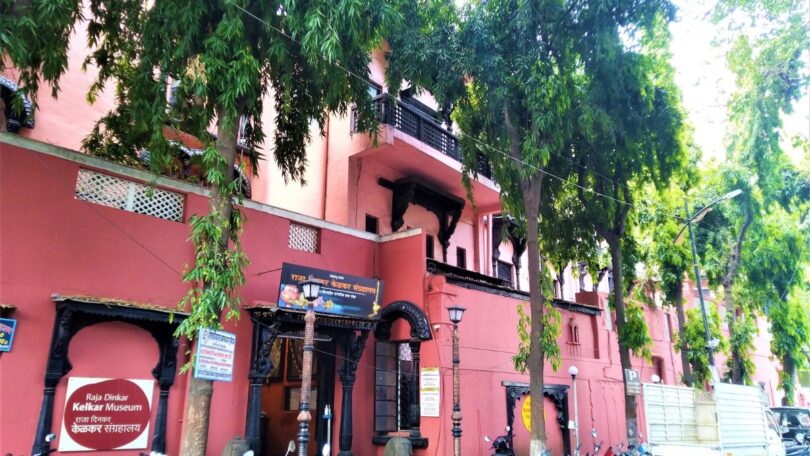

There is a museum in Pune that most tourists walk past without noticing. It sits on Bajirao Road in Shukrawar Peth, tucked between shops and traffic, with no dramatic signage screaming for your attention. And yet, once you walk through its doors, most people come out saying some version of the same thing: “I had no idea this existed. Why doesn’t everyone know about this place?”
The Raja Dinkar Kelkar Museum is one of the most extraordinary private collections in India — 20,000 artefacts gathered by one man over six decades of passionate, obsessive collecting. Not royal commissions. Not government acquisitions. One man, travelling across India, collecting the objects of everyday Indian life with the devotion of someone who believed that the ordinary is the most sacred thing of all.
This guide tells you everything you need for your visit — timings, entry fee, floor-by-floor breakdown of what to see, photography rules, how to reach, honest tips, and why this museum genuinely deserves 2–3 hours of your time.
📍 Combining with Dagdusheth Ganpati? The Kelkar Museum is just 1 km from Dagdusheth Ganpati Temple. See our Perfect 1-Day Pune Heritage Itinerary to plan both in a single day.
Kelkar Museum Pune — Quick Facts
| Detail | Information |
|---|---|
| Full Name | Raja Dinkar Kelkar Museum |
| Address | 1377–78, Natu Baug, Off Bajirao Road, Shukrawar Peth, Pune – 411002 |
| Timings | 9:30 AM to 5:30 PM (daily) |
| Closed on | Public holidays (check ahead) |
| Entry Fee — Indians | ₹100 per adult |
| Entry Fee — Foreign nationals | ₹200 per person |
| Photography fee | Additional ₹100 for mobile photography (confirm at ticket counter) |
| Time needed | 2 to 3 hours (minimum) |
| Contact | +91-20-2448-2101 |
The Story of One Man and 20,000 Objects
Dr. Dinkar G. Kelkar was born in 1896. He was not a king, a minister, or an industrialist. He was a private citizen from Pune with an insatiable curiosity about Indian everyday life — the utensils people cooked in, the lamps they lit at night, the musical instruments they played at weddings, the toys their children played with, the doors of houses that were being demolished and forgotten.
He began collecting in the 1920s, soon after his only son Raja died at the age of seven. The grief transformed him. He channelled everything — his energy, his income, his travels — into building a collection that would preserve what India’s own people were discarding and forgetting. He named the museum after his son.
For six decades, he travelled to remote corners of India. He haggled at markets in Gujarat. He found doors about to be demolished in Rajasthan. He rescued musical instruments from abandoned havelis in Karnataka. He gathered hookah pipes, betel-nut cutters, writing instruments, pottery, ivory carvings, armour, and paintings with equal enthusiasm — because to him, all of it was equally precious.
By 1962, the collection was substantial enough to open as a museum. By 1975 (some sources say 1992), Dr. Kelkar donated his entire life’s work to the Government of Maharashtra — so that it would be preserved and remain accessible to the public forever. He died in 1990 at the age of 94, leaving behind 20,000 objects and one of India’s most unusual museums.
Today, only 2,500 of those 20,000 objects are on display. Space constraints mean that 85% of the collection remains in storage, unseen by the public. What you see in the museum is just the beginning.
Opening Timings — Full Details
The museum is open daily from 9:30 AM to 5:30 PM, except on public holidays. Last entry is typically 30–45 minutes before closing.
Best time to arrive: 10:00 AM on a weekday. This gives you enough time to explore all three floors comfortably before the post-lunch crowds arrive. Weekday mornings are significantly quieter than weekends, and the lower footfall means you can spend more time at individual exhibits without people pressing behind you.
Photography tip: The museum’s interior is quite dim in many sections (to protect the artefacts). Morning light through the upper floor windows provides better natural light for photographs than afternoon visits.
Floor-by-Floor Guide — What to See and Where
The museum occupies two wings (Wing A and Wing B) across three floors. Below is an honest guide to what each floor contains and which exhibits are genuinely unmissable:
Wing A — Ground Floor: Objects of Beauty and Culture
This is where most visitors begin, and it sets the tone for everything that follows. The ground floor of Wing A holds pottery, vessels, and decorative objects primarily from the 18th and 19th centuries. Look for:
- The Dabado from Gujarat — a vessel used to transport dowry items. Dr. Kelkar found this in Gujarat and considered it one of his most fascinating finds. Its existence tells a complete story of a social practice in one object.
- Terracotta, copper and brass vessels from Maharashtra, Gujarat, and Kerala — humble cooking vessels elevated by the craftsmanship of their makers
- Paintings on scenes from the Ramayana and Mahabharata — including the distinctive Chitrakathi style of painting from Maharashtra
- Idols of Lord Ganesha, Lord Shiva, and Goddess Parvati — across different regional styles and centuries
Wing A — First Floor: Utensils of Daily Life
This floor is quietly one of the most fascinating sections of the museum, and the one most visitors underestimate. It holds the objects that Indian households used every day for centuries — betel-nut cutters, hookah pipes, writing instruments, toys, and kitchen equipment.
- Betel-nut cutters (Sarota): Dr. Kelkar collected hundreds of these — each one different, each one a miniature sculpture. The variety of regional styles is astonishing.
- Hookah pipes from different eras and regions — from simple clay to elaborate brass and silver
- Writing instruments and ink pots from the Mughal era and earlier
- Children’s toys — clay animals, wooden carts, puzzles — a deeply moving section because the objects are both ancient and completely familiar
Wing A — Second Floor: Textile Gallery
Textiles, costumes, and fabrics from across India. The weaving techniques and dye work on display here represent traditions that have been dying out across India since the industrial era. The collection includes work from Karnataka, Gujarat, Rajasthan, and Maharashtra.
Wing A — Third Floor: Special Exhibition Gallery
Rotating special exhibitions and a mixed collection of artefacts that don’t fit neatly into other categories. The silver and ivory ornaments from the Mughal era displayed here are among the most visually spectacular objects in the museum.
Wing B — Ground Floor: Ivory Gallery
One of the most delicate and remarkable sections. Ivory carvings from different centuries and regions — miniature sculptures, decorative objects, and utilitarian items carved with a precision that is almost incomprehensible given the tools available at the time. Note: all ivory in this collection is antique and was legally collected before modern wildlife protection laws.
Wing B — First Floor: Musical Instruments and the Mastani Mahal
This floor contains two of the museum’s greatest highlights:
The Musical Instrument Collection — Dr. Kelkar had a particular passion for Indian musical instruments, and this collection reflects that. String instruments, wind instruments, and percussion from different parts of India, some dating back centuries. The Chandrashekhar Agashe Wing (donated by his sons) adds a particularly fine set of instruments. Many of these instruments you will never have seen or heard of before — this section alone justifies the entire visit for music lovers.
The Mastani Mahal — this is the single most talked-about section of the museum, and it earns that attention.
The Mastani Mahal — The Star of the Museum
Mastani was the celebrated companion of Peshwa Bajirao I — one of the greatest military commanders in Indian history. She was beautiful, accomplished, a skilled musician and warrior, and their love story became one of the most debated chapters of Maratha history.
When Dr. Kelkar learned that a section of the original Mastani Mahal (palace) was lying abandoned and decaying in the forests of Kothrud, he did what he always did: he acted. With the help of craftsmen, he carefully dismantled the original carved wooden sections of the palace interior and transported them to the museum. He then reconstructed them as a faithful recreation of the palace chamber.
What you see today is a room with:
- Original carved wooden panels and architectural elements from the actual Mastani Mahal
- Grand period-appropriate chandeliers
- Mirrors and decorative elements consistent with 18th-century Peshwa-era design
- Paintings and artistic details that create a complete atmospheric recreation of the period
The result is atmospheric in a way that very few museum exhibits manage. You are not looking at objects behind glass. You are standing inside a room that once belonged to one of the most fascinating and tragic figures in Maharashtra’s history. Most visitors stand here longer than anywhere else in the museum.
The Lamp Collection — 2,000 Lamps and Counting
One of Dr. Kelkar’s deepest obsessions was lamps. The museum holds over 2,000 lamps from across India and across centuries — from simple oil lamps to elaborate multi-tiered brass constructions used in temple rituals. The variety is extraordinary. Each lamp is different. Each one was designed to throw light in a specific way, for a specific purpose, in a specific cultural context.
This section of the museum tends to be the one that stops visitors unexpectedly. Nobody comes expecting to spend 20 minutes looking at lamps. But the collection is genuinely extraordinary in its breadth and craftsmanship.
Don’t Miss: The Crocodile Armour
Near the weapons section of the museum sits one of its most unusual objects: a complete suit of armour made from crocodile skin and fish scales. Dating from the Maratha period, it is simultaneously bizarre, functional, and completely unlike anything most visitors have encountered in a museum. It tends to stop people in their tracks.
Photography Rules
| Photography Type | Permitted | Fee |
|---|---|---|
| Mobile photography (general) | Yes, with fee | ₹100 additional |
| Professional camera / DSLR | Check at ticket counter | Separate fee may apply |
| Flash photography | Not permitted | N/A |
| Video recording | Check at ticket counter | Separate fee |
Tips for better photos: The museum lighting is dim to preserve the artefacts. Stabilise your phone, avoid flash (strictly prohibited), and increase ISO settings. The Mastani Mahal section has the best light conditions of any area in the museum. Arrive early on a weekday morning for the fewest people in frame.
How to Reach Kelkar Museum
| Mode | Details |
|---|---|
| 🚂 From Pune Railway Station | 4 km, 15–20 minutes. Auto-rickshaw recommended. Tell driver “Kelkar Museum, Bajirao Road, Shukrawar Peth”. Fare approximately ₹60–100. |
| From Dagdusheth Ganpati Temple | 1 km, 12–15 minute walk through the old city lanes — a pleasant heritage walk in itself |
| From Shaniwar Wada | 1.4 km, 15–20 minute walk |
| 🚗 By Car | Limited parking near Bajirao Road. Best to park near Shaniwar Wada and walk. |
Combining Kelkar Museum With Other Nearby Sites
The museum sits at the heart of Pune’s historical district. These are all within easy reach:
- Dagdusheth Halwai Ganpati Temple — 1 km (15-minute walk)
- Shaniwar Wada — 1.4 km (Peshwa-era fort palace, open 8 AM – 6:30 PM)
- Lal Mahal — 1 km (Shivaji Maharaj’s childhood home)
- Pataleshwar Cave Temple — 2.5 km (8th-century rock-cut Shiva temple)
See our Perfect 1-Day Pune Heritage Itinerary for a complete plan combining all four in one well-timed day.
Frequently Asked Questions
What are Kelkar Museum Pune timings?
The museum is open daily from 9:30 AM to 5:30 PM, except on public holidays. Best to arrive by 10:00 AM to have enough time to explore all floors.
What is the entry fee for Kelkar Museum Pune?
₹100 per adult for Indian nationals. ₹200 for foreign nationals. An additional ₹100 fee applies for mobile phone photography.
How long does Kelkar Museum take?
Plan for a minimum of 2 hours. If you are genuinely interested in Indian art, craft, or history, 3 hours is better. The collection rewards slow, attentive looking.
What is the Mastani Mahal at Kelkar Museum?
The Mastani Mahal is a reconstruction of a palace chamber associated with Mastani, companion of Peshwa Bajirao I. Dr. Kelkar salvaged original carved wooden panels from the crumbling Mastani Mahal in Kothrud and recreated the interior at the museum. It is widely considered the most atmospheric and beautiful section of the museum.
Is Kelkar Museum suitable for children?
Yes, especially for children aged 8 and above. The interactive variety of objects — toys, weapons, instruments, lamps, pottery — holds attention well. The Mastani Mahal story is particularly engaging for children with some knowledge of Maratha history.
Can I reach Kelkar Museum from Dagdusheth Ganpati by walking?
Yes — it is a pleasant 12–15 minute walk through the lanes of old Pune. Most heritage visitors combine both in the same trip.
Also read: Kelkar Museum Hidden Gems — 10 Things Most Visitors Miss | Dagdusheth Ganpati Complete Guide | 1-Day Pune Heritage Itinerary