

If you are visiting Pune for the first time — or even if you have lived here for years — there is one place that deserves to be on every list. The Shrimant Dagdusheth Halwai Ganpati Temple in the heart of Pune (Budhwar Peth) is not simply a temple. It is Pune’s living soul. Millions of devotees, tourists, and first-time visitors walk through this temple every year, and almost every single one leaves with the same feeling: that this place is different from everywhere else they have been.
This guide tells you everything you need to know before you visit — the complete darshan timings, full aarti schedule, how to reach, what to expect inside, the best time to visit to avoid crowds, and the remarkable story behind the temple. Bookmark this page before you go.
📍 Planning a full heritage day in Pune? Dagdusheth Ganpati is part of our Perfect 1-Day Pune Heritage Itinerary — combining this temple, Kelkar Museum, Shaniwar Wada and Lal Mahal in one well-planned day.
Dagdusheth Halwai Ganpati — Complete Darshan Timings 2026
The temple is open every day of the year. There are no holidays. The darshan schedule follows a precise routine built around five daily aarti ceremonies. Between each aarti, the temple is open for general public darshan.
| Day | Temple Opens | Temple Closes |
|---|---|---|
| Monday, Wednesday, Thursday, Friday, Saturday, Sunday | 5:00 AM | 10:30 PM |
| Tuesday (extended) | 5:00 AM | 11:00 PM |
Full Aarti Schedule — Daily
| Aarti | Time | What Happens |
|---|---|---|
| Suprabhatam Aarti (Morning awakening) | 7:30 AM – 7:45 AM | The first formal aarti of the day. The deity is awakened with incense, flowers and devotional singing. One of the most peaceful times to be in the temple. |
| Naivedyam (Food offering) | 1:30 PM – 1:45 PM | Sacred food is offered to the deity. Darshan is briefly paused during this ritual. |
| Madhyana Aarti (Afternoon aarti) | 3:00 PM – 3:15 PM | Midday aarti with incense and lamps. Short but atmospheric — the temple is typically less crowded at this time. |
| Mahamangal Aarti (Grand evening aarti) | 8:00 PM – 9:00 PM | The most spectacular aarti of the day. Full one hour, with brass instruments, conch shells, elaborate lamp-waving and hundreds of devotees. This is the experience most people come for. |
| Shejarti (Night aarti) | 10:30 PM – 10:45 PM | The closing ceremony of the day. The deity is bid goodnight with a final aarti before the temple closes. |
Important: General darshan continues between all aartis. The queue pauses briefly during the aarti itself, then reopens. If you time your arrival for 15–20 minutes before the Mahamangal Aarti at 8 PM, you can experience the transition from regular darshan into the full evening ceremony — a truly memorable experience.
Special Weekly Ritual — Abhishek
Every day from 8:00 AM to 12:00 noon, a ritual Abhishek (sacred bathing of the idol) is available for devotees who book in advance. On every Tuesday and Vinayak Chaturthi, a full Ganeshyag (fire ritual) is conducted from 8:00 AM to 12:00 noon. On special occasions like Angarak Chaturthi, Gudi Padwa, Akshay Tritiya, and Diwali Padwa, extended special Ganeshyag ceremonies are held.
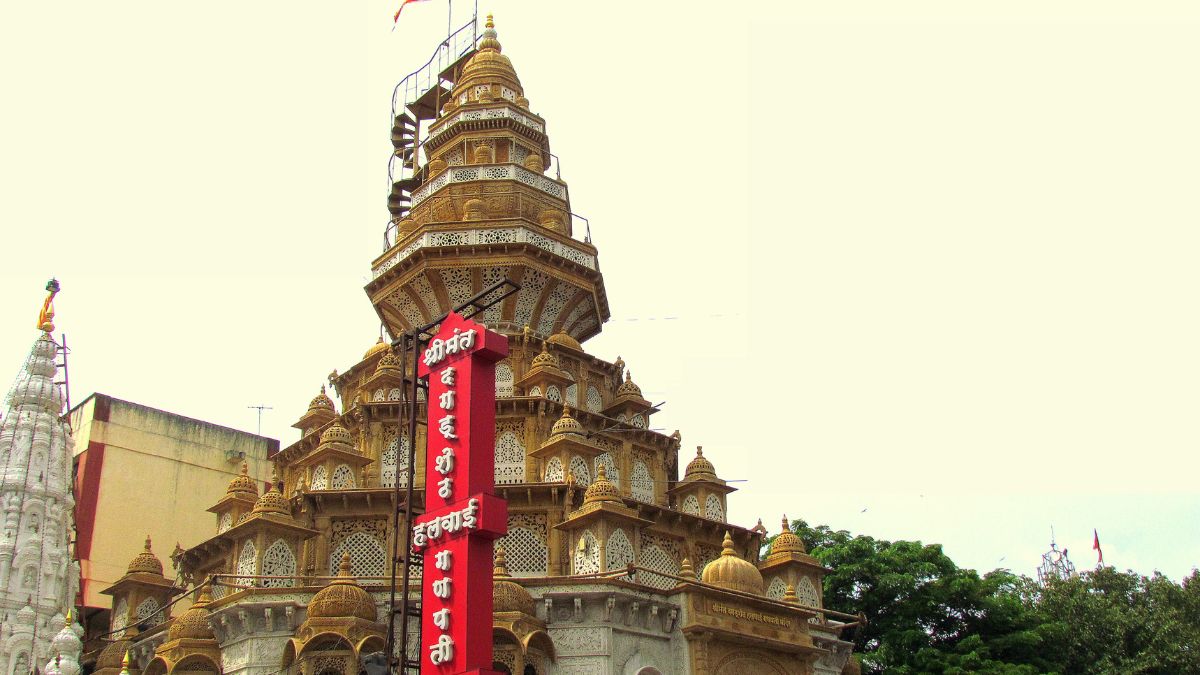
Source: https://upload.wikimedia.org/wikipedia/commons/a/a8/Shikhara_of_Dagdusheth_Halwai_Ganapati_Temple_in_Pune.jpg
History — The Story That Makes This Temple Different
Every temple has a story. The story behind Dagdusheth Halwai Ganpati is one of grief, faith, and an act of devotion that accidentally changed the history of Maharashtra.
In the late 19th century, Pune was still part of colonial India, grappling with devastating plague epidemics that swept through Maharashtra. A respected sweet-maker (halwai) named Shrimant Dagdusheth Halwai and his wife Lakshmibai lost their only son to one such epidemic. Crushed by grief, the couple turned entirely to Lord Ganesha for solace. They installed a Ganesha idol and began worshipping it with daily devotion. Their personal grief became a daily act of collective faith — and word spread through the neighbourhood that this idol was a Jagrut Devasthan, a place where the deity was alive and responsive to prayer.
Then came Lokmanya Bal Gangadhar Tilak.
In 1893, Tilak — one of the greatest leaders of India’s independence movement — saw something powerful in the public devotion at Dagdusheth Ganpati. He recognised that Ganesh Chaturthi, until then a largely private household festival, could be transformed into a public gathering that would unite people across caste and class — a powerful tool of community resistance against colonial rule. He began the Sarvajanik Ganeshotsav movement, and Dagdusheth Ganpati became its beating heart.
That movement grew into one of the world’s largest religious festivals. And Dagdusheth Ganpati remained, decade after decade, its most celebrated icon.
The Idol — What Makes It Extraordinary
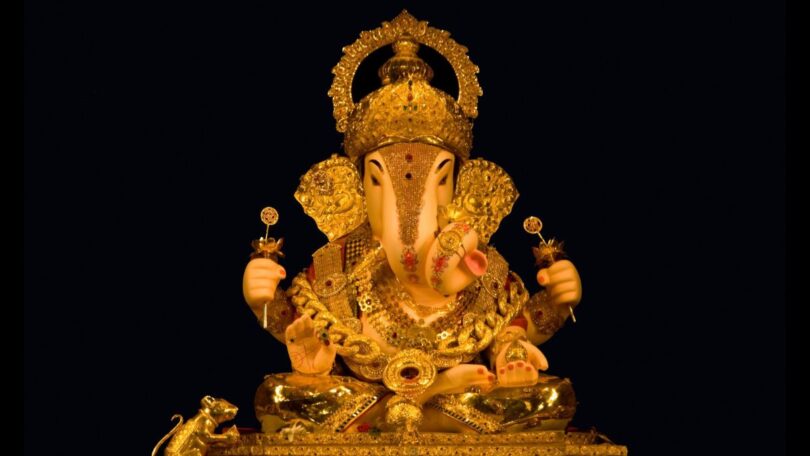
The Ganesha idol at Dagdusheth is not ancient — it was commissioned in 1968 to mark the 75th anniversary of the Ganeshotsav. It was crafted by master sculptor Shree Shankar Appa Shilpi. What has made it remarkable over the decades is the devotion it has accumulated:
- The idol stands 7.5 feet tall and 4 feet wide — an imposing, majestic presence
- It is adorned with over 40 kg of pure gold donated by devotees over generations
- The idol is flanked by two ornate silver doors depicting scenes from Lord Ganesha’s life
- Four enormous chandeliers illuminate the sanctum, creating a golden glow that visitors describe as otherworldly
- The temple dome itself is gold-plated
On ordinary days, the idol is beautifully decorated with flowers and gold ornaments. During Ganesh Chaturthi, the ornamentation becomes extraordinarily elaborate — with new thematic decorations each year designed by craftsmen from across Maharashtra.
The Temple Trust — More Than Just a Place of Worship
The Shrimant Dagdusheth Halwai Sarvajanik Ganpati Trust has grown over more than a century into one of the most active social service organisations in Pune. What the trust does with the faith of millions of devotees:
- Pitashree Old Age Home at Kondhwa — providing dignified accommodation and care for elderly residents
- Free ambulance service available to the poor throughout Pune
- Health clinics in tribal belts of Pune district
- Educational support — scholarships, hostels and schools
- Annual cultural programmes — singing concerts, bhajans, Atharvasheersh recitation events
This is why visiting Dagdusheth Ganpati is not just a spiritual act. Every rupee offered here has, over decades, been channelled back into the community.
How to Reach Dagdusheth Halwai Ganpati Temple
Address: Ganpati Bhavan, 250, Budhwar Peth, Pune – 411002 (near Laxmi Road)
Phone: 020-24479222 (Ganpati Bhavan) / 020-24461185 (Temple)
| Mode of Transport | Details |
|---|---|
| 🚂 From Pune Railway Station | Approximately 4 km. Take an auto-rickshaw or cab — 15–20 minutes depending on traffic. Fare ₹60–₹100. |
| ✈️ From Pune Airport | Approximately 10 km. Cab recommended — 25–35 minutes. Fare ₹250–₹400. |
| 🚌 By City Bus | PMPML buses serve the Budhwar Peth area from all major points in Pune. |
| 🛺 Auto / Cab | Tell the driver “Dagdusheth Ganpati, Budhwar Peth” — every driver in Pune knows it immediately. |
| 🚗 By Car | Shaniwar Wada is 300 metres away. Small parking available near the temple — arrive very early for a parking spot. The area gets extremely congested after 9 AM. |
Entry Fee
There is no entry fee to enter the temple or take darshan. The temple is open to all. Donations are voluntary and go to the trust’s social welfare activities.
Best Time to Visit — Honest Guide
This depends entirely on what kind of experience you want:
| When to Go | Experience | Crowds |
|---|---|---|
| 6:00 AM – 8:00 AM (Weekdays) | Most peaceful. The temple is quiet, the morning light is beautiful, and you can spend time in genuine contemplation. Suprabhatam Aarti at 7:30 AM is intimate and unhurried. | Very low |
| 8:00 PM – 9:00 PM (Any day) | Mahamangal Aarti — the grandest experience. Full lamps, instruments, chanting. Expect a crowd but the atmosphere is electric. | High |
| Weekends, 10 AM – 6 PM | Standard tourist visit. Busy but manageable. Queue times 30–60 minutes. | High |
| Tuesday evenings | Tuesday is the most auspicious day for Lord Ganesha. Extended temple hours (until 11 PM). Very crowded but special energy. | Very high |
| Ganesh Chaturthi (Aug–Sep) | The experience of a lifetime — but expect multi-hour queues, enormous crowds (20 lakh+ visitors across 10 days) and a completely transformed atmosphere. | Extremely high |
Our recommendation: If this is your first visit to Dagdusheth Ganpati, arrive at 7:15 AM on a weekday. You will experience the Suprabhatam Aarti in a relatively peaceful setting, take your darshan unhurried, and leave before the city wakes up fully. There is no version of this temple more authentic than the early morning.
What to Expect When You Arrive
- Remove your footwear before entering the temple complex. Footwear stands are available outside.
- Dress modestly. Shoulders and knees should be covered out of respect. There is no strict enforcement but it is the right thing to do.
- Photography is permitted in the outer courtyard but restricted near the main idol during aarti ceremonies. Follow the security staff’s instructions.
- Mobile phones should be on silent mode inside.
- Prasad (sacred sweets, especially modak) is available from stalls around the temple. The modaks here are genuinely excellent — a Pune speciality worth trying.
- Queue system: Separate queues for VIP darshan (faster, paid), and general darshan (free). For most visitors, the general queue moves reasonably quickly outside of festival season.
Nearby Attractions — Plan Your Full Day
Dagdusheth Ganpati sits at the heart of Pune’s most historically rich neighbourhood. Everything below is within walking distance or a short auto ride:
- Shaniwar Wada — 300 metres (the historic Peshwa palace, open 8 AM – 6:30 PM, ₹25 entry)
- Lal Mahal — 1 km (Shivaji Maharaj’s childhood home)
- Raja Dinkar Kelkar Museum — 1 km (one of India’s most extraordinary private collections — a must-visit)
- Laxmi Road — 200 metres (Pune’s famous shopping street for traditional sweets, sarees, and silver jewellery)
- Pataleshwar Cave Temple — 2.5 km (rock-cut Shiva temple dating to the 8th century)
See our complete 1-Day Pune Heritage Day Itinerary to plan how to combine all of these in one perfectly-timed day.
Live Darshan
If you cannot visit in person, the Dagdusheth Halwai Ganpati Trust offers Live Darshan on their official website at dagdushethganpati.com. The live stream runs during all major aarti timings and on festival days.
Frequently Asked Questions
What are Dagdusheth Ganpati temple timings?
The temple is open from 5:00 AM to 10:30 PM daily (until 11:00 PM on Tuesdays). Darshan continues between aarti ceremonies throughout the day.
What is the best time to visit Dagdusheth Ganpati to avoid crowds?
Early weekday mornings between 6:00 AM and 8:00 AM are the least crowded. Weekends and Tuesday evenings are the busiest times outside of festival season.
Is there an entry fee for Dagdusheth Ganpati?
No. Darshan is completely free for all visitors. Donations to the trust are voluntary.
How far is Dagdusheth Ganpati from Shaniwar Wada?
Just 300 metres — a 5-minute walk. Most visitors combine both in the same visit.
When is Dagdusheth Ganpati most beautifully decorated?
During Ganesh Chaturthi (August–September), the temple is elaborately decorated with a new theme each year — created by craftsmen from across Maharashtra. The 2025 theme was a life-sized replica of the Padmanabhaswamy Temple in Kerala.
Can I watch Dagdusheth Ganpati aarti online?
Yes — Live Darshan is available on the official website dagdushethganpati.com during all main aarti timings.
Also read: Dagdusheth Ganpati During Ganesh Chaturthi — The Complete Festival Guide | Raja Dinkar Kelkar Museum Pune — Complete Visitor Guide | Perfect 1-Day Pune Heritage Itinerary