

Most visitors to the Raja Dinkar Kelkar Museum spend their time in the obvious places — the Mastani Mahal, the main lamp gallery, the pottery section. They walk briskly through the rest. They leave having seen perhaps 40% of what the museum actually has to offer.
This is not their fault. The museum is large, slightly labyrinthine, and many of its most extraordinary objects are displayed without dramatic signage or spotlight lighting. The collection rewards the slow, curious visitor who stops and looks closely — and this article is for exactly that visitor.
Below are 10 things that most visitors to the Kelkar Museum either miss entirely or walk past without realising what they are looking at. Each one is worth stopping for.
📍 Planning your first visit? Read our Complete Visitor Guide to Kelkar Museum first — full timings, entry fee, floor-by-floor breakdown, and practical tips.
1. The Crocodile Skin and Fish Scale Armour
Somewhere in the weapons section of the museum sits what may be the most unusual object in any museum in Maharashtra: a complete suit of armour made from crocodile skin and fish scales. It dates from the Maratha period and was almost certainly custom-made for a specific warrior.
Think about what this object represents: someone — possibly in the 17th or 18th century — sat down and thought through every practicality of using crocodile and fish materials as armour. The result is functional, strange, and completely unlike anything you have ever seen. Most visitors walk past it because there is nothing particularly dramatic-looking about it from a distance. Stop. Look closely. The craftsmanship involved in assembling something this unusual is extraordinary.
2. The 2,000-Lamp Collection — Every One Different
The Kelkar Museum is often described as having “a lamp collection” — which makes it sound like a shelf with a few lamps on it. It is not. Dr. Kelkar collected over 2,000 lamps, and the museum displays hundreds of them across several sections.
What makes this extraordinary is not the number but the variety. There are:
- Single-wick earthen lamps from rural Maharashtra that cost almost nothing when new
- Elaborate multi-armed brass oil lamps used in temple rituals, standing over a metre tall
- Mughal-era lamps with intricate Persian-influenced metalwork
- Hanging lamps, standing lamps, boat-shaped lamps, animal-shaped lamps
- Festival-specific lamps designed to be lit only on certain ritual days
Walk through the lamp sections slowly. Each lamp was designed to solve the same problem — providing light — in a completely different way. Two thousand different solutions to the same problem, each one reflecting the cultural context of the person who made it. This is what makes the collection philosophically interesting, not just visually impressive.
3. The Betel-Nut Cutters (Sarota) Collection
Dr. Kelkar had a particular obsession with betel-nut cutters — the small scissor-like instruments used to cut areca nut for paan. He collected hundreds of them, and they are displayed across several cases in the museum. Most visitors glance at them and move on quickly. This is a mistake.
Look at the variety of regional styles: the Bengali version is completely different from the Rajasthani, which is different again from the Maharashtrian, the Keralite, the Gujarati. Some are plain iron. Others are silver with intricate floral engravings. Some are carved into animal shapes — birds, elephants, horses. Each one is a miniature sculpture that was also a functional everyday tool.
The betel-nut cutter collection is one of the best demonstrations in the museum of Dr. Kelkar’s core belief: that the objects of everyday life are more revealing of a culture than the objects made specifically to impress.
4. The Mastani Mahal — But Look at the Ceiling
Everyone comes to see the Mastani Mahal. Very few people look at the ceiling properly.
Dr. Kelkar salvaged the carved wooden panels from the decaying Mastani Mahal in Kothrud and reconstructed the room at the museum. The main draw is the overall atmosphere — the chandeliers, the mirrors, the period furniture. But the ceiling itself is a work of extraordinary craftsmanship. The carved wooden lattice work, the painted panels between the structural beams, and the way different decorative techniques from the 18th century Peshwa-era aesthetic come together overhead — all of this is easily missed because visitors are looking forward and sideways, not up.
Stand in the centre of the Mastani Mahal room and look directly up for 60 seconds. Most people see something they had completely missed.
5. The Vanita Kaksha — The Women’s Quarter
The Vanita Kaksha (women’s room) is in the new wing of the museum and is frequently overlooked because it is slightly off the main path that most visitors follow. It holds a collection of the daily toiletry objects used by women in royal households during the Mughal and Peshwa eras:
- Foot-cleaners (pumice stones with carved handles)
- Combs made from ivory, wood, and metal — each one distinct in design
- Vermillion caskets (for sindoor) in silver and gold
- Mirrors with elaborately carved frames
- Collyrium boxes (for kajal) in remarkable variety
This section of the museum is quietly revolutionary. By displaying the everyday objects of women’s private lives with the same curatorial care as royal weapons and palace furniture, Dr. Kelkar made an argument — perhaps unconsciously — that women’s daily lives deserved to be preserved and remembered just as much as kings’ battles. The section rewards a slow, attentive visit.
6. The Doors and Windows From Rajasthan, Gujarat, Kerala and Karnataka
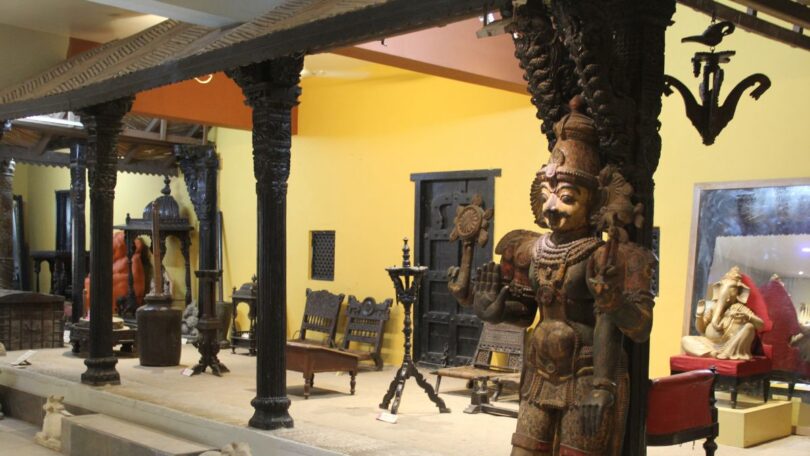
Throughout the museum, you will encounter carved wooden doors and window frames that seem too grand to be on display in a corridor. These are not reproductions. They are original architectural elements salvaged from havelis (merchant houses) and temples across India that were being demolished or abandoned.
Dr. Kelkar understood something that most people miss: a beautifully carved door is a more complete record of a culture than most paintings. A door had to be functional. It had to be affordable (at some level). It had to reflect the owner’s status, the carpenter’s skill, and the regional decorative tradition — all at once. Look at the differences between the Kerala-style door (with its dense, precise floral carvings) and the Rajasthani version (bigger figures, more dramatic imagery). Two completely different aesthetic philosophies, in the same corridor.
7. The Gurulas — Ritual Vessels With Hidden Mechanisms
Scattered through the collection are a category of ritual vessels that most visitors do not recognise: Gurulas, or ritual pourers used in temple ceremonies. Some of these have hidden mechanical mechanisms — internal chambers that control the flow of liquid, small springs or counterweights that make the liquid pour only when the vessel is tilted at a specific angle.
These are — to be direct about it — engineering marvels made by craftsmen who had no formal engineering education. The precision required to build a functioning internal mechanism into a brass vessel using only hand tools is extraordinary. Ask a museum guide to show you which vessels have mechanisms if this interests you.
8. The Paintings — Chitrakathi and the Miniature Tradition
The Kelkar Museum holds an important collection of Chitrakathi paintings — a distinctive folk painting tradition from the Palghar district of Maharashtra. These are narrative paintings on paper, typically depicting stories from the Ramayana and Mahabharata, in a flat, two-dimensional style with bold outlines and vivid natural dyes.
What makes these particularly significant is that the Chitrakathi painting tradition was nearly extinct until relatively recent revival efforts. The museum’s collection predates the revival and includes works in original styles and on original materials that are rare even in specialist collections. Most visitors spend perhaps 90 seconds looking at this section. It deserves ten minutes.
9. The Silver and Ivory Collection — Mughal-Era Craftsmanship
On the upper floor of Wing A, the museum displays silver ornaments and ivory objects from the Mughal era. These are different in character from the rest of the collection — they are explicitly luxurious, made to impress, and demonstrate a completely different kind of craftsmanship from the folk and vernacular traditions that dominate the rest of the museum.
The contrast is instructive. After spending time with the betel-nut cutters and earthen lamps downstairs, the Mughal-era silver work feels almost alien — a completely different relationship between maker, object, and function. Dr. Kelkar collected both with equal enthusiasm, believing that the full picture required both.
10. Dr. Kelkar Himself — The Portrait at the Entrance
At the entrance to the museum, there is a portrait of Dr. Dinkar G. Kelkar. Most visitors walk past it immediately in their rush to begin exploring the collection. Stop here for one minute before you enter.
This man spent 60 years of his life — almost every rupee he earned, every hour of personal time — building what you are about to see. He was not a millionaire. He was not backed by a foundation or a government grant. He was a private citizen who believed, with absolute conviction, that the ordinary objects of Indian daily life were worth preserving. He was right. And the fact that you can walk into this museum today and spend two hours with 2,500 of the most interesting objects in India is entirely because one person decided that grief could become purpose.
The portrait is worth a moment of your time before you begin.
How to Make the Most of Your Visit
- Go slowly. The museum rewards patience. The people who rush through leave having seen the shapes of things. The people who stop leave having understood them.
- Take a museum guide if available — guides at Kelkar Museum often have stories about specific objects that are not written on the labels.
- Visit on a weekday morning for the quietest, most attentive experience. The museum is open from 9:30 AM.
- Pay the photography fee. You will want photographs.
- Allow 2.5 to 3 hours minimum if you want to see the collection properly.
Frequently Asked Questions
What is the most famous thing in Kelkar Museum Pune?
The Mastani Mahal — a recreation of the palace chamber associated with Mastani, companion of Peshwa Bajirao I, using original carved wooden panels salvaged from the crumbling structure in Kothrud. It is the most atmospheric and most photographed section of the museum.
What should I not miss at Kelkar Museum?
The Mastani Mahal, the lamp collection (look slowly — there are 2,000 of them), the betel-nut cutter collection, the crocodile skin armour, the Chitrakathi paintings, and the Vanita Kaksha section. Allow at least 2.5 hours to see these properly.
Is there a guide available at Kelkar Museum?
Museum guides are available at the ticket counter. We strongly recommend taking one — the stories behind specific objects are as interesting as the objects themselves.
What is the story behind the Kelkar Museum?
Dr. Dinkar G. Kelkar began collecting in the 1920s after the death of his young son Raja. He spent 60 years travelling across India collecting everyday objects of Indian life. In 1962 he opened the museum, naming it after his son. He later donated the entire collection to the Maharashtra government. He died in 1990 at age 94, leaving behind 20,000 objects and one of India’s most extraordinary museums.
Also read: Kelkar Museum Complete Visitor Guide — Timings, Entry Fee & Floor-by-Floor | Dagdusheth Ganpati Temple — Complete Visitor Guide | 1-Day Pune Heritage Itinerary