

In 2015, Sanjay Leela Bhansali’s lavish period drama “Bajirao Mastani” — starring Ranveer Singh and Deepika Padukone — introduced millions of people to a love story most had never heard of: the relationship between Peshwa Bajirao I, the undefeated Maratha general, and Mastani, the warrior-poet who became his second wife despite the fierce opposition of his family and the entire Brahmin establishment of 18th-century Pune.
The film was visually spectacular and emotionally powerful. It was also, like most Bollywood historical dramas, a heavily dramatised version of real events. This article separates what is documented history from what is cinematic invention — and tells you what actually survives of this story at Shaniwar Wada today.
📍 Visiting the Mastani Darwaza? See our complete guide to all five gates of Shaniwar Wada, including the Mastani Darwaza.
Who Was Bajirao I — Beyond the Film
Before discussing Mastani, it’s worth understanding who Bajirao actually was, because the film’s romantic framing can obscure the scale of his real historical achievement. Bajirao Ballal Bhat was appointed Peshwa (Prime Minister) of the Maratha Empire in 1720 at the age of 20. Over a 20-year career, he fought more than 41 battles and never lost a single one — an unmatched record in 18th-century Indian military history.
He expanded Maratha control from the Deccan plateau to the banks of the Yamuna, came close enough to Delhi in 1737 that the Mughal Emperor barricaded himself in the Red Fort, and built Shaniwar Wada as the physical capital of this expanding empire. He was, by any historical measure, one of the most consequential military leaders India has produced.
Who Was Mastani — Separating History From Legend
Mastani’s exact origins are debated among historians, but the most widely accepted account holds that she was the daughter of Chhatrasal, the Hindu ruler of Bundelkhand (in present-day Madhya Pradesh), and a Persian or Muslim mother — though the precise details of her mother’s identity remain disputed in different historical sources.
The connection to Bajirao began in 1728, when Chhatrasal, facing a Mughal invasion of his territory, called on Bajirao for military assistance. Bajirao’s intervention successfully defended Bundelkhand. In gratitude, Chhatrasal is said to have offered Bajirao a portion of his territory — and, according to most accounts, his daughter Mastani.
By contemporary accounts, Mastani was extraordinarily accomplished — skilled in warfare, an exceptional dancer, a poet, and a woman of considerable political acumen. She reportedly rode into battle alongside Bajirao and was as comfortable on a battlefield as in a royal court.
The Relationship — What the Historical Record Shows
Bajirao took Mastani as his second wife — though the legitimacy of this marriage was fiercely contested throughout his lifetime and remains debated by historians today. Several factors made the relationship deeply controversial within the conservative Brahmin establishment of Pune:
- Mastani’s mixed heritage — her Muslim or Persian maternal lineage was unacceptable to the orthodox Brahmin priesthood that held significant social and religious authority in Pune
- The existing marriage to Kashibai, Bajirao’s first wife, who came from a respected Brahmin family and whose position was threatened by Mastani’s elevated status
- Political opposition from Bajirao’s own family, particularly his mother Radhabai, who saw Mastani as a threat to family honour and political stability
Despite this opposition, Bajirao maintained his relationship with Mastani for over a decade, and they had a son together, Shamsher Bahadur, who was raised partly as a Muslim — itself an extraordinary statement in the context of 18th-century Maratha Brahmin society.
Mastani at Shaniwar Wada
The most enduring physical connection between this story and Shaniwar Wada is the Mastani Darwaza — one of the fort’s five gates, traditionally understood to have been the entrance she used. Given the social opposition to her presence, historical accounts suggest that Mastani’s quarters within the palace complex were kept somewhat separate from the main royal household — though the precise arrangement is not fully documented in surviving records.
What can be said with confidence: the Mastani Darwaza’s name has persisted for nearly 300 years, a permanent acknowledgment, embedded in the fort’s own architecture, of her place in the palace’s history — regardless of how contested that place was during her own lifetime.
The End of the Story
Bajirao I died suddenly of fever in April 1740, at just 40 years old, while on military campaign at Raverkhedi on the banks of the Narmada river — far from Pune, far from both Kashibai and Mastani.
What happened next is one of the most genuinely tragic footnotes to the story. According to most historical accounts, Mastani — devastated by Bajirao’s death and facing intensified hostility from his family now that his protection was gone — died shortly afterward, in the same year, 1740. The precise circumstances of her death are not fully documented; some accounts suggest illness, others suggest she may have taken her own life. The uncertainty itself reflects how marginalised her position remained even in the historical record.
Their son, Shamsher Bahadur, was raised separately and went on to become a notable military commander in his own right, eventually dying in battle at the Third Battle of Panipat in 1761 — fighting, notably, for the same Maratha cause his father had built.
Real History vs the 2015 Film — Key Differences
| Element | Historical Record | Film Portrayal |
|---|---|---|
| Mastani’s background | Daughter of Chhatrasal of Bundelkhand; mixed Hindu-Muslim/Persian heritage debated among historians | Presented with more cinematic clarity than historical sources actually provide |
| Bajirao and Kashibai’s relationship | Complex, documented tension, but less theatrically framed in most historical sources | Heavily dramatised as a more direct rivalry for dramatic effect |
| Mastani’s confinement | Some historical accounts suggest she was kept apart from the main palace; exact details not fully documented | Depicted with a specific dramatic narrative of imprisonment that may exceed verified historical detail |
| Bajirao’s death | Died of fever while on campaign at Raverkhedi, April 1740 | Portrayed with significant cinematic license regarding the circumstances |
| Mastani’s death | Died shortly after Bajirao in 1740; exact cause not definitively documented | Dramatised with a specific narrative that historical sources cannot fully confirm |
This is not unusual — Bollywood historical dramas routinely compress, dramatise, and fill historical gaps with narratively satisfying invention. The core facts — that Bajirao and Mastani had a real relationship, that it was genuinely controversial, that they had a son, and that both died within the same year under difficult circumstances — are historically grounded. The specific scenes, dialogue, and dramatic confrontations in the film are creative interpretation.
What You Can See Today
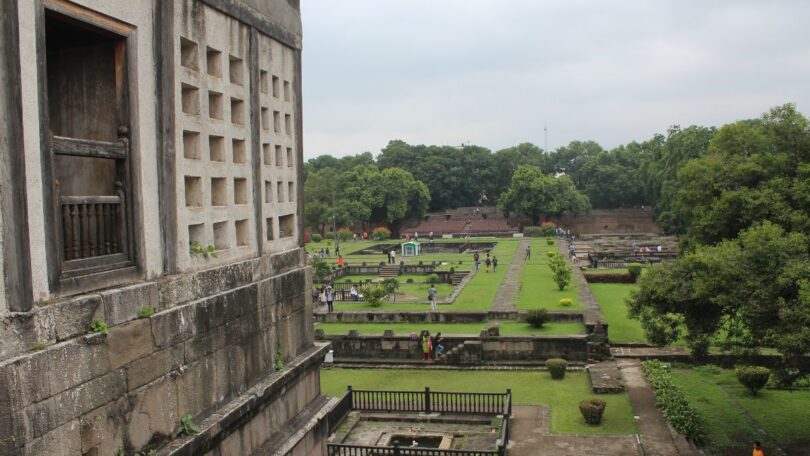
At Shaniwar Wada itself, the physical connection to this story is primarily the Mastani Darwaza — one of the five surviving gates. The original palace interior where Mastani would have lived was destroyed in the 1828 fire, so there is no surviving “Mastani’s chamber” to visit at the fort itself.
Note: visitors sometimes confuse Shaniwar Wada with the Kelkar Museum’s “Mastani Mahal” — these are different things. The Kelkar Museum’s Mastani Mahal is a separate reconstruction built by Dr. Dinkar Kelkar using salvaged wooden panels from a different, smaller palace structure in Kothrud that is also associated with Mastani’s name in local tradition. Full details: Kelkar Museum Complete Visitor Guide.
The light and sound show at Shaniwar Wada also includes a narrative segment on the Bajirao-Mastani relationship as part of its broader storytelling about the Peshwa era. Details: Light & Sound Show Guide.
FAQs
Was Bajirao Mastani a true story?
Yes, the core relationship between Peshwa Bajirao I and Mastani is documented history, though the 2015 film dramatises and embellishes many specific details, scenes, and dialogue for cinematic effect.
Which gate at Shaniwar Wada is named after Mastani?
The Mastani Darwaza, located on the north side of the fort near the main Delhi Darwaza, is traditionally understood to have been the entrance associated with her.
What happened to Mastani after Bajirao died?
Most historical accounts indicate Mastani died shortly after Bajirao, in the same year (1740), though the exact circumstances of her death are not fully documented in surviving historical records.
Is the Mastani Mahal at Kelkar Museum the same as Shaniwar Wada?
No — these are different locations. Shaniwar Wada has the Mastani Darwaza (gate). The Kelkar Museum’s Mastani Mahal is a separate reconstructed room using salvaged wooden panels from a different palace structure associated with Mastani in Kothrud.
Also read:
→ Complete History of Shaniwar Wada
→ The Five Gates of Shaniwar Wada
→ Kelkar Museum & the Mastani Mahal
→ Shaniwar Wada Visitor Guide