

History is written in buildings. And nowhere in Maharashtra is that statement more true than at Shaniwar Wada. Built in 1730 by a man who was not a king — but who wielded more power than most kings — this palace was the nerve centre of the Maratha Empire for nearly a century. What happened within the walls of Shaniwar Wada that shaped the political destiny of the entire Indian subcontinent.
This is the complete story of Shaniwar Wada — from the day a 33-year-old Peshwa laid its foundation stone on a Saturday morning in 1730, to the mysterious fire that reduced it to ruins in 1828, to what it stands for today.
📍 Planning to visit? See our Complete Visitor Guide to Shaniwar Wada for timings, entry fees, how to reach and practical tips.
The Man Who Built Shaniwar Wada — Peshwa Bajirao I
To understand Shaniwar Wada, you must first understand Bajirao I — because the palace is essentially a physical manifestation of his ambition, his genius, and his contradictions.
Bajirao Ballal Bhat was born in 1700 and appointed Peshwa (Prime Minister) of the Maratha Empire at the remarkably young age of 20, in 1720. His employer was Chhatrapati Shahu I, grandson of Chhatrapati Shivaji Maharaj. But in practice, from the moment of his appointment, Bajirao was the most powerful man in the Deccan.
He was a military genius of extraordinary ability. In a career spanning just 20 years, Bajirao I fought over 41 battles and never lost a single one — a record without parallel in 18th-century Indian military history. He expanded Maratha territory from the Deccan plateau to the banks of the Yamuna river in north India, coming so close to Delhi that the Mughal Emperor barricaded himself in his palace when Bajirao’s cavalry appeared on the outskirts of the capital in 1737.
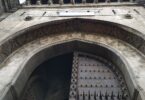
His ambition was written into Shaniwar Wada’s very name. The main gate of the palace — the Delhi Darwaza (Delhi Gate) — was named for his stated intention to conquer Delhi. He never did. But he came closer than any Maratha before him.
The Foundation of Shaniwar Wada — January 10, 1730
The ceremonial foundation stone of Shaniwar Wada was laid on Saturday, January 10, 1730. The name “Shaniwar Wada” directly reflects this date — Shaniwar means Saturday in Marathi, and Wada means a large residential complex.
The choice of location was deliberate. Bajirao wanted his residence in Pune — not in any of the many territories the Marathas controlled — because Pune was his family’s base and because he understood the city’s strategic position. By choosing to build at the centre of what would become old Pune, he was simultaneously creating a residence and laying out the urban geography of a city.
An interesting local legend about the site selection: it is said that Bajirao noticed a rabbit chasing a dog at the site — an inversion of the natural order that he interpreted as auspicious. A place where even the weak could overcome the strong would be the right home for the Maratha revival.
The Construction of Shaniwar Wada — Materials, Costs and Controversies
Building Shaniwar Wada was not straightforward. A significant controversy arose immediately: stone palaces were traditionally reserved for kings alone. The Peshwa was the Prime Minister — not a king himself. The use of stone for a Peshwa’s palace was seen as presumptuous by many.
The compromise: only the foundation and ground floor would be built in stone. The upper floors would be constructed in brick. This explains why the stone base survived the 1828 fire while everything above it burned.
Materials used to build Shaniwar Wada and their sources:
- Teak wood — imported from the Junnar forests, north of Pune
- Lime — from the Jejuri lime belts, south of Pune
- Stone — from the Chinchwad quarries
- Marble floors — covered with Persian rugs, in the fashion of the Mughal courts the Peshwas both competed with and admired
The total construction cost of Shaniwar Wada was ₹16,110 — a figure that was considered enormous at the time, roughly equivalent to several years of tax revenue from a medium-sized town.
The Shaniwar Wada palace was completed in 1732. From foundation to completion in two years, it was one of the fastest major construction projects of the Maratha era.
The Palace at Its Height — What Shaniwar Wada Once Was
The Shaniwar Wada that stands today is a shadow of what existed before 1828. At its peak, it was:
- Shaniwar Wada was a seven-storey palace — the upper storeys visible from miles around
- Shaniwar Wada covered an area of approximately 625 acres — larger than many modern Indian towns
- Shaniwar Wada was home to the Peshwa and his entire extended court — family members, ministers, soldiers, domestic staff, stables, gardens
- The walls of Shaniwar Wada were painted with scenes from the Ramayana and Mahabharata
- Floors of Shaniwar Wada were covered with Persian rugs, ceilings decorated with gold leaf
- Shaniwar Wada Contained a Ganpati Rang Mahal — a dedicated hall for religious ceremonies
- The Shaniwar Wada has Hazari Karanje (lotus fountain with 272 jets) as its centrepiece
- A Nagarkhana (drum house) from which announcements were made to the entire palace
Contemporary accounts describe the Shaniwar Wada as rivalling the finest Mughal palaces in its grandeur — which was, of course, entirely the point.
The Seven Peshwas of Shaniwar Wada
Seven Peshwas called Shaniwar Wada home. Their stories trace the full arc of Maratha power — from its peak to its collapse.
1. Bajirao I (Peshwa 1720–1740)
The builder. The undefeated general. The man who made the Maratha Empire a continental power. He never actually lived in Shaniwar Wada for long — he was almost always on campaign. He died in 1740 at just 40 years old, of fever, while on campaign in central India. He never got to see his palace at its full glory. His love for Mastani — and her connection to Shaniwar Wada — is a story that still resonates. Read it fully here: Bajirao Mastani — The Real Story at Shaniwar Wada.
2. Balaji Bajirao (Nana Saheb) (Peshwa 1740–1761)
Bajirao’s son. A capable administrator who continued the empire’s expansion. Under him, Maratha territory reached its greatest extent — stretching from Attock in the northwest to Orissa in the east. His reign ended with the catastrophic defeat at the Third Battle of Panipat in 1761, in which 100,000 Maratha soldiers died. Nana Saheb died of grief within months of the disaster.
3. Madhavrao I (Peshwa 1761–1772)
Perhaps the most admired of all the Peshwas after Bajirao I. He was 16 when he became Peshwa and died at just 27 of tuberculosis. In 11 years, he reversed the damage of Panipat and restored Maratha power to something approaching its previous glory. He is remembered in Maharashtra with enormous respect — many historians believe that if he had lived longer, the Maratha Empire might have survived the British challenge.
4. Narayan Rao (Peshwa 1772–1773)
The fifth Peshwa and the most tragic figure of Shaniwar Wada. He was 17 years old when he became Peshwa and was murdered within the palace walls at 18 — killed by palace guards at the instigation of his uncle Raghunath Rao and aunt Anandibai. His screams as he ran through the palace are the source of Shaniwar Wada’s haunted legend. Full story: The Haunted Story of Shaniwar Wada.
5. Raghunath Rao (Peshwa 1773–1774, disputed)
Narayan Rao’s uncle, who orchestrated his murder to seize power. His rule was short and contested — other Maratha chiefs refused to recognise him. His desperate attempt to hold power led him to make a catastrophic decision: he invited the British East India Company to help him, offering them territorial concessions in exchange for military support. This opened the door that ultimately led to the fall of the entire Maratha Empire.
6. Sawai Madhavrao (Peshwa 1774–1795)
Narayan Rao’s posthumous son, born after his father’s murder. His regency was managed by the Maratha chiefs. When he died at 21 — jumping from the first floor of Shaniwar Wada — another tragedy was added to the palace’s dark history.
7. Baji Rao II (Peshwa 1796–1818)
The last Peshwa. Ineffective, paranoid, and ultimately unable to hold together the increasingly fractured Maratha confederacy. He surrendered to the British East India Company in 1818 following defeat in the Third Anglo-Maratha War. With his surrender, Shaniwar Wada passed from Maratha hands to British control — and the era of the Peshwas ended.
The Mysterious Fire of 1828 inside Shaniwar Wada — The Greatest Unsolved Mystery of Pune
On February 27, 1828, a fire broke out inside the Shaniwar Wada compound. What happened next is extraordinary: the fire burned for seven continuous days. By the time it was extinguished, the entire upper palace — six of the seven storeys, all the interior rooms, the painted walls, the Persian rugs, the teak pillars, the ceilings — was gone. Only the stone base, the granite fortification walls, and a few of the original teak gates survived.
The British East India Company, which controlled the Shaniwar Wada at the time, launched an investigation. No conclusive cause was ever established. The three theories that historians have debated ever since:
Theory 1: Accidental fire
A lamp or cooking fire got out of control in one of the residential quarters. Plausible given the amount of teak wood in the upper floors. But the seven-day duration is difficult to explain through an accident — fires of that scale and duration usually indicate multiple ignition points.
Theory 2: Deliberate arson by local resistors
The palace had become a symbol of defeated Maratha power under British control. Some historians argue that local Maratha loyalists deliberately set the fire rather than allow the palace to be used as a British administrative centre. This would explain the scale and duration of the blaze.
Theory 3: Deliberate destruction by the British
A more controversial theory: that the British themselves ordered the palace destroyed to eliminate a potent symbol that could serve as a rallying point for Maratha resistance. No documentary evidence has ever surfaced to support this.
The truth has never been established. The fire of 1828 in Shaniwar Wada remains one of the great unsolved mysteries of Pune’s history.
After the Shaniwar Wada Fire — What Remained
After the fire, the British Archaeological Survey took charge of what remained of Shaniwar Wada. The site was eventually opened to the public as a heritage monument. The Archaeological Survey of India now maintains Shaniwar Wada.
In 1975, a light and sound show was installed to tell the Peshwa story to visitors. The illuminated fort at night with the dramatic narration has since become one of Pune’s most popular evening experiences. Details: Shaniwar Wada Light & Sound Show Guide.
Shaniwar Wada Today
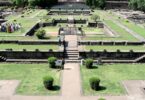
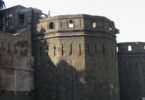
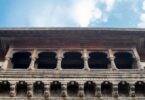
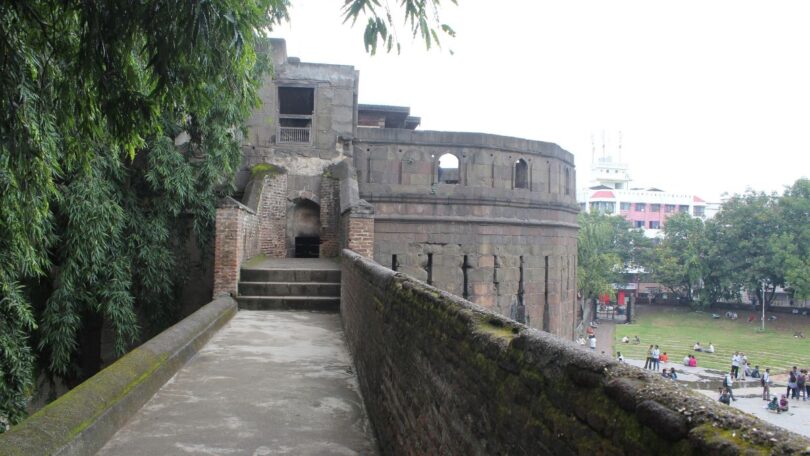
What you see today at Shaniwar Wada is the archaeological residue of the Peshwa era: the five original gates, the granite fortification walls, the stone foundations of the palace, the Hazari Karanje fountain, the Nagarkhana. Shaniwar Wada is maintained by the Archaeological Survey of India and receives hundreds of thousands of visitors annually.
Shaniwar Wada is not a complete palace. But it is a complete story — visible in every remaining stone, every iron spike on the Delhi Darwaza, every millimetre of surviving teak carving. The Peshwas built something magnificent here. They also destroyed themselves with internal betrayal and short-sighted politics. Both of those stories are visible in the ruins.
That is what makes Shaniwar Wada worth more than two hours of your time.
FAQs
Who built Shaniwar Wada?
Shaniwar Wada was built by Peshwa Bajirao I, the Prime Minister of the Maratha Empire under Chhatrapati Shahu I. The foundation was laid on January 10, 1730.
When was Shaniwar Wada built?
Construction began on January 10, 1730 and the palace was completed in 1732. It served as the seat of the Peshwas until 1818.
Why is Shaniwar Wada in ruins?
A mysterious fire on February 27, 1828 burned for seven days and destroyed the upper six storeys of the original seven-storey palace. Only the stone base, fortification walls, and five teak gates survived. The cause of the fire has never been conclusively established.
How many Peshwas lived at Shaniwar Wada?
Seven Peshwas: Bajirao I, Balaji Bajirao, Madhavrao I, Narayan Rao, Raghunath Rao, Sawai Madhavrao, and Baji Rao II. The palace served as the Peshwa seat of power from 1730 to 1818.
What happened to Shaniwar Wada after the British took over?
The British East India Company gained control of Shaniwar Wada following the defeat of Baji Rao II in 1818. Ten years later, in 1828, the palace was destroyed by fire. The site was eventually handed over to the Archaeological Survey of India and opened as a heritage monument.
Also read:
→ Shaniwar Wada Visitor Guide — Timings & Entry Fee
→ The Haunted Story of Narayan Rao
→ Bajirao Mastani — The Real Story
→ The Five Gates of Shaniwar Wada