
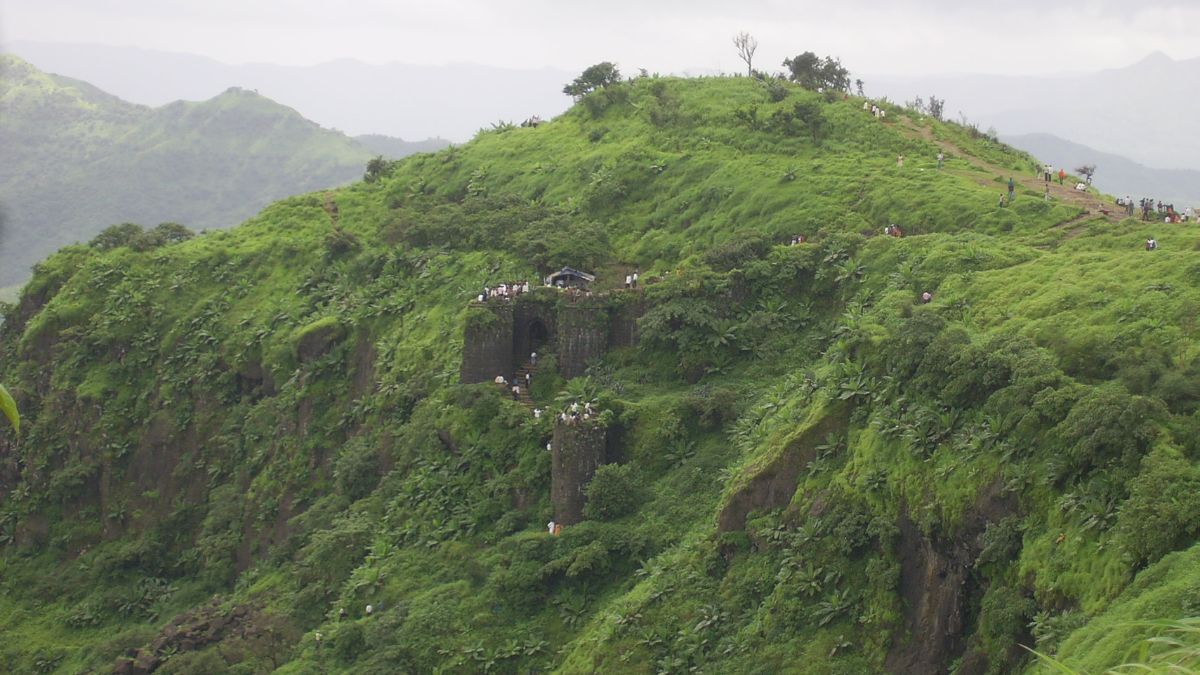
There is a particular combination that only Sinhagad Fort Pune can offer: a trek that genuinely tests you, a view that genuinely rewards you, and at the top, a plate of pitla bhakri with cold kulhad dahi that you will remember for longer than you expect to. Sinhagad Fort Pune is the most loved day trip from the city — not because it is the easiest or the most comfortable, but because it manages to be an adventure, a history lesson, a nature walk, and a food experience simultaneously.
The fort is 35 kilometres from Pune city. The climb from the base to the summit is approximately 2.7 kilometres by the main route. The history embedded in the stone walls is 2,000 years deep, with the decisive moment — the night battle of 1670 in which Tanaji Malusare gave his life to return the fort to Shivaji Maharaj — being one of the most dramatic stories in Maratha history. And at the top, the food stalls serving pitla bhakri in a mist rolling in from the Sahyadri valleys are as much a part of sinhagad fort pune’s identity as the ramparts themselves.
This guide tells you everything you need to plan your sinhagad fort pune visit: the trek routes, the 2026 timings, the entry fee, how to reach the base, where to park, what to eat at the top, and what to carry for each season.
Sinhagad Fort Pune — Quick Facts at a Glance
| Detail | Information |
|---|---|
| Full Name | Sinhagad Fort (also: Sinhagad, Kondhana Fort historically) |
| Location | Sinhagad Road, near Sinhagad Village, Pune District |
| Distance from Pune City Centre | Approximately 35 kilometres |
| Altitude | 1,312 metres above sea level |
| Fort Timings | 5:00 AM to 6:00 PM daily |
| Entry Fee | ₹10 per person (nominal state government fee) |
| Parking at Base | Available — paid, approximately ₹30 to ₹50 |
| Trek Distance (Main Route) | 2.7 kilometres from base to summit |
| Trek Duration (Average) | 45 to 90 minutes depending on fitness |
| Alternative: Jeep Service | Available from base to summit — ₹200 to ₹300 per person |
| Best Season | Monsoon (Jul–Sep) for dramatic scenery; Oct–Feb for clear views |
| Food at Top | Yes — pitla bhakri, kulhad dahi, kanda bhaji, solkadhi stalls |
| Maintained by | Maharashtra State Government |
Sinhagad Fort Pune Timings 2026
Sinhagad Fort Pune is open daily from 5:00 AM to 6:00 PM. There is no weekly closure. The fort is open year-round, including during the monsoon season — though access during heavy monsoon rainfall can occasionally be restricted for safety reasons on specific days.
The most important timing consideration at sinhagad fort pune is not the official closing time — it is your own arrival calculation relative to the trek duration and what you want from the visit:
- For sunrise views from the summit: Arrive at the base at 5:00 AM and begin the trek immediately. The summit at sunrise, particularly between October and February when the skies are clear, is one of the finest views available within a day trip of Pune.
- For a monsoon experience: Arrive between 7:00 AM and 9:00 AM to complete the climb before the afternoon mist becomes rain. After 2:00 PM during heavy monsoon season, visibility can drop to near zero and the path becomes significantly more slippery.
- For the food and atmosphere: The food stalls at the summit are most active between 9:00 AM and 2:00 PM. The pitla bhakri arrives hot from the village kitchens in the morning; by late afternoon the quality of what is available declines as stocks run down.
Last entry consideration: Allow at least 1.5 hours before the 6:00 PM closing time to complete your descent comfortably. If you arrive at the base at 3:30 PM, you will need to move at a reasonable pace to see the fort and descend before closing.
Sinhagad Fort Pune Entry Fee
The entry fee at sinhagad fort pune is ₹10 per person — a nominal state government fee collected at the main entrance gate at the summit. There is no ticket required at the base; you pay at the top after completing the trek.
Parking at the base is a separate paid arrangement, typically ₹30 to ₹50 for cars and ₹10 to ₹20 for two-wheelers, collected by local parking operators rather than the government.
How to Reach Sinhagad Fort Pune
Sinhagad Fort Pune is 35 kilometres from the centre of Pune. The approach road is Sinhagad Road, which connects from Pune’s Swargate area and Dhayari through a series of villages to the fort base at Sinhagad Village.
By Personal Vehicle (Car or Two-Wheeler)
This is the most common approach for sinhagad fort pune visitors from Pune city. The route from Swargate via Sinhagad Road to the base is well-signed and takes approximately 45 to 60 minutes by car under normal traffic. Two-wheelers take a similar time and have the advantage of being able to park closer to the trailhead.
The road to the fort base has several sections of sharp incline — not difficult for modern vehicles but worth knowing about if you are bringing an older or underpowered vehicle. The road surface is generally good for the first 25 kilometres; the last 10 kilometres before the base have some rough sections, particularly during and after monsoon.
By Auto-Rickshaw From Pune
Auto-rickshaws from Pune city to sinhagad fort pune base typically charge ₹350 to ₹500 one-way. This is a practical option for visitors who do not have personal transport — negotiate the fare and confirm whether the driver will wait at the base or if you need to arrange separate return transport.
By PMPML Bus
PMPML operates bus services toward the Sinhagad area from Swargate. The bus drops visitors at Sinhagad village, from which the trek to the fort entrance is approximately 2 to 3 kilometres. This is the most budget-friendly option but adds time to the approach.
By Cab (Ola / Uber)
Cab services to sinhagad fort pune are available from Pune city. The cab will drop you at the base. For the return journey, arrange with the driver to either wait or return at a specific time — availability of cabs at the fort base for the return journey cannot be assumed, particularly on busy weekends.
Parking at Sinhagad Fort Pune Base
Parking at the sinhagad fort pune base is available in paid lots managed by local operators. Capacity is reasonably generous on weekdays but can become strained on weekend mornings, particularly during peak season (October to February) and monsoon weekends (July to September).
On popular weekend days, arrive at the base before 7:30 AM to ensure parking availability. Later arrivals on peak Sundays may find the main lots full and need to park along the road a short distance from the trailhead.
Weekend mornings from approximately 8:00 AM to 11:00 AM see the highest volume at sinhagad fort pune — this is when the pitla bhakri crowd and the casual trekkers overlap. If you want the trek itself rather than the weekend social atmosphere, a weekday visit from 6:00 AM gives you a fundamentally different experience.
The Two Trek Routes at Sinhagad Fort Pune — Compared Honestly
Sinhagad Fort Pune has two main routes from base to summit. Understanding the difference before you arrive saves you from choosing incorrectly and either finding the route too difficult or too monotonous for what you wanted.
Route 1: Donje Route (Main Trek Path)
| Feature | Detail |
|---|---|
| Distance | Approximately 2.7 km from trailhead to summit |
| Elevation Gain | Approximately 400 metres |
| Difficulty | Moderate — steep in places, requires reasonable fitness |
| Time (average adult) | 45 to 75 minutes upward; 35 to 55 minutes downward |
| Path Surface | Rocky and uneven throughout; steep stepped sections |
| Monsoon Condition | Slippery — requires care; some sections have fixed ropes |
| Most Suitable For | Regular walkers and above; not suitable for very young children |
The Donje route at sinhagad fort pune is the traditional trekking path — the one used historically by soldiers, pilgrims, and today’s trekkers. It is the more physically demanding of the two routes, with sections that require using hands for balance on steep rock faces. The reward is the authenticity of the ascent and the views opening up progressively as you climb.
This is the route Tanaji Malusare’s soldiers used during the 1670 night assault. The knowledge of that history, climbing the same rock face in daylight with good shoes and no opposing army, gives the ascent a particular resonance.
Route 2: Jeep Track / Kalyan Darwaza Route
| Feature | Detail |
|---|---|
| Distance | Approximately 6 km (longer but less steep) |
| Difficulty | Easy to moderate — gradual ascent on a vehicle-width track |
| Time (average adult) | 90 to 120 minutes upward |
| Path Surface | Gravel and dirt road — more consistent underfoot |
| Monsoon Condition | Generally manageable; muddy in places but not hazardous |
| Most Suitable For | Families with older children; those who prefer a gradual ascent |
| Jeep Available | Yes — shared or private jeep service on this route |
The jeep track at sinhagad fort pune follows the old military road to the Kalyan Darwaza (Kalyan Gate). It is significantly longer than the Donje route but requires much less technical effort. Families with children who are not confident on steep rocky terrain typically take this route. The jeep service (₹200 to ₹300 per person for a shared jeep) makes the ascent accessible to those who want to experience the fort without the physical demands of the trek.
Which Route Should You Take?
- Fit adults who want the genuine trekking experience: Donje Route
- Families with children under 10: Jeep track or jeep service
- First-time trekkers who are unsure of their fitness: Donje route going up, jeep track coming down — you can switch between routes at the summit
- Monsoon visitors: Both routes require care; the Donje route needs more attention to footwear and slipping in rain conditions
- Senior visitors: Jeep service is the practical choice
Food at Sinhagad Fort Pune — Pitla Bhakri, Kulhad Dahi and More
The food at the top of sinhagad fort pune is one of the reasons people return. It is not gourmet food — it is the food that makes complete sense after a steep morning climb, eaten while looking out over a valley disappearing into Sahyadri mist.
Pitla Bhakri — The Defining Dish
Pitla is a thick, spiced gram flour (besan) preparation — somewhere between a thick sauce and a firm porridge, flavoured with mustard seeds, curry leaves, green chillies, turmeric, and asafoetida. Bhakri is a flatbread made from jowar (sorghum) flour — thicker, coarser, and more filling than wheat roti.
Pitla bhakri at sinhagad fort pune is served with a raw onion, a wedge of lime, and sometimes a small portion of thecha (crushed green chilli and garlic condiment). The combination — robust, spiced, genuinely filling — is perfectly calibrated for the post-trek appetite. A full plate costs ₹100 to ₹150 as of 2026.
The stalls at sinhagad fort pune that serve the best pitla bhakri are consistently those with the highest turnover — look for the stalls where the bhakri is being made continuously on a flat tawa rather than sitting in a basket. The bhakri should be warm, slightly charred on the outside, and soft on the inside. If it bends without cracking, it has been made correctly.
Kulhad Dahi — Cold Yoghurt in a Clay Cup
The kulhad dahi at sinhagad fort pune — thick, cold yoghurt served in an unglazed clay cup — is the correct companion to pitla bhakri and arguably the most refreshing thing available after a monsoon trek when you are simultaneously sweating and cold. The clay cup adds a faint earthiness to the flavour that plastic containers cannot replicate. ₹30 to ₹50 per kulhad.
Kanda Bhaji — Onion Fritters
During monsoon season, the kanda bhaji stalls at sinhagad fort pune do a trade that is hard to justify rationally — you have just climbed a mountain in the rain and you stop to eat fried onion fritters and drink chai in the mist — and yet it is exactly right. The bhaji are freshly fried at the stalls, crispy outside, soft inside, served with a thin green chutney. The combination of hot, oily, spiced bhaji against the cold damp of a monsoon Sahyadri morning is one of those flavour-memory experiences that Pune people associate specifically with sinhagad fort.
Solkadhi — The Pink Digestive Drink
Solkadhi is a Konkan speciality — a thin, pleasantly sour drink made from kokum and coconut milk, pale pink in colour, cooling and digestive. Some stalls at sinhagad fort pune serve it as a post-meal drink. If you have not tried solkadhi before, this is as good a place as any to start: the tartness of kokum after the spice of pitla bhakri is an excellent combination.
A complete food guide to sinhagad fort pune with stall recommendations and prices: Sinhagad Fort Food — Pitla Bhakri, Kulhad Dahi and Best Stalls.
What to See at Sinhagad Fort Pune
The fort at the summit of sinhagad fort pune is not a museum — it is an archaeological site in active use by the Maharashtra government for certain heritage functions. The main features visible during a visit:
- The Tanaji Malusare Samadhi: The memorial to the general who led the 1670 night assault and died securing the fort for Shivaji Maharaj. A simple stone structure within the fort complex — more moving than its plainness suggests, once you know the story.
- The Kalyan Darwaza (Kalyan Gate): The main gate of sinhagad fort pune through which the jeep track approach arrives. The gate’s scale communicates the defensive importance of the site — it was designed to be the last line of access control for the fort.
- Kondeshwar Temple: An ancient Shiva temple within the fort precincts, considered one of the oldest structures on sinhagad fort pune.
- The Rampart Walls: The outer defensive walls of sinhagad fort pune offer the best panoramic views of the surrounding valley. On clear days (October to February), the view extends across the Deccan plateau. During monsoon, the valleys fill with cloud and the fort appears to float above them — one of the most photographed natural phenomena associated with sinhagad fort pune.
- Tilaknala / Tilakamal Kund: A historic water tank within the fort associated with Lokmanya Tilak’s visits to sinhagad fort pune.
Sinhagad Fort Pune — Brief History
The full history of sinhagad fort pune — including the extraordinary 1670 night battle — is in our dedicated article: Sinhagad Fort History — Tanaji Malusare, the 1670 Battle and Shivaji’s Famous Words.
The essential summary: Sinhagad Fort Pune — then called Kondhana — was captured from the Mughals in a daring night assault on 4 February 1670 by Maratha general Tanaji Malusare. The assault involved climbing the near-vertical cliff face with monitor lizards used to anchor ropes. Tanaji died in the battle after securing the fort. When Shivaji Maharaj received news of both the victory and Tanaji’s death, he reportedly said: “Gad ala pan Sinh gela” — The fort came, but the Lion is gone. The name Sinhagad (Lion Fort) commemorates Tanaji from that day.
What to Carry for Sinhagad Fort Pune
Year-Round Essentials
- Water — minimum 1 litre per person for the trek; 2 litres in summer
- Sturdy closed-toe shoes with good grip — sandals and chappals are genuinely inadvisable on the Donje route
- Snacks for the climb — bananas, dry fruits, glucose biscuits
- Small backpack leaving hands free for the steep sections
- Cash — stalls at the summit are mostly cash-only; UPI connectivity at the top is unreliable
Monsoon-Specific (July to September)
- Raincoat or waterproof jacket — an umbrella is impractical on the trek
- Leech socks or full-length pants tucked into socks — leeches are active during monsoon in the vegetation sections of the Donje route
- Salt packet in a small container — salt causes leeches to detach immediately if they have latched on; do not pull them off as the head may remain embedded
- Change of clothes for after the trek — you will be wet regardless of rain cover
- Waterproof bag liner for your phone and documents
Winter (October to February)
- Light jacket for the summit — temperatures at 1,312 metres above sea level are noticeably cooler than Pune city, particularly in December and January mornings
- Sunscreen — the exposed sections of the Donje route at mid-morning in winter are deceptively sunny
Frequently Asked Questions About Sinhagad Fort Pune
What are Sinhagad Fort Pune timings?
5:00 AM to 6:00 PM daily, year-round. No weekly closure. Occasional temporary restrictions during heavy monsoon rainfall for safety.
What is the Sinhagad Fort Pune entry fee?
₹10 per person, collected at the entrance gate at the summit. Parking at the base is ₹30 to ₹50 for cars (charged by local operators).
How difficult is the Sinhagad Fort trek?
The Donje route is moderate — steep and rocky in sections, requiring good footwear and reasonable fitness. Average adults complete it in 45 to 75 minutes. The jeep track alternative is easier and longer, suitable for families. The jeep service (₹200 to ₹300 per person) is available for those who prefer not to trek.
What food is available at the top of Sinhagad Fort Pune?
Pitla bhakri (₹100 to ₹150), kulhad dahi, kanda bhaji, solkadhi, chai, corn (bhutta), and packaged snacks. Morning visits get the freshest food. Full food guide: Sinhagad Fort Food Guide.
Is Sinhagad Fort Pune good in monsoon?
Yes — it is arguably at its most spectacular during monsoon, with the valleys below filling with cloud and the fort appearing to float above them. However, the Donje route is slippery and leeches are active. Wear appropriate clothing, carry leech protection, and move carefully on the steep sections.
How far is Sinhagad Fort from Pune?
Approximately 35 kilometres from Pune city centre. By car via Sinhagad Road, the drive takes 45 to 60 minutes.
What is the story of Tanaji Malusare and Sinhagad Fort Pune?
Tanaji Malusare was the Maratha general who led the 1670 night assault that recaptured the fort from the Mughals. He died in the battle. Shivaji Maharaj named the fort “Sinhagad” (Lion Fort) in his memory. The full story: Sinhagad Fort History.
Explore More About Sinhagad Fort Pune:
1 thought on “Sinhagad Fort Pune — Complete Visitor Guide 2026 (Trek Routes, Timings, Food at Top, How to Reach)”