
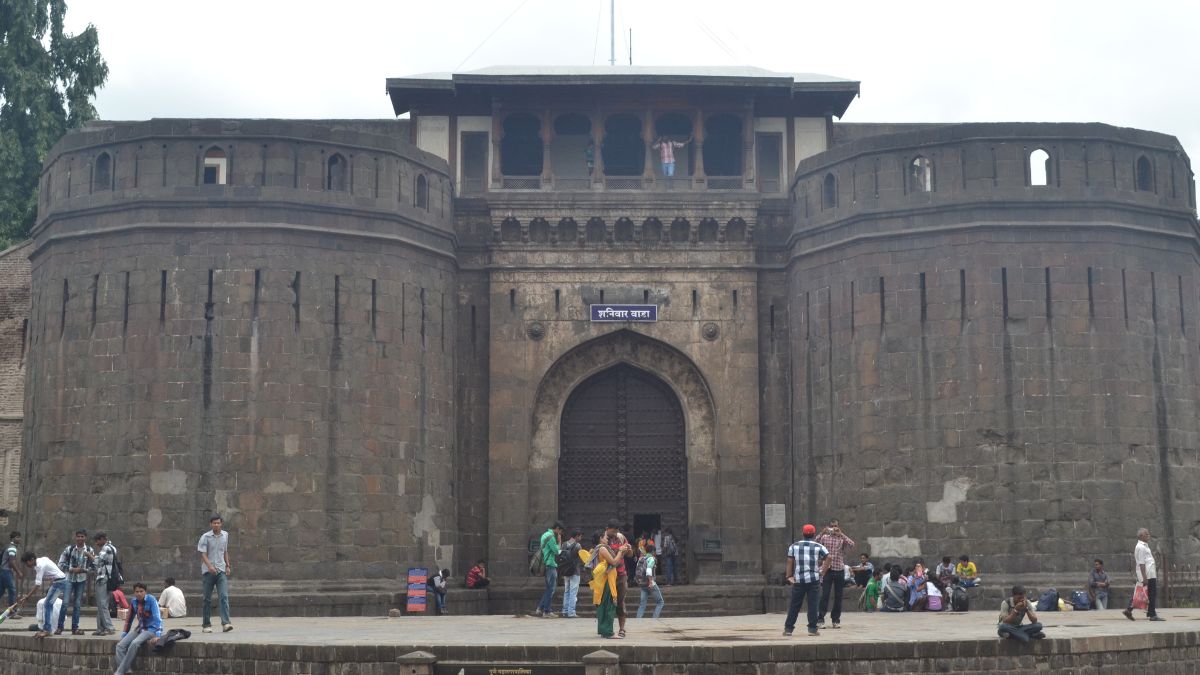
Most visitors to Shaniwar Wada enter through the Delhi Darwaza, spend a moment with the iron spikes, photograph the view through the arch, and move on to the garden. They leave having seen one of the five shaniwar wada gates. The other four — each with its own name, its own story, and its own place in Peshwa history — remain unseen.
This is a significant omission. The five shaniwar wada gates are not decorative features. They are the most durable surviving elements of the original 1730 construction, each built for a specific function, each named to commemorate something — ambition, love, domestic hierarchy, faith, or grief. Reading the five shaniwar wada gates in sequence is reading 18th-century Maratha history in teak and iron and granite.
This guide takes you through all five shaniwar wada gates in the order a visitor moving through the fort naturally encounters them, with the stories, the architectural details, and the photography angles that most guides leave out.
Why the Five Shaniwar Wada Gates Tell the Complete Story
The original shaniwar wada fort complex had nine bastions (buru) positioned at intervals along the outer fortification wall, and five gates positioned at strategic points along those walls. Each gate served a different function — military, ceremonial, domestic, religious — and each was given a name that reflected either its purpose, its location, or the person or event most closely associated with it.
The shaniwar wada gates were built in teak from the forests of Junnar, reinforced with iron fittings, and set in stone and brick archways built to last. The fire of 1828 that destroyed the upper six storeys of the palace interior left the gates substantially intact — which is why you can still walk through the original 18th-century teak structures today, nearly 300 years after they were installed.
The nine defensive bastions of the fort are best seen from outside the main walls — the walk around the perimeter of shaniwar wada on Bajirao Road gives a clear sense of the fortification scale. The shaniwar wada gates themselves are best appreciated from inside, which is where the walking route below begins.
The Defensive System — Nine Bastions and Five Purposeful Gates
Before examining the individual shaniwar wada gates, understanding the defensive logic of the fort’s layout helps. The outer wall of shaniwar wada was designed by builders from Rajasthan experienced in fortification architecture — the same tradition that produced the massive forts of Jodhpur, Jaisalmer, and Chittorgarh.
The positioning of the five shaniwar wada gates around the perimeter was deliberate:
- The main gate (Delhi Darwaza) faced north — toward Delhi and Bajirao’s military ambitions
- Secondary gates were positioned to allow separate access flows for different categories of users — military, domestic staff, religious processions, and private family use
- No two adjacent shaniwar wada gates opened at the same angle, preventing an attacker who breached one from having a direct line of sight or approach to another
This defensive sophistication is part of why the shaniwar wada gates remain so structurally impressive even in their current state — they were built to resist, and they have.
Gate 1: Delhi Darwaza — The Gate of Ambition
Location: North wall — main entrance
Dimensions: 21 feet tall, reinforced teak
Most distinctive feature: 72 iron spikes across the exterior face
The Delhi Darwaza is the most famous of the five shaniwar wada gates — the one every visitor photographs, the one featured in every heritage guide, the one whose 72 iron spikes have become synonymous with the fort’s martial identity.
The name is precisely what it appears to be: a statement of Bajirao I’s ambition. When he built shaniwar wada in 1730, Bajirao I was in the middle of a campaign to establish Maratha supremacy across the subcontinent. His stated goal was to install a Maratha ruler in Delhi — to fly the Maratha flag over the Mughal capital. Seven years after the Delhi Darwaza was installed, he came closer to realising that ambition than any Maratha general before or after him: his cavalry reached the outskirts of Delhi in 1737, and the Mughal Emperor retreated behind the walls of Lal Qila.
The Delhi Darwaza of the shaniwar wada gates named that ambition in stone and teak — a permanently installed declaration of where Bajirao intended to go.
The 72 Iron Spikes — Anti-Elephant Engineering
The exterior face of the Delhi Darwaza carries 72 iron spikes, each approximately 12 inches long and set at approximately chest height for a war elephant. This is not decoration — it is 18th-century military engineering responding to a specific tactical problem.
War elephants were used in siege warfare to ram fort gates. A war elephant running at full speed into unprotected teak doors could breach them — as several such gates across India’s military history had demonstrated. The 72 spikes on the Delhi Darwaza would puncture the elephant’s forehead and chest on impact, causing severe pain and causing the animal to retreat or collapse before contact with the gate itself.
The spikes are visible from both inside and outside the gate, but the most striking view is from inside shaniwar wada looking back out through the archway toward Bajirao Road — the spikes silhouetted against the sky, with the granite archway framing them. This is also the best photograph available at the Delhi Darwaza: not the standard exterior shot that everyone takes, but the interior reverse angle.
Photography tip for Delhi Darwaza: Enter through the gate, turn around immediately, and shoot back through the archway toward Bajirao Road. Shoot at 8:00 AM to 9:00 AM when the morning light is behind you and illuminates the exterior. The 72 spikes against the morning sky from this angle is the best architectural photograph at shaniwar wada.
Gate 2: Mastani Darwaza — The Gate Named for Love
Location: North wall, adjacent to Delhi Darwaza
Character: More ornate than the Delhi Darwaza, smaller in scale
Named for: Mastani, companion of Peshwa Bajirao I
The Mastani Darwaza is the most personally significant of the five shaniwar wada gates. It commemorates the most controversial personal relationship in Peshwa history — Bajirao I’s long association with Mastani, a woman of mixed Hindu and Muslim heritage, the daughter of Bundelkhand’s ruler Chhatrasal.
Mastani came to Pune as part of the political relationship between Bajirao and Chhatrasal after the Maratha general helped defend Bundelkhand against Mughal forces. Bajirao I recognised her as a second companion — but the Peshwa court, the Brahmin establishment, and Bajirao’s own family never accepted this relationship. The controversy was religious, social, and political simultaneously.
The Mastani Darwaza among the shaniwar wada gates is significant because its existence represents a public acknowledgement — the gate was apparently the primary point of access to the section of the palace where Mastani’s quarters were located. The name was not applied after Bajirao’s death as a memorial; it was used during his lifetime, which made it a deliberate public statement in a court where the relationship was already contested.
Standing at the Mastani Darwaza today — smaller and more quietly ornate than the massive Delhi Darwaza beside it — the contrast between the two shaniwar wada gates tells its own story: the gate of imperial ambition and the gate of personal devotion, built within metres of each other by the same person.
The full story of Bajirao and Mastani — what the historical record shows versus what the 2015 film dramatised — is in our dedicated article: Bajirao Mastani — Real History vs the 2015 Film.
Gate 3: Khidki Darwaza — What Modesty Reveals About Hierarchy
Location: East wall
Character: The smallest of the five shaniwar wada gates
Function: Domestic access — servants, supplies, daily operations
“Khidki” means window in Marathi — the name itself signals the scale and purpose of this gate. The Khidki Darwaza is the smallest of the five shaniwar wada gates and was used primarily for the movement of domestic staff, supplies, and the daily operational necessities of a palace complex housing thousands of people.
Its modest scale is, in a way, more historically revealing than the grandeur of the Delhi Darwaza. The Khidki Darwaza shows you the social architecture of 18th-century Peshwa court life — the careful separation of different categories of people, the coding of movement through physical design, and the fact that the builders of shaniwar wada thought carefully about every kind of traffic through the compound, not just the ceremonial arrivals of dignitaries.
Most visitors to the shaniwar wada gates spend the least time at the Khidki Darwaza because it offers the least dramatic experience. But understanding what it represents — the infrastructure of the palace’s daily life — adds a dimension to the visit that the grander gates cannot provide on their own.
Gate 4: Ganesh Darwaza — Faith and Tragedy Combined
Location: Southeast wall
Named for: The Ganesh temple (Ganpati Rang Mahal) within the original palace complex
Historical significance: The location of Narayan Rao Peshwa’s murder in 1773
The Ganesh Darwaza carries the heaviest historical weight of all five shaniwar wada gates. It was named for the Ganpati Rang Mahal — the ceremonial Ganesh temple that was one of the most important religious spaces within the original palace complex, used for festivals, court ceremonies, and daily devotion.
But the Ganesh Darwaza is known in Maharashtra primarily for the event that occurred here on 30 August 1773: it was at or near this gate that Peshwa Narayan Rao was killed by the Gardi mercenaries acting on orders traced to his uncle Raghunathrao. Narayan Rao had been running through the inner palace toward his uncle’s apartments — not knowing the order had come from within those same apartments — when the assassins caught up with him near the Ganesh Darwaza.
His dying cry — “Kaka mala vachva”, Uncle save me — has been associated with this gate and this location for 250 years. The full story is in our dedicated article: Shaniwar Wada Haunted Story — Narayan Rao’s Ghost.
Standing at the Ganesh Darwaza among the shaniwar wada gates — in the southeast section of the fort that sees less visitor traffic than the main entrance area — the quality of quiet in this corner of the compound feels different from the rest of the fort. Whether that is a reasonable response to knowing the history or something else is a question each visitor answers differently.
Gate 5: Narayan Darwaza — The Memorial Gate
Location: South wall
Named for: Narayan Rao Peshwa, the murdered Peshwa
Significance: The only shaniwar wada gate named as a memorial to a tragedy
The Narayan Darwaza is unique among the five shaniwar wada gates in that it was named not for an aspiration, a person still living, a function, or a deity — but for a death. After Narayan Rao was killed inside the fort, and as the full implications of that murder for Maratha politics began to play out, the south gate of shaniwar wada was designated as a permanent memorial to him.
The four other shaniwar wada gates carry names that look outward or upward — Delhi (ambition), Mastani (love), Khidki (function), Ganesh (faith). The Narayan Darwaza looks back — at a 17-year-old who deserved better, and at the political violence that ended his life inside the very walls these gates were designed to protect.
It is the quietest of the five shaniwar wada gates to visit — less photographed than Delhi Darwaza, less romantically charged than Mastani Darwaza, less historically loaded-in-the-moment than Ganesh Darwaza. But for anyone who has spent time with the full history of shaniwar wada, the Narayan Darwaza is the gate that lingers.
Walking Route — How to See All Five Shaniwar Wada Gates in One Visit
The five shaniwar wada gates are distributed around the perimeter of the fort in a pattern that makes a logical walking circuit possible within 45 to 60 minutes. This route assumes you enter through the main Delhi Darwaza:
- Delhi Darwaza (Entry) — Enter, turn immediately to shoot the interior reverse angle. Note the 72 spikes against the sky. (5 minutes)
- Walk the inner perimeter northward — keeping the outer wall on your left. (3 minutes)
- Mastani Darwaza — On the north wall adjacent to Delhi Darwaza. Stand in the archway and look at the construction difference between this gate and the main gate. (5 minutes)
- Continue along the east wall — past the garden section and toward the east. (5 minutes)
- Khidki Darwaza — East wall. Smaller, less dramatic, worth examining the construction quality in the door frame. (5 minutes)
- Continue southeast — through the garden, past the Hazari Karanje fountain, toward the southeast section. (8 minutes)
- Ganesh Darwaza — Southeast wall. This is the corner of the fort that sees least traffic. Spend time here. (10 minutes)
- Continue along the south wall. (5 minutes)
- Narayan Darwaza — South wall. The quietest of the five gates. (5 minutes)
- Return through the garden to the exit through Delhi Darwaza. (8 minutes)
Total time: approximately 60 minutes for a thorough walk of all five shaniwar wada gates. This does not include time in the garden or at the Hazari Karanje fountain — allow an additional 30 to 45 minutes if you want to spend time at those features as well.
Frequently Asked Questions About Shaniwar Wada Gates
How many gates does Shaniwar Wada have?
Five: Delhi Darwaza, Mastani Darwaza, Khidki Darwaza, Ganesh Darwaza, and Narayan Darwaza. The fort also had nine defensive bastions positioned along the outer walls.
Why does Delhi Darwaza have 72 iron spikes?
The spikes are anti-elephant defensive engineering — designed to prevent war elephants from ramming and breaching the gate during military assault. Each spike is approximately 12 inches long and positioned at elephant forehead height.
What is the Mastani Darwaza named after?
Mastani — the companion of Peshwa Bajirao I, whose quarters within shaniwar wada were accessed primarily through this gate. The name was used during Bajirao’s lifetime, making it a public acknowledgement of a controversial relationship.
Where was Narayan Rao killed inside Shaniwar Wada?
Near the Ganesh Darwaza (southeast gate), on 30 August 1773. This event is at the heart of the shaniwar wada haunted legend and is documented in Maratha historical records.
Can I see all five gates of Shaniwar Wada during a standard visit?
Yes — the walking circuit covering all five shaniwar wada gates takes approximately 60 minutes from the main Delhi Darwaza entrance. The route is within the standard fort compound and does not require any special access.
Explore More:
2 thoughts on “Five Gates of Shaniwar Wada — Delhi Darwaza, Mastani Darwaza and Every Gate’s Hidden Story”