
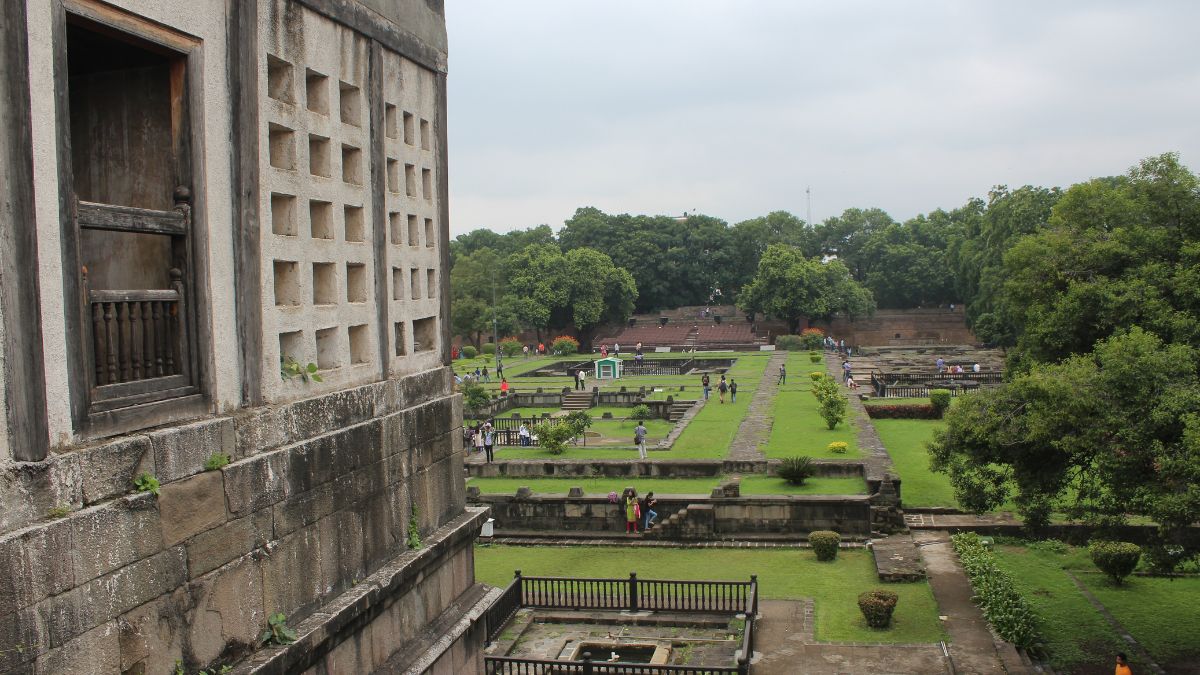
The history of Shaniwar Wada begins with a general who never lost a battle and ends with a fire that burned for seven days and was never explained. In between, across roughly one hundred years, this fort-palace in the heart of old Pune was the seat of an empire that stretched from the Deccan to the Himalayas, the home of seven Peshwas whose individual stories range from inspiring to tragic, and the site of one political murder so brutal it is still discussed 250 years later.
Shaniwar Wada history is not simply the history of a building. It is the concentrated history of 18th-century India.
Why Shaniwar Wada History Matters — Before We Begin
Most historical monuments in India are connected to one era, one ruler, one decisive event. Shaniwar Wada history is unusually layered. The same walls witnessed Bajirao I planning campaigns that kept the Mughals out of the Deccan, Madhavrao I rebuilding an empire after the catastrophe of Panipat, and Narayan Rao dying at the hands of assassins sent by his own uncle.
Understanding Shaniwar Wada history — the real version, not the tourist brochure version — changes how you see the fort when you visit. The five gates stop being decorative features and become markers of specific stories. The ruins stop being picturesque decay and become the aftermath of a specific fire on a specific night in February 1828. The place becomes inhabited by the people who actually lived there.
That is what this article attempts.
Who Built Shaniwar Wada? The Story of Bajirao I
Shaniwar Wada was built by Peshwa Bajirao I, formally known as Bajirao Ballal Bhat, Prime Minister of the Maratha Empire under Chhatrapati Shahu Maharaj. He was appointed Peshwa in 1720 at the age of twenty — an almost absurdly young age for the most powerful administrative position in one of India’s largest empires.
In his two decades as Peshwa, Bajirao I fought more than forty major battles and lost none of them. This is not mythology or nationalist embellishment — it is the consensus of both Indian and British historical sources, including the records of the East India Company, who watched his campaigns with considerable anxiety. He expanded the Maratha Empire from the Deccan plateau to Rajputana in the north and Bengal in the east. When he rode toward Delhi in 1737, the Mughal Emperor Muhammad Shah retreated behind the walls of Lal Qila — a Mughal emperor effectively besieged in his own capital by a general from Pune.
It was this man who founded Shaniwar Wada.
Why Bajirao Chose This Location
In 1730, Bajirao I was based in Saswad and needed a permanent capital befitting the expanding Maratha Empire. Pune — then a modest market town — was chosen for its strategic position in the Sahyadri foothills and its access to trade routes in multiple directions.
Local tradition holds that Bajirao chose the specific site of Shaniwar Wada after witnessing an unusual sight: a hare chasing a dog across that particular piece of land. In Hindu tradition, a place where the naturally weaker creature stands its ground against the stronger is considered auspicious. Whether this story is literally true or allegorical, it has been part of Shaniwar Wada history since the beginning.
January 10, 1730 — The Foundation Day and Why a Saturday?
The foundation stone of Shaniwar Wada was laid on Saturday, 10 January 1730. The name encodes this fact: Shaniwar is the Marathi and Sanskrit word for Saturday, and Wada means a large residential compound or palace.
The choice of a Saturday was deliberate. Saturday in Hindu tradition is associated with Shani Dev (the planet Saturn), considered a powerful and auspicious influence when properly honoured. The Peshwas were Brahmin scholars who took astrological timing seriously — the foundation was laid at a specific muhurt (auspicious moment) calculated by court astronomers.
Construction began immediately and continued through 1732, when the palace was first occupied. The initial investment was approximately ₹16,110 — a significant sum in 1730 currency. The materials came from across the region: teak from Junnar forests to the north, limestone from Jejuri quarries to the south, and granite from Chinchwad.
The Architecture Compromise
A complication arose during construction. Under Maratha convention, stone buildings of this grandeur were reserved for kings — not Peshwas, who were technically ministers. Bajirao I’s decision to build in stone was politically sensitive.
The resolution was architectural: only the ground floor and foundations would be in stone. The upper six storeys would be built in brick. This distinction between the stone base (which survived 1828) and the brick upper floors (which did not) explains precisely why the ruins you visit today look the way they do. The shaniwar wada history of the 1828 fire and the building’s survival are directly connected to this 1730 architectural decision.
What Shaniwar Wada Looked Like at Its Peak
Between 1732 and 1828, Shaniwar Wada was a seven-storey palace covering an area of roughly 625 acres within its outer walls. The inner palace complex was smaller — perhaps 20 to 25 acres — but extraordinarily refined for its era.
Contemporary accounts and post-demolition surveys describe:
- Exterior walls reaching up to 40 feet in height, built from the same blue-grey granite that survives today
- Frescoed interior walls depicting scenes from the Ramayana and Mahabharata
- Persian carpets and Dutch glassware in the principal reception halls — evidence of the international trade connections the Peshwas maintained
- The Hazari Karanje (lotus fountain) with 272 water jets in a formal garden at the centre of the inner compound
- The Ganpati Rang Mahal, a ceremonial hall used for religious occasions and court festivals
- The Nagarkhana, a gatehouse where drums were beaten to announce official proclamations
- Five gates of teak wood reinforced with iron, each designed with specific defensive and ceremonial functions
The total effect, according to a Scottish visitor’s account from the 1790s, was of a city within a city — self-contained, densely populated with court officials, servants, soldiers, scholars and their families, and organised around the routines of Peshwa governance with the same complexity as a medieval European capital.
All Seven Peshwas of Shaniwar Wada — Their Stories in Order
Shaniwar Wada was home to seven Peshwas across nearly a century. Their individual stories form an arc that goes from military genius to political betrayal to final collapse.
Peshwa 1: Bajirao I (1720–1740) — The Undefeated Builder
The founder of Shaniwar Wada and the greatest military commander in Maratha history. His campaigns carried the Maratha Empire to its greatest territorial extent. He is also the Peshwa whose personal life became the subject of the 2015 Bollywood film — his relationship with Mastani, a woman of mixed Hindu-Muslim heritage and the daughter of Bundelkhand’s ruler Chhatrasal, was controversial in its time and has become the most romanticised element of shaniwar wada history.
Bajirao I died in April 1740 during a military campaign, of what contemporary sources describe as fever, at the age of forty. He never returned to Shaniwar Wada from his last campaign. The full story of Bajirao and Mastani is in our dedicated article: Bajirao Mastani — Real History vs the 2015 Film.
Peshwa 2: Balaji Bajirao — Nana Saheb (1740–1761) — The Peak of Power
Under Nana Saheb, the Maratha Empire reached its greatest geographical extent. Maratha armies operated simultaneously in Rajputana, Bengal, the Punjab and the far south. The Peshwa court at Shaniwar Wada became one of the most sophisticated in India — a centre of scholarship, arts, and administration.
Then came 14 January 1761: the Third Battle of Panipat. A Maratha army of 45,000 soldiers, accompanied by civilians and camp followers numbering possibly 200,000, was destroyed in a single day by the Afghan forces of Ahmad Shah Durrani. Estimates of Maratha dead range from 40,000 to 100,000. Entire Brahmin families from Pune lost their men in a single afternoon.
Nana Saheb received the news of Panipat at Shaniwar Wada. He died six months later, in June 1761, reportedly unable to recover from the grief of what had happened.
Peshwa 3: Madhavrao I (1761–1772) — The Beloved Rebuilder
Madhavrao became Peshwa at sixteen. By twenty-seven, he was dead of tuberculosis. In the eleven years between those ages, he did something that most rulers never achieve in full careers: he rebuilt an empire from near-total collapse.
After Panipat, the Maratha territories had fragmented and the treasury was depleted. Madhavrao I systematically reorganised the administration, rebuilt the military, reasserted Maratha authority over vassal states, and restored the dignity of Shaniwar Wada as a centre of governance. He is remembered in Maharashtra with a reverence that approaches that of Shivaji Maharaj himself.
He died in November 1772, at Theur near Pune, where he had gone for a change of climate in hopes of recovering his health. He was twenty-seven years old. Shaniwar Wada history takes a distinctly darker turn after his death.
Peshwa 4: Narayan Rao (1772–1773) — The Murder
Narayan Rao became Peshwa at sixteen. He was murdered inside Shaniwar Wada at seventeen. His death is the central event in the shaniwar wada history of the haunted legend, and one of the most disturbing episodes in Maratha political history.
The full story belongs in its own article — and we have written it: Shaniwar Wada Haunted Story — The True History of Narayan Rao’s Ghost. The brief version: his uncle Raghunathrao conspired to have him assassinated on 30 August 1773. The words Narayan Rao reportedly cried as he fled toward his uncle’s apartments — “Kaka mala vachva” (Uncle, save me) — have been associated with Shaniwar Wada ever since.
Peshwa 5: Sawai Madhavrao (1774–1795) — The Posthumous Son
Sawai Madhavrao was the posthumous son of the murdered Narayan Rao, born after his father’s death and raised at Shaniwar Wada under the regency of the Peshwa council. He showed considerable promise — contemporaries considered him a worthy successor to Madhavrao I — but died in 1795 at twenty-one by falling from an upper floor of Shaniwar Wada. Whether it was suicide, an accident, or something else has never been definitively established.
Peshwa 6: Raghunathrao (Brief, Contested)
The uncle who arranged Narayan Rao’s murder briefly occupied the position of Peshwa, but was never accepted as legitimate by the Maratha confederacy. His reign is remembered primarily as the period when he invited British intervention to consolidate his disputed claim — a decision whose consequences would ultimately end the Maratha Empire.
Peshwa 7: Bajirao II (1796–1818) — The Last Peshwa
Bajirao II lived in Shaniwar Wada as the Maratha Empire was dismantled around him. Three Anglo-Maratha wars progressively reduced Maratha territory, authority, and sovereignty. After the final defeat at the Battle of Khadki in 1817 and the Battle of Koregaon in 1818, Bajirao II surrendered to the British East India Company.
He was exiled to Bithoor near Kanpur with a pension. Shaniwar Wada passed to British control. The Peshwai — the institution of Brahmin Peshwa governance that had shaped Maharashtra for a century — was over. Shaniwar Wada, already diminished without its Peshwa family, stood largely unused.
The Mysterious Fire of 27 February 1828 — Three Theories
On the night of 27 February 1828, fire broke out inside Shaniwar Wada. It burned for seven continuous days. When it finally died, the six brick upper storeys of the palace had been entirely consumed. The stone ground floor, the fortification walls, and the five teak gates survived.
The British conducted an investigation. The cause was never established. Three theories have been debated by historians ever since:
Theory 1: Accidental Fire
The most straightforward explanation — a lamp, a kitchen fire, or a carelessly stored source of heat — started a blaze that found easy purchase in the wooden galleries, staircases and interior walls of the upper storeys. Given the age of the building and its materials, this is entirely plausible. However, it does not explain why the fire burned for seven days, or why it appeared to start in multiple locations simultaneously — as some contemporary accounts suggest.
Theory 2: Deliberate Arson by Maratha Loyalists
With Shaniwar Wada in British hands, some historians argue that Maratha loyalists set fire to the palace deliberately, choosing destruction over the indignity of having it used as a British administrative building. This theory has a certain historical logic to it — the destruction of a symbol rather than its occupation by the enemy. It would explain the simultaneous origin points of the fire.
Theory 3: British Deliberate Destruction
A minority of historians argue that the British themselves set the fire, motivated by the desire to destroy a symbol of Maratha power that might serve as a rallying point for future resistance. There is no documentary evidence for this, and British records from the period treat the fire as accidental. It remains the least supported of the three theories.
“The cause of the fire was never conclusively determined by the British inquiry that followed, and remains one of the genuine historical mysteries of 19th-century Maharashtra.” — The question of what actually happened on 27 February 1828 is still open.
Shaniwar Wada History After 1828
After the fire, Shaniwar Wada was gradually cleared and the ruins were stabilised. The British used parts of the compound for administrative purposes during the colonial period. After Indian independence, the site was transferred to the Archaeological Survey of India.
ASI undertook partial restoration work on the five gates, the Hazari Karanje fountain, and the fortification walls. The garden was maintained. The ruins of the upper palace were left in their post-fire state, which is largely what visitors see today.
Shaniwar Wada was declared a protected monument under the Ancient Monuments and Archaeological Sites and Remains Act. Today it is one of ASI’s most visited sites in Maharashtra, drawing hundreds of thousands of visitors each year.
What Survives of Shaniwar Wada History Today
When you visit Shaniwar Wada today, what you are walking through is:
- The original five teak gates, restored but substantially original — each a surviving fragment of 1730 craftsmanship
- The outer fortification walls in stone and brick, reaching up to 15 feet in many sections
- The Hazari Karanje fountain, partially functional after restoration
- The stone ground floor foundations of the original palace, visible as the patterned pathways through the garden
- The Nagarkhana with its carved wooden pillars
- The formal garden layout, substantially following the original Mughal-influenced design
The ghost of the upper floors exists only in old engravings, British survey drawings, and contemporary accounts. But the stone base — built specifically in stone because Peshwas were not supposed to live in stone palaces — survived exactly what it was designed to survive. The irony of that is very much part of shaniwar wada history.
Frequently Asked Questions About Shaniwar Wada History
Who built Shaniwar Wada?
Peshwa Bajirao I, Prime Minister of the Maratha Empire, on Saturday 10 January 1730. The name means “the palace built on a Saturday.”
When was Shaniwar Wada built?
Construction began in 1730 and was completed in 1732. The fort served as the seat of the Peshwas until 1818.
How many Peshwas lived in Shaniwar Wada?
Seven Peshwas: Bajirao I, Balaji Bajirao (Nana Saheb), Madhavrao I, Narayan Rao, Sawai Madhavrao, Raghunathrao, and Bajirao II.
Why did Shaniwar Wada burn down?
A fire on 27 February 1828 burned for seven days and destroyed the upper six storeys. The cause was never established — three theories exist (accidental fire, Maratha arson, British arson) but none is proven.
What remains of the original Shaniwar Wada?
The five gates, the outer fortification walls, the Hazari Karanje fountain, the stone ground floor foundations, and the Nagarkhana all survive from the original 1730–1732 construction period.
How does Shaniwar Wada relate to the Bajirao Mastani story?
Bajirao I, who built Shaniwar Wada, had a controversial relationship with Mastani, which is commemorated in the fort by the Mastani Darwaza (Mastani Gate). The 2015 Bollywood film dramatised this story. Our dedicated article covers what the historical record actually says: Bajirao Mastani — Real History vs the 2015 Film.
Where can I visit Shaniwar Wada?
Shaniwar Peth, Bajirao Road, Pune – 411 030. Timings 8:00 AM to 6:30 PM daily. Entry fee ₹25 for Indian adults. Full visiting information: Shaniwar Wada Complete Visitor Guide.
Explore More About Shaniwar Wada:
1 thought on “Shaniwar Wada History — Complete Story of Bajirao, the Peshwas and the Mystery Fire of 1828”