
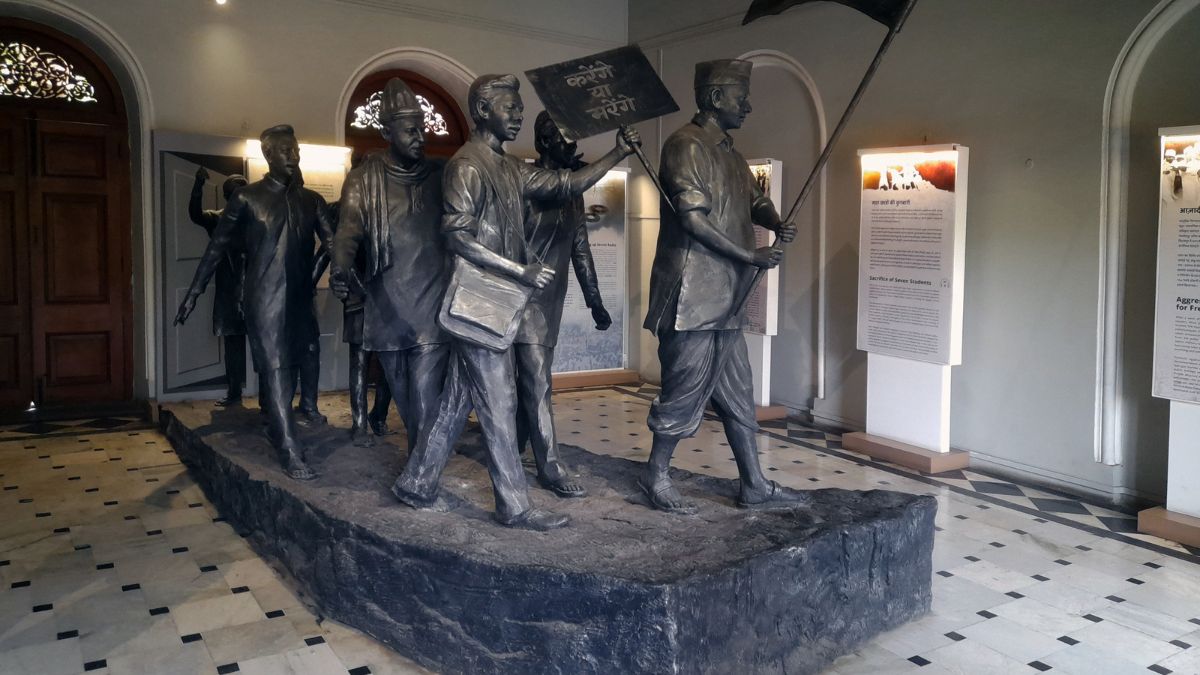
Aga Khan Palace history divides cleanly into two chapters separated by fifty years. In the first chapter, a wealthy imam builds a palace as an act of charity during a famine, employing thousands of people who would otherwise have gone hungry. In the second chapter, the British government uses that same palace as a prison for the most inconvenient person in colonial India — a 73-year-old man who had just told an empire to leave.
Both chapters of aga khan palace history matter. Together they make this building something unusual in India’s heritage landscape: a place where an act of generosity and an act of political resistance exist in the same architecture, and where the personal cost of the independence movement is visible not in statistics or timelines but in two grave sites in a garden.
Chapter One: 1892 — Aga Khan Palace History Begins With Famine
The first chapter of aga khan palace history belongs to Sultan Mohammed Shah Aga Khan III, the 48th Imam of the Ismaili Muslim community and one of the most influential Muslim leaders in 19th-century India. He was educated at Eton and Cambridge, moved with ease between colonial India and European capitals, and had a perspective on governance and social responsibility that went considerably beyond the typical role of a religious leader of his era.
In the late 1880s and early 1890s, a catastrophic famine struck the Deccan plateau. The combination of drought, crop failure, and inadequate colonial relief infrastructure left hundreds of thousands of farmers and agricultural labourers without income, food, or meaningful prospects. The mortality figures from the Deccan famines of this period are difficult to establish precisely, but they run into the hundreds of thousands across Maharashtra.
Aga Khan III’s response to this crisis was practical rather than purely charitable. He commissioned the construction of a large palace on Nagar Road in the Yerwada area of Pune — not because he needed a Pune residence, but because the construction project would employ thousands of local labourers for several years, giving them income when income was otherwise unavailable. The palace was, in the most direct sense, a public works project funded by private wealth.
Construction began in 1892. The palace took nearly a decade to complete. The design drew on Italian Renaissance architecture — five broad arched bays across the main facade, Corinthian columns supporting the verandah, high-ceilinged interior rooms with teak woodwork — combined with the broader Deccan context of the site. Nineteen acres of formal gardens were laid out around the building.
When the palace was completed in the early 1900s, it stood as one of the finest colonial-era buildings in Maharashtra. Aga Khan III used it occasionally but it was not his primary residence. It remained largely a symbol of what the construction project had accomplished rather than a working royal household.
This is the first chapter of aga khan palace history — and it explains something that visitors sometimes find surprising: why a building with Italian arches and Mughal garden influences in the middle of Yerwada exists at all. It exists because one person decided that the most useful thing he could do with significant wealth during a famine was give it to the people who needed work.
August 9, 1942 — The Night That Changed Aga Khan Palace History
The second chapter of aga khan palace history begins on a specific night: 9 August 1942.
On that afternoon, Mahatma Gandhi delivered a speech at the Gowalia Tank Maidan in Bombay (now August Kranti Maidan) that launched the Quit India Movement — his most direct and uncompromising challenge to British colonial rule. The speech ended with the words that became the movement’s rallying call: “Do or Die.”
The British government had anticipated the speech. The Governor-General Lord Linlithgow had already decided that Gandhi and the senior Congress leadership would be arrested immediately. Before dawn on 10 August 1942, at approximately 5:00 AM, the police arrived at Birla House in Bombay where Gandhi was staying.
Gandhi, his wife Kasturba, his personal secretary Mahadevbhai Desai, and the poet and nationalist Sarojini Naidu were arrested. They were taken by train to Pune. Their destination was Aga Khan Palace — chosen not for its historical associations but for its practical characteristics: large enough to house the prisoners and their immediate staff, isolated enough from the general public to prevent demonstrations, and structurally secure enough to serve as a detention facility.
Gandhi was 73 years old when he arrived at the palace in Yerwada. He was not well. He had been intermittently fasting and was thin, though characteristically calm. He asked, upon arrival, whether he was a guest or a prisoner. The British official present reportedly did not answer directly.
Mahadevbhai Desai — The First Death at Aga Khan Palace
The first tragedy of aga khan palace history’s second chapter came within five days of Gandhi’s arrival.
Mahadevbhai Desai was Gandhi’s personal secretary — not in the administrative sense alone, but in the most complete sense of the word. For 25 years, Desai had been the person who managed Gandhi’s correspondence, recorded his conversations, accompanied him on every significant journey, and knew the texture of his daily life better than almost anyone. Gandhi described Desai not as a secretary but as a son.
Desai arrived at aga khan palace history’s second chapter in poor health. The arrest, the overnight train journey, and the anxiety of imprisonment were too much. On 15 August 1942 — exactly five days after arriving at the palace — Mahadevbhai Desai suffered a cardiac arrest and died. He was 50 years old.
Gandhi’s grief was profound. He had lost, in a single moment, the person who had been closest to him in his daily working life for a quarter century. Desai was buried in the palace garden — the first grave in what would become a garden of mourning.
The memorial to Mahadevbhai Desai at aga khan palace is often overlooked by visitors focused on the Gandhi and Kasturba memorials. It should not be. His death five days into imprisonment — a 50-year-old man who had given his entire adult life to Gandhi’s work, dying in a colonial prison before the movement he had served could complete its work — is one of the more heartbreaking personal stories of the independence era.
Kasturba Gandhi — Her Imprisonment and Death at Aga Khan Palace
Kasturba Gandhi — universally known as Ba, meaning mother — was 73 years old when she arrived at aga khan palace in August 1942. She was not in good health before the arrest; the rigours of imprisonment at her age and in her physical condition made whatever was already wrong progressively worse.
Kasturba had been Gandhi’s companion since their marriage in 1883, when she was 13 and he was 13. For nearly six decades she had moved with him through South Africa, England, and across India — through ashrams, prisons, hunger strikes, and the full arc of the independence movement. She had been imprisoned herself on multiple occasions, always on her own terms and never with complaint. Her public persona was quieter than Gandhi’s but her personal courage was not less.
In the 18 months she spent at aga khan palace history’s most tragic location, Kasturba’s health declined steadily. She suffered from bronchial pneumonia and from complications of the chronic bronchitis that had affected her for years. Congress leaders sought British permission to bring in specific doctors; the requests were sometimes granted and sometimes denied. Alternative medicine practitioners — Ayurvedic doctors, nature cure specialists — were also consulted.
Nothing reversed the decline. On 22 February 1944, at approximately 7:35 PM, Kasturba Gandhi died — with her head in Gandhi’s lap, in the room that is now part of the memorial exhibition at aga khan palace. She was 74 years old.
Gandhi reportedly sat with her body through the night. The following morning, she was cremated in the palace garden. Her samadhi — the memorial site where her ashes are interred — remains there today, under a tree in the southeast section of the garden, one of the most quietly powerful memorials in any Indian heritage site.
“She was by nature truthful. She was never afraid of truth. She was honest to the core. In those days when I was full of anger and fight, she stood by me firmly. She was my severest critic and my staunchest supporter.” — Gandhi, speaking of Kasturba after her death at Aga Khan Palace.
Gandhi’s 21 Months at Aga Khan Palace — What He Did
Despite the grief of Mahadevbhai Desai’s death in August 1942 and Kasturba’s death in February 1944, Gandhi continued to work during his imprisonment at aga khan palace. He wrote extensively — letters, essays, notes — that were smuggled out of the palace and circulated in the independence movement’s networks. He spun yarn on his charkha daily, maintained his routines of prayer and physical exercise, and received the limited number of visitors the British allowed.
He also undertook a 21-day fast within the palace — a political action designed to force the British to respond to the Quit India Movement’s demands. The fast nearly killed him at his age and in his condition. The British refused to release him during the fast; international pressure eventually led them to make some concessions without explicitly acknowledging the fast’s political intent.
Gandhi was released from aga khan palace on 6 May 1944 — 21 months after his arrest, and three months after Kasturba’s death. He was 74 years old, significantly weakened by the imprisonment, the grief, and the fast. He would live for nearly four more years, to be assassinated in January 1948 in Delhi. He never returned to Aga Khan Palace.
1969 — Aga Khan Palace History’s Final Chapter
After independence in 1947, the palace returned to the Aga Khan family’s possession. In 1969 — twenty-two years after independence — Sultan Shah Karim Aga Khan IV (the current, 49th Imam of the Ismaili Muslims) gifted the palace to the Indian nation as a gesture of respect for Gandhi and the independence movement.
The Gandhi National Memorial Society was established to manage the palace and maintain it as a national memorial. The society converted the rooms where Gandhi, Kasturba, and their associates had been held into memorial and exhibition spaces, maintained the gardens and the two samadhis (Kasturba’s and Mahadevbhai Desai’s), and opened the palace to the public as both a heritage site and an ongoing educational resource about the independence movement.
The palace is today managed by the Gandhi National Memorial Society and maintained with a seriousness of purpose that is visible in the quality of the exhibitions and the condition of the gardens. It is, by any measure, one of the most thoughtfully maintained independence-era memorials in India.
Aga Khan Palace History — Why It Matters to Visitors Today
The two chapters of aga khan palace history — charity and resistance — give the building a significance that goes beyond being a beautiful colonial-era palace. It is a place where two of the most important acts in the story of how India became independent have physical addresses: the room where Kasturba died, the garden where her ashes are interred, the garden bench where Gandhi reportedly sat and wrote during his imprisonment.
For visitors who know the full aga khan palace history, the experience of walking through the memorial rooms and sitting for a few minutes beside Kasturba’s samadhi in the garden is different in character from most heritage visits. Most heritage visits are about looking at things from the past. This one is about standing in a specific place where specific people experienced specific things — and the directness of that connection is what makes aga khan palace history unusual among Pune’s heritage sites.
Frequently Asked Questions About Aga Khan Palace History
Who built Aga Khan Palace and when?
Sultan Mohammed Shah Aga Khan III, the 48th Imam of the Ismaili Muslims, between 1892 and 1900. It was built as a charitable project to provide employment to people affected by the Deccan famine of the late 1880s and early 1890s.
Why was Gandhi imprisoned at Aga Khan Palace?
Following his Quit India Movement speech on 9 August 1942, Gandhi was arrested by the British government and brought to Aga Khan Palace in Pune. The palace was chosen for its size, isolation, and suitability as a detention facility. He remained there for 21 months until 6 May 1944.
Did Kasturba Gandhi die at Aga Khan Palace?
Yes. Kasturba Gandhi died at Aga Khan Palace on 22 February 1944, of bronchial pneumonia, at the age of 74. She died with her head in Gandhi’s lap. Her samadhi is in the palace garden and is part of the current visitor experience.
Who was Mahadevbhai Desai and why is he remembered at Aga Khan Palace?
Mahadevbhai Desai was Gandhi’s personal secretary for 25 years — his closest working associate. He died of cardiac arrest on 15 August 1942, just five days after arriving at the palace under arrest, at the age of 50. His samadhi is also in the palace garden. Gandhi described his death as an irreparable loss.
When was Aga Khan Palace given to India?
In 1969, Sultan Shah Karim Aga Khan IV gifted the palace to the Indian nation. It is now managed by the Gandhi National Memorial Society as a public memorial and heritage site.
Is Aga Khan Palace connected to Shaniwar Wada in Pune?
The two sites are distinct — Shaniwar Wada tells the story of 18th-century Maratha power, while Aga Khan Palace tells the story of 20th-century independence. They are 5 kilometres apart and together give a visitor a more complete picture of Pune’s historical significance than either provides alone. Full visitor guide: Aga Khan Palace Complete Visitor Guide.
Explore More:
1 thought on “Aga Khan Palace History — Gandhi, Kasturba and the Quit India Movement Prison Story Pune”