
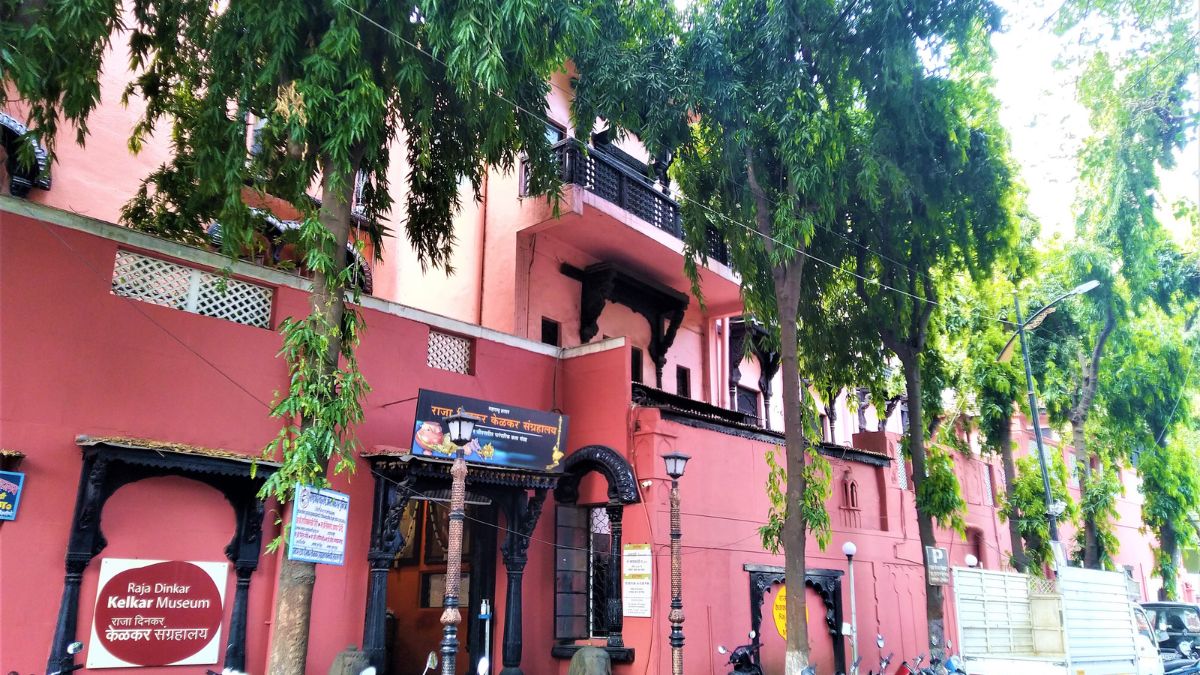
Kelkar Museum Pune is one of those places that almost everyone who visits leaves saying the same thing: why does no one talk about this?
The Raja Dinkar Kelkar Museum on Bajirao Road holds over 20,000 objects collected by one man across six decades of travel across India. A suit of armour made from crocodile skin and fish scales. Two thousand oil lamps, every one different from the last. A collection of betel-nut cutters that are, individually, miniature sculptures. The reconstructed interior of a room from a Peshwa-era palace associated with Bajirao I’s companion Mastani. Ivory carving so fine it appears to have been made under a microscope. A woman’s quarter filled with the intimate objects of royal domestic life from 200 years ago.
Kelkar Museum Pune is, by any reasonable assessment, one of the most extraordinary private collections in India. The entry fee is ₹100. Most visitors spend 2.5 to 3 hours inside and come out wondering why they only gave themselves 45 minutes.
Kelkar Museum Pune — Quick Facts at a Glance
| Detail | Information |
|---|---|
| Full Name | Raja Dinkar Kelkar Museum |
| Address | 1377–78, Natu Baug, Bajirao Road, Shukrawar Peth, Pune – 411 002 |
| Phone | +91-20-2448-2101 |
| Official Website | rajakelkarmuseum.com |
| Timings | 9:30 AM to 5:30 PM (daily) |
| Weekly Closure | None — open all 7 days |
| Entry Fee — Indian Adults | ₹100 per person |
| Entry Fee — Indian Children (5-12) | ₹50 |
| Entry Fee — Foreign Nationals | ₹200 per person |
| Photography (mobile) | ₹100 additional permit |
| Audio Guide | Available — inquire at counter |
| Guided Tour | Available — inquire at counter |
| Time Needed | Minimum 2 hours; recommended 2.5 to 3 hours |
| Distance from Shaniwar Wada | 1.4 kilometres — 18 minutes walk |
| Distance from Dagdusheth Ganpati | 1 kilometre — 12 minutes walk |
Kelkar Museum Pune Timings 2026
Kelkar Museum Pune is open daily from 9:30 AM to 5:30 PM, seven days a week, with no weekly closure. Last entry is accepted around 5:00 PM.
The single best time to visit kelkar museum pune is immediately after opening at 9:30 AM on a weekday. In the first hour, you will often have entire wings of the museum almost to yourself — a significant advantage in a collection where the experience of being alone with the objects is qualitatively different from sharing the space with a school group. The lamp collection, the Mastani Mahal, the betel-nut cutter display — all of them deserve the kind of unhurried attention that the first hour of a weekday morning allows.
Avoid Sunday afternoons during school holiday periods — the museum is genuinely crowded at these times, and the three-storey layout with narrow display corridors creates congestion that affects the quality of the experience.
Kelkar Museum Pune Entry Fee 2026
| Visitor Category | Entry Fee |
|---|---|
| Indian adults | ₹100 |
| Indian children (5 to 12 years) | ₹50 |
| Children under 5 | Free |
| Foreign nationals | ₹200 |
| Photography permit (mobile phone) | ₹100 additional |
| Guided tour (if arranged) | Inquire at counter |
If you plan to photograph inside kelkar museum pune — and the Mastani Mahal ceiling, the lamp collection and the ivory carving section are genuinely worth photographing — buy the photography permit at the ticket counter. It is ₹100 well spent. Professional photography or videography for commercial purposes requires prior written permission from the museum administration.
The Story of Dr. Dinkar Kelkar — Why This Museum Exists
Before the collection, the man. Because kelkar museum pune cannot be properly understood without understanding what kind of person spent sixty years of his life creating it.
Dr. Dinkar Gopal Kelkar was born in 1896 in Pune. He was not a king, a wealthy industrialist, or a colonial official. He was a middle-class Pune resident — educated, civic-minded, with a modest income — who became consumed by one conviction: that the ordinary objects of Indian daily life were as worthy of preservation as the weapons and jewellery that filled official museums.
The personal motivation was grief. His young son — named Raja — died in childhood. Dr. Kelkar decided to create a museum in Raja’s memory. That intention, which began as an act of mourning, became the organising principle of six decades of collecting. He travelled across India — to Gujarat, Rajasthan, Karnataka, Kerala, Bengal, the Deccan — and acquired objects not for their monetary value but for their beauty, their craftsmanship, and their ability to tell the story of how people actually lived.
In 1975, he donated the entire collection to the Maharashtra government. He died in 1990 at the age of 94, having given away 20,000 objects and received the Padma Shri in recognition of what he had created.
When you stand in front of the 2,000-lamp collection at kelkar museum pune, or the crocodile skin armour, or the carved doors salvaged from demolition-threatened havelis across India, you are looking at the result of one person’s sixty-year conviction that these things mattered. The full story is in our dedicated article: Raja Dinkar Kelkar — Complete Life Story.
Floor-by-Floor Guide — What to See in Kelkar Museum Pune
Kelkar museum pune is organised across three floors, with over 2,500 objects on display (from the total collection of 20,000+). The layout is broadly thematic — weapons and armour on one level, domestic objects on another, musical instruments and performance arts in a third section — though the collection’s density means the boundaries between themes blur in the richest parts of the museum.
Ground Floor — Entry and Historical Overview
The ground floor of kelkar museum pune begins with the portrait of Dr. Kelkar near the entrance — pause here before you go further. Everything you are about to see is the result of one person’s decision. That context matters.
The ground floor houses the weapons and military artefacts section, including the celebrated crocodile skin armour — a suit of armour assembled from crocodile leather and fish scales that is, by any measure, one of the most unusual objects in any museum in India. Most visitors spend 30 seconds at this case and move on; it rewards five minutes of close attention, particularly the articulation of the individual scales and the construction of the joints.
Also on the ground floor: Maratha-era firearms, swords with carved ivory handles, ceremonial shields, and several items of Peshwa court military dress that give a sense of what the warriors who inhabited Shaniwar Wada wore and carried.
First Floor — The Lamp Collection, Musical Instruments and the Vanita Kaksha
The first floor of kelkar museum pune houses what many visitors consider the most hypnotic section of the entire museum: the lamp collection. Dr. Kelkar collected over 2,000 oil lamps from across India — from the simplest single-wick terracotta lamp to elaborate multi-tiered brass temple lamps that stand four feet tall. Every lamp in the collection is different from every other. The range of design across one object with one function — to produce light — is a lesson in the richness of Indian craft tradition that takes a long time to fully absorb.
Look slowly in this section. The temptation is to walk past them as a collective display; the reward is to stop at individual lamps and ask where they came from, who made them, and what specific context required exactly this design.
Also on the first floor: the musical instruments collection (sitar, sarod, tabla, tanpura, and several regional instruments rarely seen in standard museum displays), the Vanita Kaksha (women’s quarter — a display of intimate personal objects from royal women’s domestic life: ivory combs, sindoor containers, hand mirrors, kajal boxes, jewellery cases), and the children’s toys from the 17th to 19th centuries.
Second Floor — The Mastani Mahal and Special Collection
The most famous section of kelkar museum pune is the Mastani Mahal — a room assembled from the original carved wooden panels and architectural elements of a hall that was part of the Peshwa-era palace complex in Kothrud associated with Mastani, the companion of Peshwa Bajirao I.
When the building in Kothrud was being demolished in the mid-20th century, Dr. Kelkar intervened to salvage the carved teak panels, the door frames, and the decorative elements. He transported them to the museum and reassembled them as a room — not a reconstruction or a replica, but the actual original panels put back together in a coherent interior space.
Walking into the Mastani Mahal at kelkar museum pune is disorienting in the best possible way. The room looks and feels inhabited — the carved ceiling, the dark teak walls, the carved archways — and the knowledge that these are 18th-century original materials from the actual Peshwa period gives it a presence that no reproduction could achieve.
Critical tip for the Mastani Mahal: look at the ceiling. Most visitors look at the walls and the door frames and miss the ceiling entirely. The carved wooden ceiling — the most intricate element in the room — is directly above you. Tilt your head back when you enter. The ceiling is the reason to photograph this room, if you have the photography permit.
Also on the second floor: Mughal-era jewellery and decorative objects, the ivory carving collection, and rotating special displays from the portions of the collection not permanently exhibited.
The Betel-Nut Cutter (Sarota) Collection — Wherever You Find It, Stop
The betel-nut cutter collection at kelkar museum pune deserves a special mention because most visitors walk past it quickly and miss what they are looking at. Dr. Kelkar collected hundreds of sarota — the handheld hinged blades used to cut areca nut (betel nut) for paan — from across India. Bengali sarotas, Rajasthani sarotas, Maharashtrian sarotas, Gujarati sarotas: each regional tradition produced its own aesthetic for an object that performs a single simple function.
Many of them are miniature sculptures — animals, birds, mythological figures, purely geometric forms — wrought in silver, brass, and carved iron. The display case is usually in the domestic objects section; walk slowly along it.
Photography Tips for Kelkar Museum Pune
If you purchase the photography permit (₹100), these are the shots most worth taking at kelkar museum pune:
- Mastani Mahal ceiling — wide angle from the centre of the room, looking straight up. This is the single best photograph available in the museum.
- Lamp collection detail shots — individual lamps with distinct shapes against the display background. Macro photography works well here.
- Crocodile armour close-up — the scale articulation is not visible from standard distance; get close.
- Carved doors section — the doors salvaged from Karnataka, Rajasthan, and Kerala havelis. Frame them individually against a simple background.
Flash photography disturbs other visitors and can damage delicate objects — keep flash off throughout kelkar museum pune. The museum’s indoor lighting is adequate for photography with modern phone cameras.
How to Reach Kelkar Museum Pune
Address: 1377–78, Natu Baug, Off Bajirao Road, Shukrawar Peth, Pune – 411 002
From Shaniwar Wada
1.4 kilometres — 18 minutes walk through the old city lanes. The walk itself is worth doing — the lanes between Shaniwar Wada and kelkar museum pune pass through some of the most historically dense residential streets in Pune. Auto-rickshaw 5 to 7 minutes; fare ₹40 to ₹60.
From Dagdusheth Ganpati Temple
1 kilometre — 12 to 15 minutes walk. The temple and kelkar museum pune are natural companions for the same morning visit.
From Pune Junction Railway Station
4 kilometres. Auto-rickshaw 15 to 20 minutes; fare ₹70 to ₹100. Tell the driver “Kelkar Museum, Bajirao Road, Shukrawar Peth” — the full address is useful here as some drivers know it as “Kelkar Museum” and others respond better to the street and neighbourhood name.
Parking
Street parking on and around Bajirao Road, subject to Pune’s P1/P2 alternate-side rules. The two-wheeler parking lanes around the museum are managed by local attendants at ₹10 to ₹20. Four-wheelers are better off parking near Shaniwar Wada (if combining both) and walking the 18 minutes.
Combining Kelkar Museum Pune With Shaniwar Wada and Dagdusheth Ganpati
Kelkar museum pune is an essential component of any full heritage day in old Pune. The standard combination:
- 6:30 AM — Dagdusheth Ganpati for the morning Suprabhatam Aarti
- 8:00 AM — Bedekar Misal for breakfast (10 minutes walk)
- 9:30 AM — Kelkar Museum Pune opens — be at the ticket counter at exactly 9:30 AM
- 12:00 PM — Exit kelkar museum pune
- 12:30 PM — Lunch (Shreyas or nearby thali restaurant)
- 1:30 PM — Shaniwar Wada (15 minutes walk from the museum)
The full timed itinerary with transport and budget is in our dedicated article: One Day in Pune — Complete Heritage Itinerary.
Frequently Asked Questions About Kelkar Museum Pune
What are Kelkar Museum Pune timings?
Daily 9:30 AM to 5:30 PM, all seven days, no weekly closure. Last entry approximately 5:00 PM.
What is the Kelkar Museum Pune entry fee?
₹100 for Indian adults. ₹50 for children aged 5 to 12. Foreign nationals ₹200. Photography permit ₹100 additional.
What is the most famous thing to see in Kelkar Museum Pune?
The Mastani Mahal — the reconstructed interior from the actual original carved wooden panels of a Peshwa-era building associated with Bajirao I’s companion Mastani. The 2,000-lamp collection and the crocodile skin armour are equally worth the visit.
How long should I spend at Kelkar Museum Pune?
Minimum 2 hours. A thorough visit — taking time with the lamp collection, the Mastani Mahal, the sarota collection, the vanita kaksha, and the ivory section — takes 2.5 to 3 hours.
Is a guided tour available at Kelkar Museum Pune?
Yes — guided tours can be arranged through the museum administration. Inquire at the ticket counter on arrival. If available, a guide significantly deepens the experience of kelkar museum pune — many of the objects have stories that the display labels only hint at.
What is the Mastani Mahal at Kelkar Museum?
A room assembled from the original 18th-century carved teak panels and architectural elements from a Peshwa-era building in Kothrud, Pune, historically associated with Mastani — the companion of Peshwa Bajirao I. Dr. Kelkar salvaged the panels from demolition and reassembled them at the museum. It is distinct from the Mastani Darwaza at Shaniwar Wada.
Explore More About Kelkar Museum Pune:
5 thoughts on “Kelkar Museum Pune — Complete Visitor Guide 2026 (Timings, Entry Fee, Floor-by-Floor What to See)”