
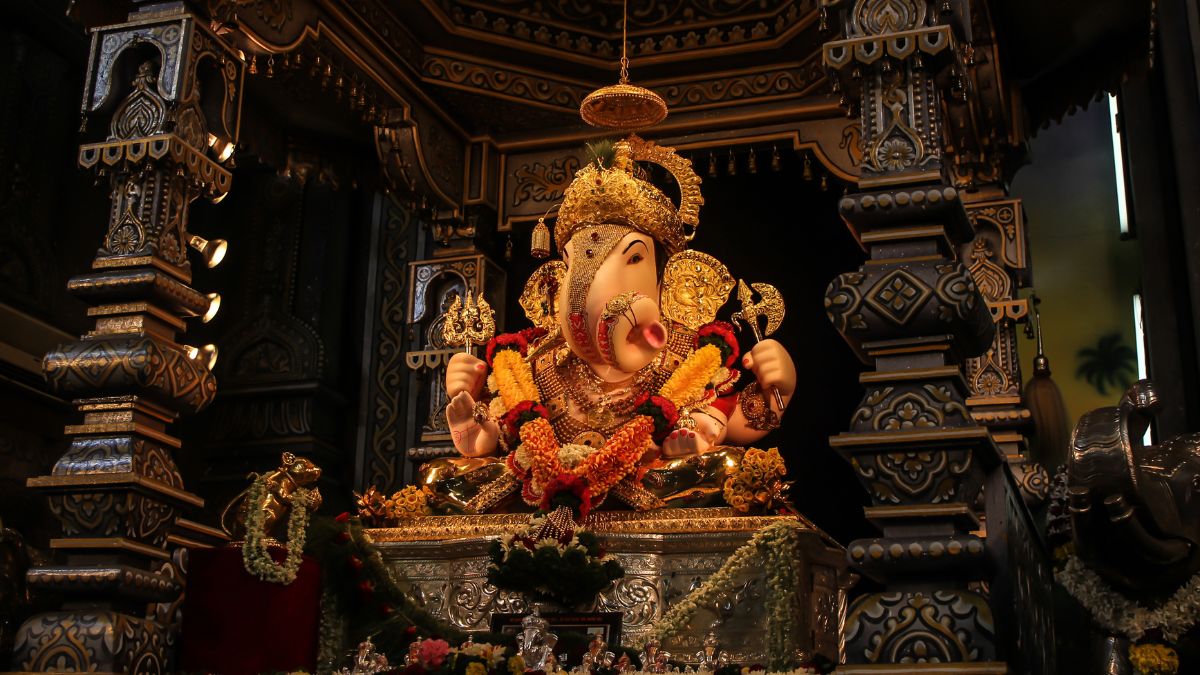
The dagdusheth ganpati history begins not with a grand religious vision or a royal commission, but with an ordinary man in extraordinary grief. In the last decade of the 19th century, a prosperous sweet-maker in Budhwar Peth lost his only son to a devastating plague that was sweeping through Pune. What he did next — how he channelled that grief into devotion, how a small local temple became the anchor of Maharashtra’s largest festival, and how one nationalist leader saw in that temple something that would change Indian political history — is one of the most remarkable origin stories in the religious and cultural landscape of Maharashtra.
Who Was Dagdusheth Halwai?
Understanding dagdusheth ganpati history requires understanding the man whose name the temple carries. Dagdusheth Halwai — the word halwai means sweet-maker or confectioner — was a prosperous businessman in Budhwar Peth, the commercial heart of old Pune, in the latter half of the 19th century.
He was not a nobleman, a Peshwa minister, or a military hero. He was a successful trader whose family had built a solid reputation in the sweet-making business across generations. The Halwai community in Maharashtra had significant commercial standing in urban centres like Pune, and Dagdusheth was among its more prosperous members in the Budhwar Peth neighbourhood.
Beyond his business, the historical record of Dagdusheth Halwai as an individual is limited. What the dagdusheth ganpati history tradition preserves is the story of what happened to him — and what he did in response.
The Plague and the Grief — How Dagdusheth Ganpati History Began
In the 1890s, Pune was struck by one of the periodic plague outbreaks that devastated Indian cities during the colonial period. The Third Plague Pandemic, which reached India in 1896 and killed millions across the subcontinent over the following decades, began arriving in Maharashtra cities in the mid-1890s. The mortality in Pune during these outbreaks was significant, and no family was entirely immune — including wealthy and established business families like Dagdusheth’s.
Dagdusheth Halwai and his wife Lakshmibai lost their only son to the plague. The historical accounts preserved in the dagdusheth ganpati history tradition do not give the son’s name or his age at death, but they preserve the quality of the grief: absolute, transforming, the kind that leaves a person either broken or permanently changed in direction.
Dagdusheth and Lakshmibai were changed in direction. Their response to the loss of their son was to turn toward Lord Ganesha with the totality of their devotion — not as a transaction (worshipping in hope of something in return) but as a complete reorientation of their lives. They commissioned an idol of Ganesha, established a regular worship practice, and began building what would eventually become Pune’s most significant temple.
The specific circumstances of the temple’s establishment — who made the original idol, in which year exactly, and what the first puja arrangements looked like — are preserved in oral tradition and temple records rather than in independently verifiable historical documents. The dagdusheth ganpati history that has been passed down places the establishment in the 1890s, during the plague decade, which is consistent with the broader biographical account of Dagdusheth Halwai’s loss.
The Jagrut Devasthan — Why This Idol Became Special
The dagdusheth ganpati history explains the temple’s growing significance in the years after its establishment through the concept of a Jagrut Devasthan — literally, a place where the deity is “awake” and genuinely present, actively responding to the devotions offered.
In Maharashtra’s religious culture, not all temples are considered equally alive with divine presence. Some idols are understood to be more powerful channels for divine energy than others — they respond to prayers with unusual frequency, they give devotees experiences of genuine contact with the divine, and word spreads through the community that this is a place worth visiting. The designation of a temple as a Jagrut Devasthan is not an official certification but a collective recognition — it grows through the accumulated experiences of thousands of devotees whose prayers were answered, whose visits were transforming, whose connection to the deity felt real rather than ceremonial.
Within years of the dagdusheth ganpati temple’s establishment, word spread through Budhwar Peth and the surrounding peths of Pune that this was a Jagrut Devasthan — a place where Lord Ganesha was genuinely present and listening. Devotees who had no connection to Dagdusheth Halwai personally began coming to the temple. The circle of visitors expanded from the immediate neighbourhood to the wider city. The dagdusheth ganpati history of the temple’s growing significance is, in this phase, the history of a reputation spreading entirely through personal testimony.
Lokmanya Bal Gangadhar Tilak — The Man Who Changed Everything
The second major actor in dagdusheth ganpati history is Lokmanya Bal Gangadhar Tilak — the Pune-based nationalist leader who is, by almost any measure, one of the two or three most significant figures in the early Indian independence movement.
Tilak was a Brahmin scholar, a journalist (he ran the newspapers Kesari in Marathi and Mahratta in English), and a political agitator who understood that mass political mobilisation in India required working through existing cultural frameworks rather than against them. He observed that the colonial administration restricted political gatherings and meetings — any assembly that could be interpreted as politically subversive was subject to suppression under the laws that governed British India.
Religious festivals, however, were a different matter. Public religious observances were legally protected and could not easily be suppressed without creating the kind of international controversy the British preferred to avoid.
Tilak saw the private Ganesh worship tradition — families bringing an idol home for ten days, worshipping in the domestic sphere, and performing visarjan — and recognised in it the seed of something that could be made public and political.
1893 — The Year Sarvajanik Ganeshotsav Was Born
In 1893, Tilak transformed the private Ganesh festival into a public event. The Sarvajanik Ganeshotsav — the Public Ganesh Festival — used the dagdusheth ganpati temple as its starting point and organisational anchor. The festival that year combined traditional religious observance with public lectures, cultural performances, and political discussions that could happen under the umbrella of a religious gathering without triggering British restrictions on political assembly.
The genius of Tilak’s dagdusheth ganpati history chapter was social as much as political. Maharashtrian society in 1893 was divided by caste, class, and community in ways that made unified political action difficult. The Ganesh festival, by contrast, was accessible to all castes — Ganesha in Hindu tradition is the god of beginnings, the remover of obstacles, worshipped by everyone regardless of their position in the social hierarchy. By organising a public Ganesh festival, Tilak created a constitutionally permitted gathering space that crossed the social divisions that separated his potential political base.
The Sarvajanik Ganeshotsav that began at dagdusheth ganpati in 1893 spread across Maharashtra within years. By the early 1900s, public Ganesh festivals were being held in hundreds of communities across the state. By the 1920s, the ten-day public Ganeshotsav had become the defining annual cultural event of Maharashtrian life. Today, more than 130 years after Tilak’s intervention in dagdusheth ganpati history, the festival draws tens of millions of participants across Maharashtra and has Ganesh Chaturthi celebrations in every major Indian city and in diaspora communities worldwide.
“Bal Gangadhar Tilak converted a household ritual into a national movement. He chose Dagdusheth Halwai Ganpati as his platform not by accident but by design — it was already the most respected temple in the city, already a place where all communities came, already a Jagrut Devasthan whose reputation guaranteed attention.” — Contextual summary of Tilak’s strategy from Maharashtra’s independence-era scholarship.
The 1967 Idol — Crafted by Shankarrao Appa Shilpi
The current idol at dagdusheth ganpati history’s living centre — the 7.5-foot, 40-kilogram-gold-adorned figure that devotees come to see — was not the original idol from Dagdusheth Halwai’s time. The original idol had deteriorated over decades of intensive daily worship and the effects of Pune’s climate.
In 1967, the temple trust commissioned a new idol from Shankarrao Appa Shilpi of Satara — a master sculptor working in the traditional Maharashtrian style of Ganesh iconography. The brief to Shilpi was precise: an idol of specific dimensions (7.5 feet tall, 4 feet wide), in the seated posture, with the trunk turning to the left (considered auspicious), and with an expression that combined benevolence with authority.
What Shilpi produced has been called by devotees and art historians alike one of the finest Ganesh idols of the modern Maharashtra tradition. The proportions are exact, the expression is genuinely powerful — it is the face of a deity who is paying attention — and the seated posture gives the idol a presence that photographs consistently underrepresent. It is larger in reality than it appears in images, and more present in the space of the inner sanctum than the entry approach suggests it will be.
The gold accumulated on the idol over the decades since 1967 — now exceeding 40 kilograms donated by thousands of individual devotees — is not merely decorative. In dagdusheth ganpati history, the gold represents a century of individual acts of gratitude: devotees who felt their prayers answered, who experienced the Jagrut Devasthan quality of the temple, and who returned to offer what they had in response.
The Dagdusheth Halwai Sarvjanik Ganpati Trust — Social Service as Temple Legacy
A significant part of dagdusheth ganpati history in the modern era is the story of the temple trust’s social welfare work — which is, in many ways, the continuation of Dagdusheth Halwai’s original impulse: responding to suffering with practical action.
The Shrimant Dagdusheth Halwai Sarvjanik Ganpati Trust runs:
- Pitashri Old Age Home (Kondhwa, Pune): Housing and care for elderly residents without family support
- Free ambulance service: Operating across Pune, responding to emergency calls without charge
- Health camps: Free medical camps in tribal and rural areas of Maharashtra
- Educational scholarships: Supporting students from economically disadvantaged backgrounds
- Blood donation drives: Organising regular donor camps through the temple’s network of devotees
- Natural disaster relief: Responding to floods, droughts, and other emergencies with material support
The trust’s budget for social welfare runs to crores of rupees annually, funded through the donations of the millions of devotees who visit dagdusheth ganpati each year and who contribute voluntarily to its work. The most direct line in dagdusheth ganpati history — from Dagdusheth Halwai’s personal grief to a public institution that serves the widest possible community — runs through this trust.
Dagdusheth Ganpati History and the Five Manache Ganpati
Within the dagdusheth ganpati history of the Pune Ganeshotsav tradition, the temple occupies a specific and formally recognised position. Pune has five temples designated as the Manache Panch Ganpati — the five Ganesh temples that receive first priority in the city’s Ganesh Chaturthi procession hierarchy.
Dagdusheth Ganpati is not technically one of the five traditional Manache Ganpati — that designation goes to five specific older temples (Kasba Ganpati, Tambdi Jogeshwari, Guruji Talim, Tambat Ali, and Kesvaji Naik Chawl). However, in the popular understanding and in the practical experience of Ganesh Chaturthi in Pune, dagdusheth ganpati’s reputation, visitor numbers, and cultural significance have made it the de facto most significant Ganesh temple in the city. It receives more devotees during the festival than any of the five formal Manache temples.
Frequently Asked Questions About Dagdusheth Ganpati History
Who founded the Dagdusheth Ganpati temple?
Dagdusheth Halwai — a prosperous sweet-maker from Budhwar Peth, Pune — and his wife Lakshmibai, following the death of their only son during a plague outbreak in the 1890s. The dagdusheth ganpati history of the temple’s founding is rooted in personal grief transformed into devotion.
What is the history of the Dagdusheth Ganpati idol?
The current idol was created in 1967 by master sculptor Shankarrao Appa Shilpi of Satara. It stands 7.5 feet tall and 4 feet wide. More than 40 kilograms of gold, donated by devotees over decades, adorns the idol’s crown, garlands, and surroundings.
How did Lokmanya Tilak connect to Dagdusheth Ganpati history?
In 1893, Bal Gangadhar Tilak used the dagdusheth ganpati temple as the foundation for launching the Sarvajanik Ganeshotsav — the Public Ganesh Festival. He transformed a private domestic ritual into a public event that provided a legally protected space for nationalist assembly under British rule. This decision directly gave birth to the festival that today draws two million devotees to the temple during Ganesh Chaturthi.
When was Dagdusheth Ganpati temple established?
The temple was established in the 1890s, during the plague decade when Dagdusheth Halwai lost his son. The precise year is preserved in temple tradition rather than formal historical documentation. The Sarvajanik Ganeshotsav associated with the temple began formally in 1893 under Lokmanya Tilak’s initiative.
What is the Dagdusheth Ganpati temple trust known for?
Beyond religious worship, the Shrimant Dagdusheth Halwai Sarvjanik Ganpati Trust runs an old age home, free ambulance service across Pune, health camps in tribal areas, educational scholarships, and disaster relief work — all funded through voluntary donations from the temple’s millions of devotees.
Explore More:
2 thoughts on “Dagdusheth Ganpati History — How One Sweet-Maker’s Grief Gave Maharashtra Its Greatest Festival”