
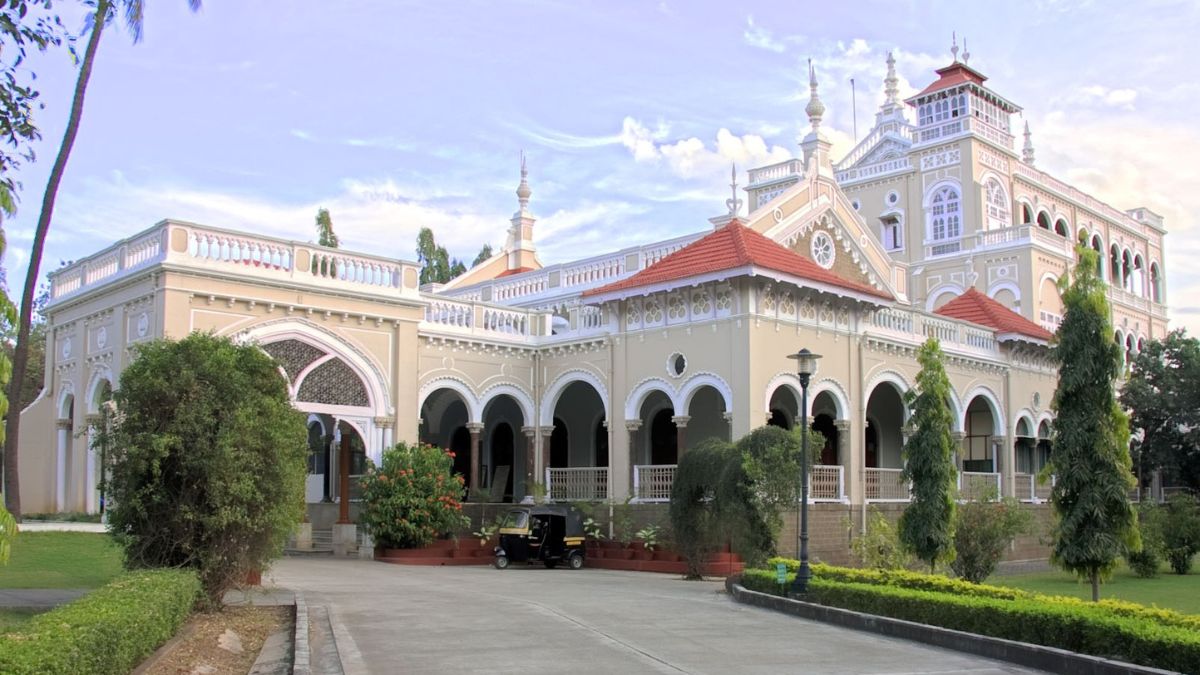
Most heritage buildings in India tell the story of power — of kings, generals, and conquests. Aga Khan Palace Pune tells a different story. It was built as an act of charity by a man who wanted to give employment to those who had none. It then became, through no design of its own, the place where the course of Indian independence was quietly but definitively shaped — where Mahatma Gandhi sat in forced confinement for nearly two years, where his wife Kasturba died in his arms, and where he continued writing, thinking, and resisting in the only ways available to a prisoner with nothing but time and conviction.
Aga Khan Palace Pune is one of the most historically significant buildings in Maharashtra. It is also one of the most undervisited, which makes the experience of going there quieter and more contemplative than the more crowded heritage sites of old Pune. This guide tells you everything you need to plan your visit — timings, entry fee, what to see, how to reach Yerwada, and why this place deserves more of your time than most visitors give it.
Aga Khan Palace Pune — Quick Facts at a Glance
| Detail | Information |
|---|---|
| Full Name | Aga Khan Palace |
| Address | Nagar Road, Yerwada, Pune – 411 006 |
| Phone | +91-20-2668-1747 |
| Timings | 9:00 AM to 5:30 PM (all days) |
| Weekly Closure | None — open all 7 days |
| Entry Fee — Indian Adults | ₹25 per person |
| Entry Fee — Foreign Nationals | ₹300 per person |
| Children under 15 | Free |
| Photography | Permitted in gardens and exterior; restricted in exhibition rooms |
| Time Needed | 1.5 to 2.5 hours |
| Maintained by | Gandhi National Memorial Society |
| Garden Area | 19 acres of landscaped grounds |
Aga Khan Palace Pune Timings 2026
Aga Khan Palace Pune is open daily from 9:00 AM to 5:30 PM, seven days a week, with no weekly closure and no seasonal shutdown. Last entry is typically accepted around 5:00 PM — allow yourself at least an hour and a half to see the palace interior, the Gandhi memorial rooms, the Kasturba samadhi, and to spend time in the gardens.
The palace is at its most atmospheric in the early morning just after 9:00 AM, when the gardens are quiet and the light on the Italian arched facade is at its clearest. On most weekdays before 11:00 AM, you will have significant sections of the palace almost entirely to yourself — a rare luxury for a site of this historical significance.
Note: On national holidays with special significance to India’s freedom struggle — particularly Gandhi Jayanti on 2 October and Independence Day on 15 August — Aga Khan Palace Pune holds commemorative events that may alter the standard visiting arrangement. Call ahead at +91-20-2668-1747 on these specific dates.
Aga Khan Palace Pune Entry Fee — Complete Breakdown
| Visitor Category | Entry Fee |
|---|---|
| Indian adult | ₹25 |
| Children under 15 | Free |
| Foreign nationals | ₹300 |
| Guided tour (if arranged) | Additional — inquire at entry |
Tickets are purchased at the entrance gate. No advance booking is required for the standard visit. The Gandhi National Memorial Society, which manages the palace, also sells books, photographs, and publications related to Gandhi’s time here — worth browsing at the counter near the main entrance.
The History of Aga Khan Palace Pune — Built From Charity, Turned Into a Prison
The history of Aga Khan Palace Pune has two distinct chapters, separated by half a century, and the contrast between them is stark enough to define the entire character of the place.
Chapter One: 1892 — Built to Feed the Hungry
The palace was built between 1892 and 1900 by Sultan Mohammed Shah Aga Khan III, the 48th Imam of the Ismaili Muslims. A severe famine had struck the Deccan region in the late 1880s and early 1890s, leaving thousands of farmers and labourers without income. Sultan Mohammed Shah commissioned the palace construction specifically to provide paid employment to the affected population — thousands of labourers were employed in building what became one of the finest colonial-era structures in Maharashtra.
The palace was not designed as a residence. It was designed as a statement — of Italian Renaissance architecture set in the Maharashtra landscape, with five arched bays across the main facade, Mughal-influenced interior details, and 19 acres of formal gardens that in their scale and greenery feel entirely separate from the noise of Pune beyond the walls.
As a piece of architecture, Aga Khan Palace Pune is genuinely beautiful. The five arches of the main facade, the proportions of the colonnaded verandah, the quality of the stonework — all of it was designed and built with an ambition that the building’s current status as a government memorial can sometimes obscure.
Chapter Two: 1942 — India’s Most Consequential Prison
On 9 August 1942, Mahatma Gandhi launched the Quit India Movement — his most uncompromising challenge to British colonial rule — with a speech at the Gowalia Tank Maidan in Bombay. The following morning, 10 August 1942, at 6:00 AM, the British government arrested Gandhi, his wife Kasturba, his secretary Mahadevbhai Desai, and Sarojini Naidu, and brought them to Aga Khan Palace Pune under armed guard.
It was not chosen for its historical associations. It was chosen because it was large, isolated enough to prevent public demonstrations, and had the physical structure to serve as a secure detention site. Gandhi was 73 years old when he arrived here. He would be 74 when he left.
In the 21 months that Gandhi spent at Aga Khan Palace Pune, two of the most important people in his life died within the palace walls.
The Gandhi Memorial — What It Contains and Why It Matters
The rooms inside Aga Khan Palace Pune where Gandhi and his associates were held have been maintained as a memorial by the Gandhi National Memorial Society, which acquired the palace from the Aga Khan family in 1969 as a gift to the Indian nation.
The memorial rooms contain:
- Gandhi’s personal belongings from his imprisonment period — his spinning wheel (charkha), his walking stick, his simple bed, his reading glasses, his sandals. These are not replicas. The intimate scale of his possessions against the grandeur of the colonial palace creates a visual argument about power and renunciation that no caption could improve.
- Photographs spanning Gandhi’s life — from his early years as a lawyer in South Africa through the major campaigns of the independence movement, curated to show the arc of a life that was entirely public and nothing if not consistent.
- Documents, letters, and handwritten notes from the period of his imprisonment here — including writings he completed during his 21-month stay at Aga Khan Palace Pune.
- A room dedicated to Kasturba Gandhi’s final months — the photographs and objects from the period between her arrival in August 1942 and her death in February 1944, when she died of bronchial pneumonia in Gandhi’s arms inside this building.
- A memorial to Mahadevbhai Desai — Gandhi’s personal secretary of 25 years, who died of a cardiac arrest on 15 August 1942, just five days after arriving at the palace. He was 50 years old. Gandhi described his death as “an irreparable loss.”
Kasturba Gandhi — Her Imprisonment and Death at Aga Khan Palace Pune
Of all the elements of Aga Khan Palace Pune’s history, the story of Kasturba Gandhi is perhaps the most moving. Kasturba — known affectionately as Ba — was 73 years old when she was brought to the palace. She was not in good health. The imprisonment at Aga Khan Palace Pune was, in effect, the last chapter of her life.
She spent the 18 months she was imprisoned here in declining health, tended by Gandhi and the small group of associates who shared their confinement. She died on 22 February 1944 at the age of 74 — with Gandhi at her side, in what is now one of the exhibition rooms you walk through during your visit.
Her samadhi (memorial) is in the palace gardens — a simple marble platform beneath a tree, surrounded by manicured lawn and absolute quiet. It is the most emotionally resonant spot in Aga Khan Palace Pune.
Gandhi himself died four years later, in 1948, in Delhi — but the Gandhi National Memorial Society ensures that his presence is felt at Aga Khan Palace Pune through the careful curation of the memorial rooms and the maintenance of the gardens exactly as they were during his imprisonment.
The Architecture of Aga Khan Palace Pune — Five Arches and 19 Acres
The building itself deserves attention beyond its historical associations. Aga Khan Palace Pune is one of the finest examples of Italian Renaissance-influenced architecture in the Deccan, and its scale — the main facade stretches across five broad arched bays — communicates the ambition of its original commission.
The exterior arches are supported by paired Corinthian columns, the stonework is cut with precision unusual for colonial-era construction in Maharashtra, and the proportions of the verandah — deep enough to provide shade across the full width of the building at almost any time of day — show a design intelligence that goes beyond mere stylistic imitation.
The interior rooms are high-ceilinged and cool even in summer, with teak woodwork in the doors and window frames that has aged to the dark, polished quality that only a century of maintenance produces. The Gandhi memorial rooms occupy a portion of the ground floor; the remaining parts of the building are used for administrative purposes by the Gandhi National Memorial Society and are not part of the standard visitor route.
The 19-acre gardens are formally laid out with paths, lawns, and planted sections that follow a loose Mughal garden influence — the structured planting, the central axes, the sense of enclosure within large green space. In the early morning, the gardens are extraordinarily peaceful. The contrast between the noise of Nagar Road outside the gate and the stillness inside is immediate and pronounced.
How to Reach Aga Khan Palace Pune
Aga Khan Palace Pune is located in the Yerwada neighbourhood, on Nagar Road, approximately 5 kilometres from the centre of old Pune (Shaniwar Wada and Dagdusheth Ganpati area).
From Pune Junction Railway Station
Approximately 6 kilometres. Auto-rickshaw takes 15 to 25 minutes depending on traffic; fare typically ₹80 to ₹130. Ola and Uber cabs are widely available from the station forecourt. Tell the driver “Aga Khan Palace, Yerwada” — it is a well-known landmark.
From Shaniwar Wada / Old Pune
Approximately 5 kilometres. Auto-rickshaw 15 to 20 minutes; fare ₹80 to ₹120. This is the natural route for visitors combining both heritage sites in the same day — though the distance means an auto between the two is more practical than walking.
From Pune Airport
Approximately 8 kilometres. The airport is on the same Nagar Road axis as the palace, making this one of the shorter airport-to-heritage-site routes in Pune. Cab fare ₹250 to ₹400; travel time 15 to 25 minutes.
By PMPML Bus
Several PMPML routes pass the Yerwada area. The stop nearest to Aga Khan Palace Pune is well-known to local bus drivers — ask for “Aga Khan Palace, Yerwada” when boarding.
Parking
Aga Khan Palace Pune has a reasonably sized car park within the compound, accessible from the Nagar Road entrance. It does not face the severe congestion issues of the old city heritage sites. On most days, parking is available without difficulty.
What to See at Aga Khan Palace Pune — A Suggested Route
A thorough visit to Aga Khan Palace Pune takes 1.5 to 2.5 hours. This is the route that makes the most of the visit:
- Start at the main entrance gate. The approach along the garden path to the main palace building gives you the best view of the five-arched facade. Take this slowly — the proportions of the building read best from a distance.
- Enter the palace and begin with the Gandhi memorial rooms. The historical timeline panels provide context before you see the personal objects. The rooms are cool and quiet; take time with each display.
- The Kasturba room. Spend more time here than in the other rooms. The photographs from the last months of her imprisonment and the objects on display communicate something that the broader history of independence sometimes does not reach — the personal cost of the movement on the people closest to Gandhi.
- The Mahadevbhai Desai memorial. Gandhi’s secretary of 25 years died here at 50, five days after arrival. The memorial to him is a quiet counter to the larger historical narrative.
- Exit to the gardens and walk to Kasturba’s samadhi. The samadhi is in the southeast section of the gardens. Allow yourself time to sit here. It is the stillest point in Aga Khan Palace Pune, and one of the stillest points in Pune.
- Walk the full garden perimeter. The 19 acres do not require a guided route — follow the paths, sit on the garden benches, and let the scale of the place register properly.
Aga Khan Palace Pune vs Shaniwar Wada — How to Combine Both
Many visitors to Pune ask whether they should visit Aga Khan Palace Pune and Shaniwar Wada in the same day. The answer is yes — they are different enough in character that they complement rather than duplicate each other. Shaniwar Wada tells the story of 18th-century Maratha power; Aga Khan Palace Pune tells the story of 20th-century colonial resistance. Together they give a more complete picture of Pune’s historical significance than either site alone.
Practical sequencing for a combined day:
- Start at Shaniwar Wada when it opens at 8:00 AM. Allow 1.5 hours.
- Walk to Dagdusheth Ganpati (5 minutes). Allow 30 minutes for darshan.
- Breakfast at Bedekar Misal or Laxmi Road. Allow 45 minutes.
- Auto-rickshaw to Aga Khan Palace Pune (15 to 20 minutes, ₹80 to ₹120). Arrive around 11:00 AM.
- Visit Aga Khan Palace Pune. Allow 2 hours.
- Full heritage day complete by 1:30 PM.
Frequently Asked Questions About Aga Khan Palace Pune
What are the Aga Khan Palace Pune timings in 2026?
9:00 AM to 5:30 PM daily, all seven days, no weekly closure.
What is the Aga Khan Palace Pune entry fee?
₹25 for Indian adults. Children under 15 free. Foreign nationals ₹300.
Why is Aga Khan Palace Pune famous?
It was the site of Gandhi’s imprisonment during the Quit India Movement (1942–1944). His wife Kasturba Gandhi died here in February 1944. His secretary Mahadevbhai Desai also died here. The palace is now a national memorial managed by the Gandhi National Memorial Society.
How long does a visit to Aga Khan Palace Pune take?
A thorough visit — palace interior, Gandhi memorial rooms, Kasturba samadhi, and garden walk — takes 1.5 to 2.5 hours.
Who built Aga Khan Palace Pune and when?
Sultan Mohammed Shah Aga Khan III, between 1892 and 1900, as a charity project to provide employment to farmers and labourers affected by a severe famine in the Deccan.
Is there parking at Aga Khan Palace Pune?
Yes — a reasonably sized car park within the compound. Access from the Nagar Road entrance. Parking is generally available without difficulty on most days.
Is Aga Khan Palace Pune worth visiting?
Yes — particularly for anyone interested in India’s independence movement. The combination of beautiful colonial architecture, the personal objects from Gandhi’s imprisonment, and the profound quiet of Kasturba’s samadhi in the gardens makes it one of the most genuinely moving heritage visits in Maharashtra. The fact that it is less crowded than Shaniwar Wada makes it an even more contemplative experience.
Explore More:
2 thoughts on “Aga Khan Palace Pune — Complete Visitor Guide 2026 (Timings, Entry Fee, Gandhi Memorial Guide)”