
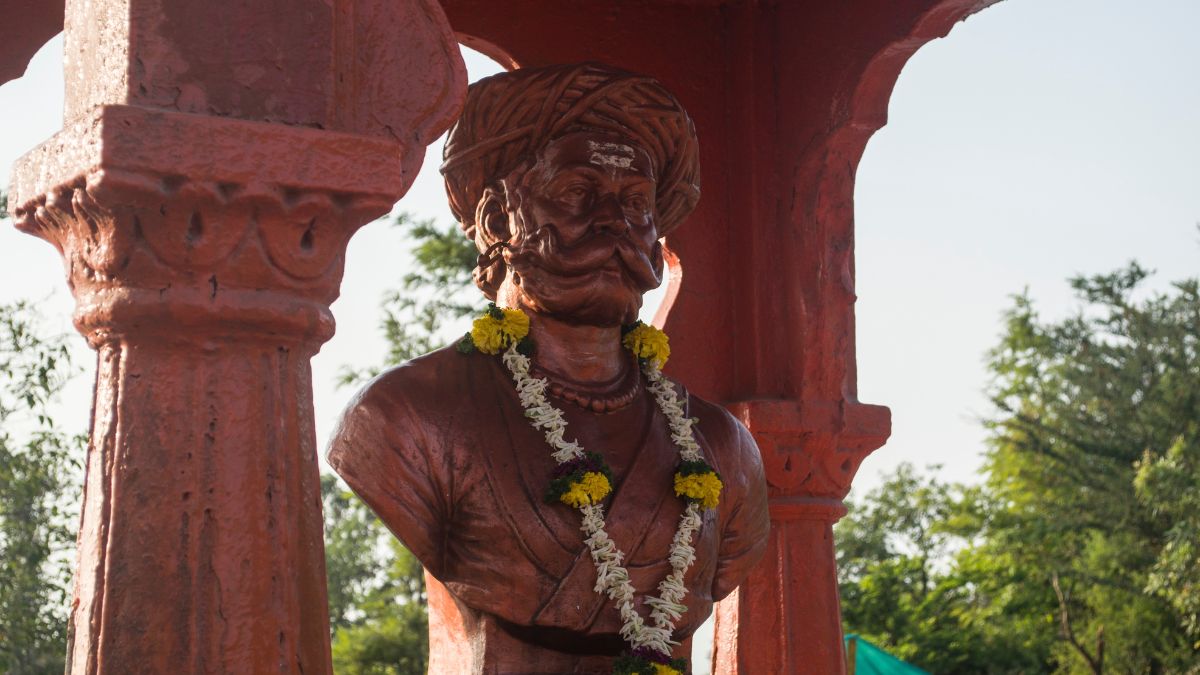
Sinhagad fort history is the story of one night in February 1670 that changed the strategic balance of the Deccan and produced one of the most celebrated phrases in Marathi cultural memory. The battle that gave this fort its current name lasted only a few hours. The general who won it died in the process. And the king who sent him — Chhatrapati Shivaji Maharaj — on receiving news of both the victory and the death, spoke words that have been repeated in Maharashtra for 350 years: Gad ala pan Sinh gela. The fort came, but the Lion is gone.
This is the central event in sinhagad fort history. Understanding it — the politics behind the assault, the engineering of the climb, the specific way Tanaji Malusare died, and what the fort meant to Shivaji’s empire-building project — gives the ruins at the summit a weight that a casual visit cannot produce.
Sinhagad Fort History — Before 1670: The Fort Called Kondhana
Before the night of 4 February 1670, sinhagad fort history begins with the name Kondhana — the original name of this fort that rises above the valley southwest of Pune at 1,312 metres above sea level. The fort had existed in some form since at least the 2nd century CE, referenced in the accounts of the Yadava dynasty that ruled the Deccan before the arrival of the Delhi Sultanate.
Through the medieval period, Kondhana changed hands multiple times — between Yadava kings, the Bahmani Sultanate, and eventually the Adilshahi Sultanate of Bijapur. By the 17th century, the fort’s strategic importance was clearly understood: it commanded the valley approaches to Pune from the south and west, controlled the trade routes through the Sahyadri ghats, and provided a defensive position of exceptional natural strength — the cliffs on three sides making a direct assault almost impossible under normal military conditions.
In 1649, Shivaji Maharaj — then in the early stages of the Maratha rebellion against the Adilshahi and Mughal powers — captured Kondhana from the Adilshahi. It became part of the growing network of Sahyadri hill forts under his control. But in 1660, the Mughal general Shaista Khan forced Shivaji to cede Kondhana as part of the Treaty of Purandar — a significant strategic loss, as Kondhana’s position directly threatened Shivaji’s base at Pune.
For ten years, Kondhana remained in Mughal hands under the command of Udaybhan Rathod — a Rajput commander of considerable military experience. Taking it back became a priority in Shivaji’s strategic planning.
Who Was Tanaji Malusare?
The central figure in sinhagad fort history is Tanaji Malusare — and understanding who he was clarifies why his death in the battle that follows had the specific emotional impact it did on Shivaji Maharaj and on Maratha memory.
Tanaji Malusare was one of Shivaji’s original inner circle — a childhood companion from the Maval region who had been with the young Shivaji from before the Maratha rebellion began. He was not merely a loyal general; he was a friend from before the project of the Maratha state existed. His relationship with Shivaji was of the kind that becomes rare once a person becomes a king — the relationship that predates the power and therefore exists on different terms than loyalty or service.
Tanaji was also, by multiple accounts, an exceptionally capable military commander — one of the handful of Maratha officers who combined tactical intelligence with the ability to inspire soldiers to do extraordinary things. He was the right person for the specific kind of assault that the sinhagad fort history of the 1670 battle required.
The personal dimension: when Shivaji summoned Tanaji for the Kondhana assault mission, Tanaji was in the process of arranging his son’s wedding. He reportedly said he would conduct the wedding after the battle — and asked his uncle Shelar Mama to take his place in the wedding preparations. In sinhagad fort history, this detail has become one of the markers of the story’s emotional register: a man who chose the battle over his son’s wedding, knowing the difficulty of what he was about to attempt.
The Problem: How Do You Take a Fort on Three Sides of Cliff?
The central tactical challenge of the 1670 battle in sinhagad fort history was simple to state and extremely difficult to solve: Kondhana’s cliffs on the north, west, and south sides made a conventional assault — ladder and rope climbing against a defended wall — a near-certain disaster. The only approach suitable for a larger force was from the east, which was exactly where the Mughal garrison expected an attack and had concentrated its defences.
Tanaji Malusare’s solution was to attack from the direction no one was expecting: the north cliff face, which was considered effectively unclimbable. Not completely unclimbable — clearly it was possible for a fit individual to scale it — but not climbable at speed, in darkness, with fighting equipment, by a significant number of soldiers.
The solution to this problem is the most famous element of sinhagad fort history: the monitor lizard.
The Monitor Lizard (Ghorpad) — Tanaji’s Climbing Solution
The ghorpad — the Bengal monitor lizard, which grows to 1.5 to 2 metres and has extremely strong claws capable of gripping rock surfaces — was used in Maratha military practice as a living anchor for rope climbing. A monitor lizard with a rope attached to a harness around its body would be released onto a cliff face; its claws would grip the rock, and soldiers could then climb the rope using the lizard’s grip as the anchor point.
In sinhagad fort history, Tanaji’s monitor lizard — named Yashwanti in the tradition — was released onto the north cliff face of Kondhana on the night of 4 February 1670. The lizard gripped, the rope held, and Tanaji’s soldiers began the climb in darkness and near-silence.
Whether this account is literally precise in every detail has been a matter of historical debate — some scholars argue the monitor lizard story is allegorical or romanticised in its telling. What is not disputed is that Tanaji Malusare led a night assault on the north cliff face of Kondhana, that his soldiers successfully scaled what was considered an unscalable face, and that they achieved complete surprise on the garrison above.
4 February 1670 — The Night Battle
The night of 4 February 1670 was a full moon night — Poornima — which gave Tanaji’s soldiers enough light to climb and assemble on the summit without torches that would alert the garrison. Approximately 342 Maratha soldiers made the climb via the north cliff. When they were assembled at the top, they launched their assault on the fort simultaneously from multiple points.
The sinhagad fort history of the battle itself is documented in both Maratha court records and in the accounts of later historians. The Mughal garrison, commanded by Udaybhan Rathod, was numerically superior and fought well — this was not a walkover. The fighting was fierce and Tanaji Malusare fought at its centre.
At some point during the battle, Tanaji’s shield was destroyed — accounts differ on whether it was cut, dropped, or smashed. What the sinhagad fort history tradition records is that he continued fighting without his shield, using his cloth turban as a makeshift grip for his sword and fighting bare-handed against Udaybhan Rathod. Both men died in the encounter — Udaybhan Rathod also died in the battle. Tanaji’s wounds were fatal.
By dawn on 5 February 1670, Kondhana was in Maratha hands. The cost was their commander.
‘Gad Ala Pan Sinh Gela’ — Shivaji’s Response
When Shivaji Maharaj received news of the battle’s outcome — simultaneously the victory and Tanaji Malusare’s death — his response has entered Marathi cultural memory as one of the most quoted phrases in the region’s history.
Gad ala pan Sinh gela.
The fort came, but the Lion is gone.
The word Sinh (lion) is a deliberate reference to Tanaji — and it became the name of the fort from that day forward. Kondhana became Sinhagad: the Lion Fort. The renaming was not administrative — it was memorial, a permanent encoding of Tanaji Malusare’s sacrifice into the identity of the place he died to recapture.
Shivaji’s phrase is significant in sinhagad fort history not just as an emotional response but as a political act. By naming the fort after Tanaji’s lion quality — his courage, his willingness to give everything — Shivaji acknowledged publicly that the fort’s value was less than the man who died for it. This is an unusual statement for a king whose project depended on military victories and territorial control. It says, in effect: the fort matters, but the man mattered more.
The Tanaji Malusare Samadhi at Sinhagad Fort
A samadhi (memorial) to Tanaji Malusare stands within the fort complex at the summit, near the area where the battle is believed to have been most intense. It is a relatively simple structure — a stone platform with a commemorative inscription — that draws a steady stream of visitors who come specifically to the sinhagad fort history site of Tanaji’s sacrifice.
The samadhi is often decorated with flowers by visitors and local devotees who treat Tanaji with a reverence that edges toward the religious. In Maratha cultural tradition, the warriors of Shivaji’s inner circle are remembered not merely as historical figures but as exemplars of a specific quality — the combination of personal courage, loyalty, and willingness to sacrifice that the Maratha revival required.
Shelar Mama — The Battle’s Unsung Hero
Sinhagad fort history preserves the name of one more figure from the 1670 battle who deserves mention: Shelar Mama — Tanaji’s uncle, who had been left in charge of the wedding preparations when Tanaji departed for Kondhana. When he received news that Tanaji had fallen and that the battle was at a critical point, Shelar Mama — reportedly in his 70s at the time — left the wedding and joined the battle, reportedly turning the tide in the Marathas’ favour in the crucial final phase.
The specific historicity of some details in Shelar Mama’s story is subject to the same scholarly scrutiny as the monitor lizard narrative. What the sinhagad fort history tradition preserves in his story is a complementary value to Tanaji’s sacrifice: the elder who could have stayed home, who had every excuse to remain at the wedding, but chose to join the battle when it mattered most.
Sinhagad Fort History After 1670
After the 1670 battle, Sinhagad remained part of the Maratha Empire through the Peshwa period. Lokmanya Bal Gangadhar Tilak — the Pune-based nationalist leader who used public Ganesh festivals as a space for political mobilisation — visited Sinhagad regularly and is associated with several of the fort’s heritage features. A water tank at the summit is named Tilakamal Kund in his memory.
The fort was used militarily through the Anglo-Maratha wars of the early 19th century and then gradually fell into its current state as an archaeological site maintained by the Maharashtra state government. Today it is visited by hundreds of thousands of trekkers, history enthusiasts, and food pilgrims annually — the food stalls at the summit and the trek itself having become as much a part of the sinhagad fort history experience as the ramparts and the samadhi.
Frequently Asked Questions About Sinhagad Fort History
Why is the fort called Sinhagad?
After the 1670 battle, Shivaji Maharaj renamed the fort from Kondhana to Sinhagad — “Lion Fort” — in memory of Tanaji Malusare, who died recapturing it. Sinh (lion) was Shivaji’s tribute to Tanaji’s courage. His words on receiving news of Tanaji’s death — Gad ala pan Sinh gela (the fort came, but the Lion is gone) — gave the fort its name.
Who was Tanaji Malusare?
One of Shivaji Maharaj’s closest military commanders and childhood companions from the Maval region. He led the night assault on Kondhana on 4 February 1670 and died in the battle after successfully capturing the fort from the Mughal garrison.
What was the monitor lizard used for at Sinhagad?
A monitor lizard (ghorpad) with a rope attached was released onto the north cliff face as a living anchor, allowing Tanaji’s soldiers to climb what was considered an unscalable face in darkness without alerting the garrison. The lizard’s claws gripped the rock, providing the anchor point for the rope.
What were Shivaji’s famous words about Sinhagad?
Gad ala pan Sinh gela — “The fort came, but the Lion is gone.” Spoken when Shivaji received news of both the battle’s victory and Tanaji Malusare’s death.
How old is Sinhagad Fort?
The fort at Kondhana (the name before 1670) dates to at least the 2nd century CE, referenced in accounts of the Yadava dynasty. It has been continuously significant as a military position for approximately 1,800 years.
Explore More:
1 thought on “Sinhagad Fort History — Tanaji Malusare, the 1670 Battle and Shivaji’s Famous Words”