
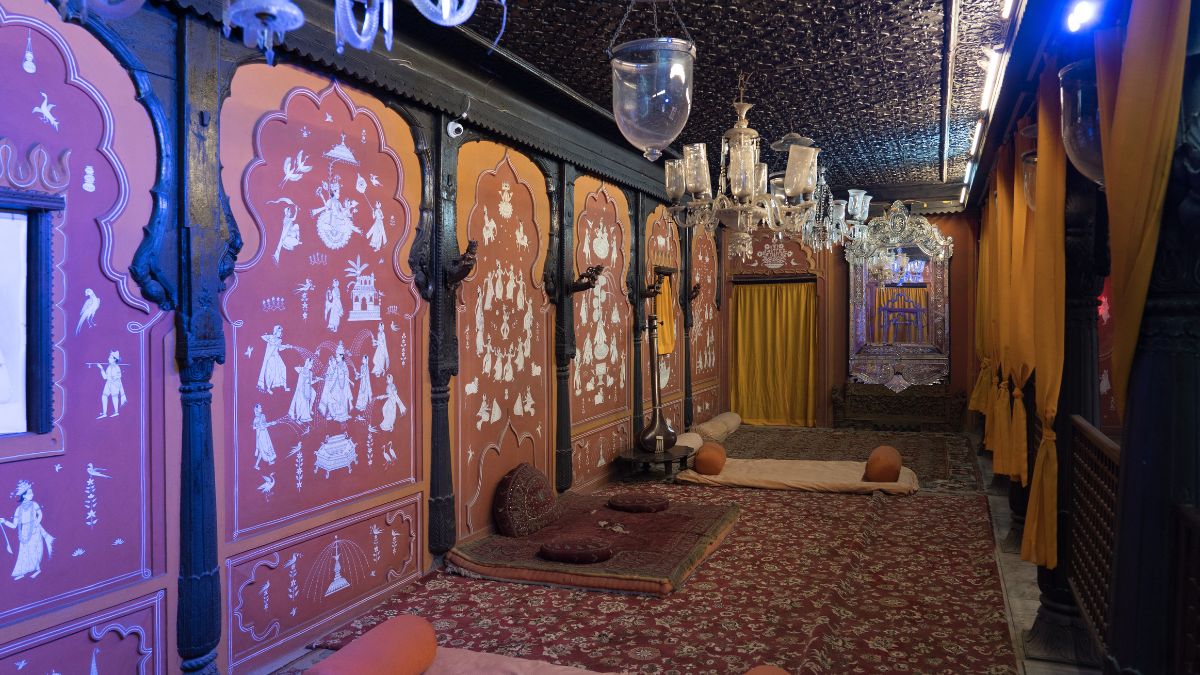
The Mastani Mahal Pune is one of those heritage discoveries that most visitors to Pune do not know exists until they are standing inside it — and then cannot quite believe they did not know. At the Raja Dinkar Kelkar Museum on Bajirao Road, on the second floor, there is a room assembled from the original 18th-century carved teak panels and architectural elements of a Peshwa-era building historically associated with Mastani — the companion of Peshwa Bajirao I. These are not replicas. They are not reconstructions from historical drawings. They are the actual original panels, salvaged from demolition, transported to the museum, and reassembled into the room you walk into today.
The Mastani Mahal Pune is one of the most historically resonant interiors in Maharashtra and one of the least visited significant heritage spaces in Pune. This guide tells you what it is, where exactly it is, how it was saved, what you see inside, and why the ceiling — almost always missed — is the most important thing in the room.
What Is the Mastani Mahal Pune?
The name requires one clarification before anything else, because visitors to Pune often confuse two distinct things that both carry Mastani’s name.
The Mastani Darwaza is at Shaniwar Wada — one of the fort’s five original teak gates, named for Mastani during Bajirao I’s lifetime as the primary access point to her section of the palace. This is a gate, still in its original location, still serving its original architectural function.
The Mastani Mahal Pune at Kelkar Museum is something different — a room. Specifically, it is a room assembled from the original architectural elements of a separate Peshwa-era building in the Kothrud area of Pune that was historically associated with Mastani. When that building faced demolition in the mid-20th century, Dr. Dinkar Kelkar intervened to save the carved teak interior panels, transported them to his museum, and had them reassembled as a coherent room within the museum building.
The Mastani Mahal Pune at Kelkar Museum is therefore not the room where Mastani actually lived — it is not a reconstruction of Shaniwar Wada’s Mastani quarters, which were destroyed in the 1828 fire. It is a room built from original materials of another building associated with her, reassembled to preserve those materials in a coherent architectural form rather than as isolated fragments in a storage room.
This distinction matters because it defines what the Mastani Mahal Pune actually is: not a memorial in the way Kasturba Gandhi’s room at Aga Khan Palace is a memorial, but a piece of material culture saved from destruction and given a second life as a museum exhibit that happens to carry the name of one of the most significant figures in Peshwa history.
Who Was Mastani? A Brief Introduction
Mastani was the companion of Peshwa Bajirao I — the Maratha Empire’s greatest military commander, who built Shaniwar Wada in 1730 and ruled from it until his death in 1740. She was the daughter of Maharaja Chhatrasal of Bundelkhand and a woman of mixed Hindu and Persian (Muslim) heritage, and she came to Pune in the context of a political arrangement after Bajirao helped defend Bundelkhand against Mughal forces.
Her presence at Shaniwar Wada — and the Mastani Mahal Pune’s existence as a preserved piece of that presence — is part of a larger story of contested personal relationships, political opposition from the Brahmin court, and the way Bajirao publicly acknowledged Mastani through the naming of the fort gate that bears her name. The full story, including what the historical record shows versus what the 2015 Bollywood film dramatised, is in our dedicated article: Bajirao Mastani — Real History vs the 2015 Film.
The Building Dr. Kelkar Saved — What Was It?
The original building from which the Mastani Mahal Pune panels were salvaged was a Peshwa-era structure in the Kothrud area of Pune — at the time of Dr. Kelkar’s intervention, a building whose historical associations with Mastani were known in the local scholarly and heritage community but which had no formal protected status under Indian archaeological law.
In the mid-20th century, as Pune expanded westward and older structures in the Kothrud and surrounding areas were demolished for new development, this building was scheduled for demolition. Dr. Kelkar’s intervention was characteristic of his entire collecting methodology: he identified objects and architectural elements of historical and craft significance that were about to be permanently lost, acquired them through negotiation with the owners, and incorporated them into his museum.
In this case, he specifically salvaged the interior architectural elements — the carved teak wall panels, the door frames, the carved ceiling sections — that constituted the finest surviving 18th-century interior in the building. The walls of the original building may have been stone or brick; what Dr. Kelkar saved was the timber interior that gave the room its character.
The Mastani Mahal Pune at Kelkar Museum is therefore, in a specific technical sense, a transplanted interior — the carved teak components of an 18th-century room, moved from their original building and reassembled in a new location. This is not unusual in museum practice; the practice of saving significant architectural elements from demolition by incorporating them into museum buildings has a long international history.
How the Room Was Reassembled
The reassembly of the Mastani Mahal Pune panels within the Kelkar Museum building required both curatorial judgment and craft skill. The panels arrived as individual pieces — the wall sections, the carved door frames, the ceiling components — and had to be fitted into a room within the museum building that was not designed to receive them. The dimensions of the original room and the museum room do not perfectly correspond; there are therefore points where the assembly makes concessions to the available space.
What Dr. Kelkar and his team achieved was a room that reads as coherent — as a room rather than a collection of fragments — while preserving all the significant carved elements in their original form. The seams where the 18th-century panels meet the museum building’s own walls are visible if you look for them. Most visitors do not notice them because the carved sections draw the eye and the joints retreat.
What You See Inside the Mastani Mahal Pune
Walking into the Mastani Mahal Pune requires a moment of adjustment. After the dense display cases of the museum’s other floors, this is a room — with walls, a ceiling, a floor, and a defined interior space. The shift in scale and the quality of the carved teak around you creates an atmosphere that the object displays elsewhere in the museum cannot produce.
The Walls
The carved teak wall panels that line the Mastani Mahal Pune display the characteristic Peshwa-era decorative vocabulary — floral and foliate patterns combined with geometric borders, with occasional figurative elements in the corner panels. The carving is in medium relief — neither the shallow surface carving of utilitarian furniture nor the deep undercutting of the finest temple carving, but a considered middle register appropriate to a high-status domestic interior.
The colour of the teak — aged to a dark, warm brown that could not be replicated by any artificial treatment — is itself significant. This wood has been through 250 years of temperature change, humidity variation, light exposure, and the accumulated handling of generations of people. The patina is the patina of age.
The Door Frames
The carved door frames of the Mastani Mahal Pune are among the most technically accomplished elements in the room. The pilasters flanking the door openings carry carved panels in the full height of the door frame — each panel a self-contained composition of birds, flowers, and geometric interlace. The quality of the carving in the door frame capitals — the carved tops of the pilasters where the frame meets the lintel — is exceptional.
The Ceiling — The Most Important Element
The ceiling of the Mastani Mahal Pune is the finest carved element in the room and the one most consistently missed by visitors. The deeply carved geometric and floral pattern in the ceiling panels — carved from the same teak as the walls but at a different scale and with a different spatial logic, since ceiling carving must be read from below rather than at eye level — is more complex and more technically demanding than anything at eye height in the room.
Stand in the centre of the Mastani Mahal Pune. Look straight up. The ceiling is above you in its entirety and the full compositional logic of the carving becomes visible only from the centre of the room, looking directly upward. Most visitors stand near the walls and look at the wall carving; the ceiling is visible from those positions only at an oblique angle that does not reveal its full depth.
If you have the photography permit, the ceiling of the Mastani Mahal Pune is the single best photograph available in Kelkar Museum. Use a wide-angle setting and shoot directly upward from the room’s centre.
Mastani Mahal Pune vs Mastani Darwaza at Shaniwar Wada
| Feature | Mastani Mahal (Kelkar Museum) | Mastani Darwaza (Shaniwar Wada) |
|---|---|---|
| What it is | A room with original 18th-century teak panels | One of five original fort gates, in original location |
| Where | 2nd floor, Kelkar Museum, Bajirao Road | North wall, Shaniwar Wada, adjacent to Delhi Darwaza |
| Original location | Kothrud building, salvaged and relocated | Original position, 1730 construction |
| Connection to Mastani | Building historically associated with her | Named for her during Bajirao’s lifetime |
| Entry fee | Included in Kelkar Museum ₹100 ticket | Included in Shaniwar Wada ₹25 ticket |
| Walking distance between | 1.4 kilometres — 18 minutes walk | |
Visiting both the Mastani Mahal Pune at Kelkar Museum and the Mastani Darwaza at Shaniwar Wada on the same day gives the most complete picture of Mastani’s material legacy in Pune — two different kinds of connection to the same historical figure, 1.4 kilometres apart.
Photography at the Mastani Mahal Pune
The photography permit at Kelkar Museum (₹100 additional to entry) covers the entire museum including the Mastani Mahal Pune. The room is one of the most photographically rewarding spaces in the museum:
- The ceiling shot: Stand in the centre of the room, point your phone camera directly upward, use the widest available lens setting. This is the primary photograph to take.
- The door frame detail: Get close to the carved pilasters and shoot the panel carving at an angle that shows the relief depth — the carved flowers and birds are three-dimensional objects in the wood, not flat surface patterns.
- The full room: From the doorway, a wide-angle shot captures the ensemble effect of the carved interior. This works best in the first hour after the museum opens when other visitors are not in frame.
Flash photography in the Mastani Mahal Pune is not recommended — it flattens the carved relief and disturbs other visitors. The room’s own lighting, combined with a modern phone camera’s low-light capability, is adequate for all three shots above.
How to Find the Mastani Mahal Pune in Kelkar Museum
The Mastani Mahal Pune is on the second floor of the museum. From the ticket counter on the ground floor:
- Enter the museum and proceed through the ground floor (weapons, armour, musical instruments)
- Take the staircase to the first floor (lamp collection, Vanita Kaksha, domestic objects)
- Take the staircase to the second floor
- The Mastani Mahal Pune is one of the principal rooms on the second floor — look for the room with the dark teak-panelled walls visible through the doorway
If you cannot locate it, ask any gallery attendant on the second floor to point you to the Mastani Mahal. It is one of the most frequently asked-about destinations within the museum.
Frequently Asked Questions About Mastani Mahal Pune
What is the Mastani Mahal Pune?
A room at Raja Dinkar Kelkar Museum assembled from original 18th-century carved teak panels salvaged by Dr. Kelkar from a Peshwa-era building in Kothrud that was historically associated with Mastani, the companion of Peshwa Bajirao I.
Is the Mastani Mahal Pune at Shaniwar Wada or Kelkar Museum?
At Kelkar Museum on Bajirao Road. The Mastani Darwaza (Mastani Gate) is at Shaniwar Wada — a different, though related, heritage element. The two are 1.4 kilometres apart.
Are the panels in the Mastani Mahal Pune original?
Yes — the carved teak panels, door frames, and ceiling sections are original 18th-century material salvaged from the original building before its demolition. They are not replicas or reconstructions.
What should I photograph at the Mastani Mahal Pune?
The ceiling — shot from the room’s centre looking directly upward — is the most important photograph. Buy the ₹100 photography permit at the ticket counter before visiting the second floor.
How do I reach Kelkar Museum from Shaniwar Wada?
1.4 kilometres — 18 minutes walk along Bajirao Road and through Shukrawar Peth lanes. Auto-rickshaw 5 to 7 minutes, fare ₹40 to ₹60. Full museum guide: Kelkar Museum Complete Visitor Guide.
Explore More:
1 thought on “Mastani Mahal Pune — What It Is, Where It Is and Why Kelkar Museum Preserved It”