
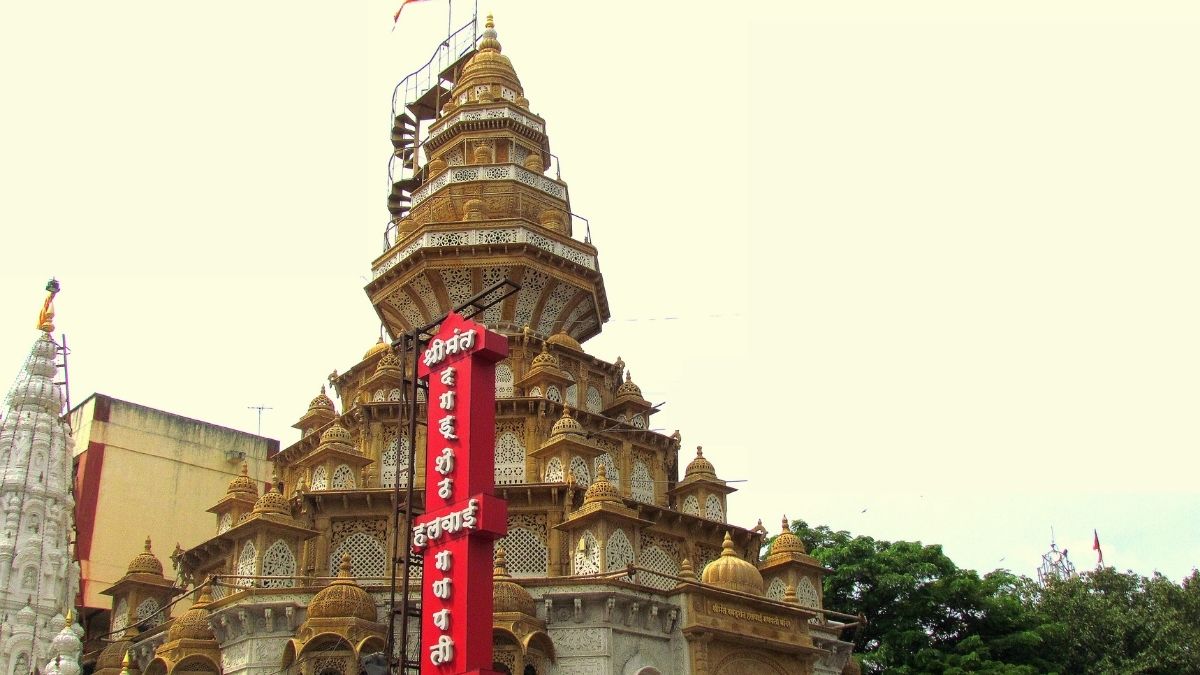
There is a moment in any first visit to Dagdushet Ganpati when the temple stops being a landmark on your itinerary and becomes something else entirely. It happens when the aarti begins — the brass instruments, the conch shell, the rhythm of a hundred voices — and the sheer scale of devotion in that small space makes everything outside it briefly irrelevant.
Dagdushet Ganpati is Pune’s most visited temple, the most beloved Ganesh idol in Maharashtra, and one of the most significant Jagrut Devasthans (living temples where the deity is considered always awake and always present) in the country. It draws devotees from across India every single day of the year — not just during Ganesh Chaturthi, but on ordinary Tuesday mornings and quiet weekday evenings when the morning crowd has dispersed and the aarti is about to begin.
This guide gives you everything you need to plan your dagdushet ganpati visit: the full 2026 timings, the complete aarti schedule, the honest parking situation, how to reach it, and the best time to arrive for each kind of experience.
Dagdushet Ganpati — Quick Facts at a Glance
| Detail | Information |
|---|---|
| Full Name | Shrimant Dagdusheth Halwai Ganpati |
| Address | Ganapati Bhavan, 250, Budhwar Peth, Pune – 411 002 |
| Phone | +91-20-2447-2085 |
| Official Website | dagdushethganpati.com |
| Timings (Mon–Sat) | 5:00 AM to 10:30 PM |
| Timings (Tuesday) | 5:00 AM to 11:00 PM |
| Timings (Sunday) | 5:00 AM to 10:30 PM |
| Entry Fee | Free (no charges for darshan) |
| Idol Height | 7.5 feet |
| Gold on Idol | Over 40 kilograms (donated by devotees over a century) |
| Distance from Shaniwar Wada | 300 metres — 5 minutes walk |
| Distance from Kelkar Museum | 1 kilometre — 12 minutes walk |
Dagdushet Ganpati Temple Timings 2026 — Full Daily Schedule
Dagdushet Ganpati temple is open every day of the year, including all public holidays, all festival days, and the entire Ganesh Chaturthi period. The temple does not close for any weekly holiday. Devotees can take darshan on any day without prior appointment or special permission.
| Day | Temple Opens | Temple Closes |
|---|---|---|
| Monday, Wednesday, Thursday, Friday, Saturday | 5:00 AM | 10:30 PM |
| Tuesday (Ganesh’s auspicious day) | 5:00 AM | 11:00 PM |
| Sunday | 5:00 AM | 10:30 PM |
| Ganesh Chaturthi Festival (10 days) | 4:00 AM | Midnight |
Tuesday is particularly significant at dagdushet ganpati because Tuesday is considered Ganeshwar in Marathi tradition — the day most auspicious for Ganesh worship. Crowds are noticeably higher on Tuesday evenings than on other weekdays. If your goal is a calm, unhurried darshan, avoid Tuesday evenings and Sunday mornings.
Complete Dagdushet Ganpati Aarti Schedule — All Five Daily Aartis
Dagdushet Ganpati follows a schedule of five aartis daily, each with its own character, its own time, and its own atmospheric quality. Understanding the aarti schedule is the single most useful thing you can know before visiting.
| Aarti Name | Time | Duration | Character |
|---|---|---|---|
| Suprabhatam | 7:30 AM – 7:45 AM | 15 minutes | Morning awakening — quiet, devotional, intimate |
| Madhyanha (Midday) | 12:00 PM – 12:15 PM | 15 minutes | Midday offering — moderate crowd |
| Sandhya (Evening) | 7:00 PM – 7:15 PM | 15 minutes | Evening prayer — becoming busier |
| Mahamangal | 8:00 PM – 9:00 PM | One full hour | The main event — brass instruments, conch, full ceremonial |
| Shejaarti | 10:00 PM – 10:15 PM | 15 minutes | Goodnight aarti — the deity’s rest |
Each aarti deserves a moment of explanation.
The Suprabhatam Aarti (7:30 AM) — Why the Early Morning Visit Changes Everything
Suprabhatam literally means “auspicious morning” and is the daily ritual awakening of the deity. At dagdushet ganpati, the 7:30 AM Suprabhatam is the most peaceful and emotionally accessible aarti for first-time visitors. The crowd at this hour is composed mostly of local devotees who have come before work — people who have been visiting the temple for years and bring a quality of quiet devotion that is genuinely moving to witness.
If you are visiting Dagdushet Ganpati for the first time and can arrange your schedule to be there by 7:15 AM, the 15-minute Suprabhatam followed by unhurried darshan is the experience that most visitors remember most vividly. Arrive at 7:15 AM, take a position near the entrance, wait for the aarti to begin, and spend half an hour without any urgency.
The Mahamangal Aarti (8:00 PM) — The Most Spectacular Hour
The Mahamangal Aarti at dagdushet ganpati is in a different category from the other four. It runs for a full hour, from 8:00 PM to 9:00 PM, with a full complement of traditional instruments — shehnai, mridangam, cymbals, conch shells — and a ceremony that has been performed in the same form for over a century. The lighting of the golden idol, the waving of the aarti lamp before the 7.5-foot form, the collective chanting of hundreds of devotees: this is the experience that draws people back to dagdushet ganpati year after year.
If you can only attend one aarti, attend the Mahamangal. Arrive at 7:30 PM to secure a position from which you can actually see the ceremony.
Between the aartis, normal darshan continues uninterrupted. You do not need to time your visit to an aarti to enter the temple — but if you can, the aarti transforms what might otherwise be a brief visit into something considerably more memorable.
The History of Dagdushet Ganpati — Grief, Faith and Tilak
The history of dagdushet ganpati begins not with celebration but with grief. In the late 19th century, a devastating plague swept through Pune. Among those who lost someone was Dagdusheth Halwai — a prosperous sweet-maker of Budhwar Peth who lost his only son to the epidemic.
In his grief, Dagdusheth and his wife Lakshmibai turned entirely to devotion to Lord Ganesha. They commissioned an idol, established a regular worship practice, and began what would eventually become Pune’s most significant temple. The idol’s extraordinary quality — its proportions, its expression, its presence — drew devotees from across the city, and word began to spread that this was a Jagrut Devasthan (a place where the deity is truly present and listening).
Then, in 1893, Lokmanya Bal Gangadhar Tilak — the nationalist leader who used Dagdushet Ganpati as a base for his revolutionary work against British rule — transformed the temple’s private festival into a public one. The Sarvajanik Ganeshotsav (Public Ganesh Festival) that Tilak launched used dagdushet ganpati as its starting point and template. His genius was political: by turning a religious festival into a public gathering, he created a legal space where Indians could assemble without violating British laws against political meetings.
The Sarvajanik Ganeshotsav that Tilak started from dagdushet ganpati in 1893 is directly ancestral to the festival that draws 20 lakh (two million) devotees to this temple each year during Ganesh Chaturthi. You can read the full story in our dedicated article: Dagdushet Ganpati History — How One Sweet-Maker’s Grief Gave Maharashtra Its Greatest Festival.
The Idol — 40 Kilograms of Gold, 7.5 Feet of Devotion
The current dagdushet ganpati idol was created in 1967 by the sculptor Shankarrao Appa Shilpi of Satara. It stands 7.5 feet tall and 4 feet wide — larger than it appears in photographs, and more powerful in presence than any photograph communicates.
Over the decades since installation, devotees have donated gold jewellery and ornaments as offerings. The accumulated gold on the idol now exceeds 40 kilograms — covering the crown, the garlands, the pedestal, and the decorative elements surrounding the figure. Two massive silver doors frame the inner sanctum. The effect of the golden figure in the lamplight during the Mahamangal Aarti is genuinely breathtaking.
Entry Fee at Dagdushet Ganpati — Free, Always
There is no entry fee at dagdushet ganpati. Darshan is completely free for all devotees, without restriction on nationality, religion, or day of visit. No advance booking, no timed entry slot, no queue management fee.
The temple trust accepts voluntary donations, which fund the trust’s social work — including the Pitashri old-age home in Kondhwa, free ambulance services across Pune, health camps in tribal areas, and scholarships for underprivileged students. Donation boxes are visible throughout the temple premises.
How to Reach Dagdushet Ganpati Pune
Address: Ganapati Bhavan, 250, Budhwar Peth, Pune – 411 002
Dagdushet Ganpati is in the heart of old Pune, in Budhwar Peth. Every auto-rickshaw driver in Pune knows it by name — no additional explanation of location is ever required.
From Pune Junction Railway Station
Approximately 4 kilometres. Auto-rickshaw takes 15 to 20 minutes; fare ₹60 to ₹100. Cab from the station forecourt takes a similar time. Tell the driver “Dagdushet Ganpati, Budhwar Peth” — they know exactly where to go.
From Shivajinagar Station
2 kilometres. Auto-rickshaw 10 to 12 minutes; fare ₹50 to ₹70. This is the closest railway station.
From Shaniwar Wada
300 metres — 5 minutes walk. Exit Shaniwar Wada’s main gate, turn left, walk along Bajirao Road, and turn into Budhwar Peth. The dagdushet ganpati temple is visible from the turn. Most visitors do both in the same trip without any transport between them.
By Pune Metro (Purple Line)
The nearest metro station is Budhwar Peth on the Purple Line, approximately 500 metres from the temple. From Swargate, the metro ride takes approximately 5 minutes. For visitors coming from the south of the city, this is now the cleanest transport option.
Parking Near Dagdushet Ganpati — The Honest Truth
There is no dedicated parking at dagdushet ganpati temple. The lanes around Budhwar Peth are narrow, heavily used, and actively monitored by Pune traffic police. This is not a problem unique to festival days — it applies year-round.
The most practical approach for four-wheeler visitors: park at Shaniwar Wada (300 metres away, small paid parking lot inside the compound) and walk to the temple. This is what most regular visitors do. Attempting to find parking in the immediate Budhwar Peth area is a reliable way to lose 20 minutes and potentially receive a challan.
Two-wheeler visitors have more flexibility — informal parking areas managed by local attendants operate in the lanes off Budhwar Peth at ₹10 to ₹20 per vehicle.
During Ganesh Chaturthi: do not drive anywhere near the area. The roads within a kilometre of dagdushet ganpati are closed or impassable from the first day of the festival through visarjan. Arrive by metro, PMPML bus, or on foot from a parking point well outside the old city.
Best Time to Visit Dagdushet Ganpati — Beat the Crowds
Dagdushet ganpati draws visitors year-round, and the crowd pattern is fairly predictable once you understand it:
| Time / Day | Crowd Level | Best For |
|---|---|---|
| Weekday, 6:00 AM – 8:00 AM | Very low | Peaceful darshan, Suprabhatam aarti at 7:30 AM |
| Weekday, 8:00 AM – 11:00 AM | Low to moderate | Comfortable darshan, clear view of idol |
| Weekday, 12:00 PM – 4:00 PM | Moderate | Acceptable — midday aarti at noon |
| Weekday, 7:30 PM – 9:30 PM | High | Mahamangal Aarti — worth the crowd |
| Tuesday evening | Very high | Maximum devotional atmosphere |
| Sunday morning | High | Family visits — less suitable for first-timers |
| Ganesh Chaturthi (10 days) | Extremely high | Once-in-a-lifetime atmosphere |
Our recommendation for a first visit: 6:30 AM on a weekday. You will have a clear view of the idol without pushing through crowds, the temple atmosphere at that hour is genuinely peaceful, and you will be positioned perfectly for the 7:30 AM Suprabhatam Aarti.
What to Expect When You Arrive
Dagdushet ganpati has no dress code requirement, but modest dress is respectful — avoid sleeveless clothing and shorts if possible. Footwear must be removed before entering the inner sanctum area; shoe storage is available outside.
Photography of the idol from within the inner sanctum is restricted. Photography of the temple exterior, the approach lanes, and from the outer temple area is generally permitted. During aartis, flash photography is discouraged as it disturbs other devotees.
Mobile phones should be on silent or switched off during the aarti. The Mahamangal Aarti in particular deserves full presence — many visitors who arrive with plans to video the entire ceremony find that they put their phones away partway through, which is the right instinct.
Nearby Places to Visit After Darshan
- Shaniwar Wada — 300 metres, 5 minutes walk. The natural pairing for any dagdushet ganpati visit.
- Laxmi Road — 200 metres. Pune’s oldest and most vibrant shopping street — Chitale Bandhu for bakarwadi, Kaka Halwai for sweets.
- Raja Dinkar Kelkar Museum — 1 kilometre, 12 minutes walk. One of the most extraordinary private collections in India.
- Lal Mahal — 1 kilometre. Shivaji Maharaj’s childhood home, now a heritage museum.
Frequently Asked Questions About Dagdushet Ganpati Timings
What are the Dagdushet Ganpati timings in 2026?
The temple is open daily from 5:00 AM to 10:30 PM. On Tuesdays, it remains open until 11:00 PM. During Ganesh Chaturthi, the temple opens at 4:00 AM and closes at midnight.
Is there an entry fee at Dagdushet Ganpati?
No. Entry and darshan at dagdushet ganpati are completely free. Voluntary donations are accepted and fund the trust’s social welfare programmes.
What time is the Mahamangal Aarti at Dagdushet Ganpati?
The Mahamangal Aarti begins at 8:00 PM and runs for a full hour until 9:00 PM daily. It is the most elaborate and most attended aarti at dagdushet ganpati — arrive by 7:30 PM for a good position.
When is the best time to visit Dagdushet Ganpati without crowds?
6:00 AM to 8:00 AM on any weekday (excluding Tuesday) offers the most peaceful darshan. The 7:30 AM Suprabhatam Aarti during this window is particularly memorable.
How far is Dagdushet Ganpati from Shaniwar Wada?
300 metres — approximately 5 minutes on foot. The two sites are almost always visited together.
Can I visit Dagdushet Ganpati on Sunday?
Yes — the temple is open every day including Sunday. Sunday mornings are moderately crowded; if you prefer quieter darshan, a weekday morning is easier.
Explore More:
6 thoughts on “Dagdushet Ganpati Timings 2026 — Complete Darshan Guide (Aarti Schedule, Entry Fee, How to Reach)”