
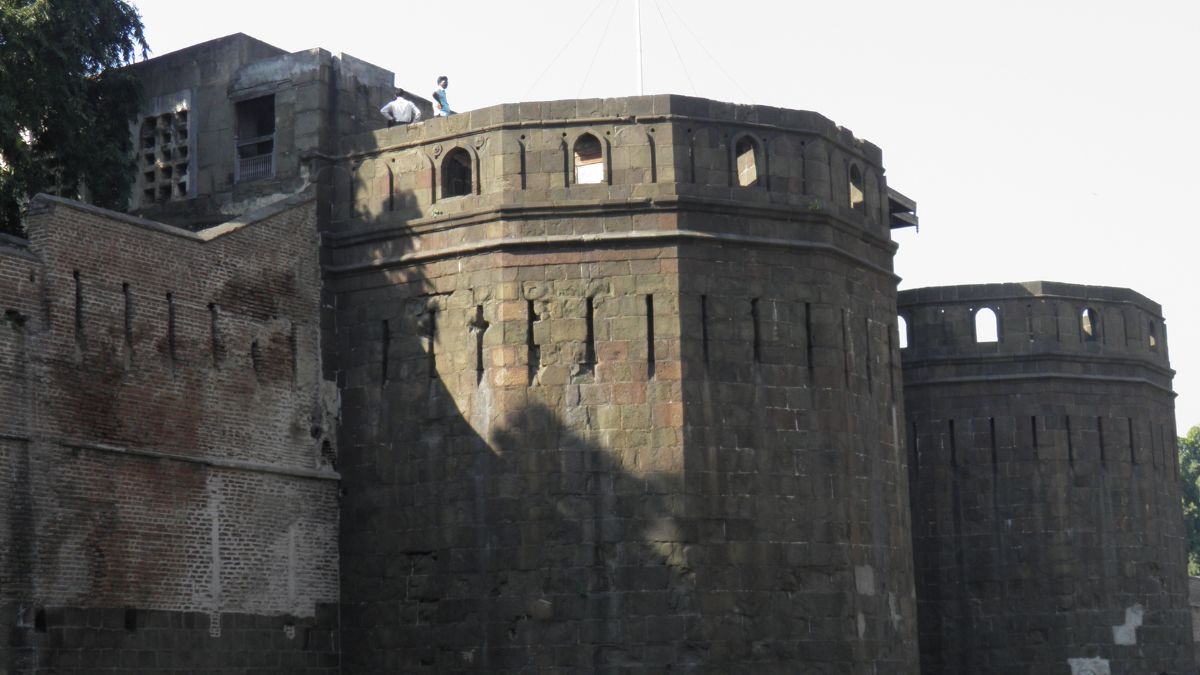
Shaniwar Wada photography has a specific challenge that most visitors don’t anticipate: the most photogenic elements of the complex — the five gates, the scale of the fortification walls, the detail of the iron spikes on the Delhi Darwaza — are all in the outer perimeter, and they require the right light, the right position, and the right timing to photograph well. The inner complex, where the palace buildings once stood, is largely open ground — historically significant but photographically sparse without context.
This guide tells you exactly where to stand, exactly what time to arrive, and what camera settings to use for the best shaniwar wada photography results — whether you are shooting on a DSLR, a mirrorless camera, or a modern smartphone.
The Golden Rule of Shaniwar Wada Photography — Arrive at 8:00 AM
The single most important piece of advice for shaniwar wada photography: arrive when the gates open at 8:00 AM. The reasons are light, crowd, and temperature — all three are optimal in the first 60–90 minutes of the day.
Light: The Delhi Darwaza faces north-northeast. In the morning (8–10 AM), the sun rises in the east and the light falls on the gate’s surface at a low angle, creating dimensional shadows in the stone carvings and the iron spike details that disappear completely under the flat overhead light of midday. Morning shaniwar wada photography has a warmth and depth that afternoon shooting cannot replicate.
Crowd: The complex is quiet at 8 AM — local walkers and the occasional early-arriving tourist group. By 10:30 AM, tourist buses and school groups begin arriving. By noon the complex is at full visitor density. Your shaniwar wada photography will have clean foregrounds and unobstructed gate shots only in the morning.
Temperature: From March through June, the temperature inside the walled complex rises sharply after 10 AM. The early morning visit is physically more comfortable and produces better photography because you are not rushing to get out of the heat.
Best Shaniwar Wada Photography Spots — 8 Locations
1. The Delhi Darwaza — Exterior (The Hero Shot)
What you get: The 21-foot main gate with its iron spikes, the stone arch, and the fortification wall receding on both sides — the most iconic shaniwar wada photography composition.
Where to stand: On the road in front of the gate, approximately 15–20 metres back from the gate arch. This distance gives the gate its proper proportional scale — too close and you lose the height of the arch; too far and the gate becomes small against the wall.
Best time: 8:00 AM to 9:30 AM, October through February. The low eastern sun lights the gate face directly at this time.
Focal length: 24–35mm (on full frame) or equivalent wide angle on phone — wide enough to include both flanking wall sections alongside the gate.
2. The Delhi Darwaza — Looking Through the Arch
What you get: The framing composition — the gate arch as a frame around the inner complex beyond, with the stone detail of the arch in the foreground and the open inner ground receding into depth.
Where to stand: Just inside the gate, looking back out — OR just outside, framing the inner view through the arch from a distance. Both compositions work; the inside-out version captures the iron spikes as foreground elements.
Best time: Early morning when the inner complex is not crowded and the light comes through the arch cleanly.
Camera note: High-contrast scene (dark arch interior, bright sky or inner grounds beyond) — use HDR mode on your phone or bracket exposures on a DSLR.
3. The Fortification Wall — Eastern Face
What you get: The full run of the basalt stone fortification wall, receding into perspective along the eastern boundary. The scale of the wall — 20–25 feet high — is best communicated with a wide composition that shows the wall receding from foreground to background.
Where to stand: Along the road on the eastern boundary, facing west. A low angle (crouching or lying on the ground) exaggerates the wall’s height dramatically in shaniwar wada photography.
Best time: Late afternoon (4:00–5:30 PM) — the western sun back-lights the eastern wall, creating a rim-light effect on the stone texture that early morning shooting does not produce.
4. The Mastani Darwaza
What you get: The second largest gate — smaller and more intricate than the Delhi Darwaza, with a different stone carving style and a different relationship to the surrounding wall. Named after Mastani, Bajirao’s consort, which gives it an additional narrative weight for shaniwar wada photography captions.
Where to stand: From outside the complex on the eastern road, facing the Mastani Darwaza at approximately 10 metres distance — close enough to show the gate’s detail, far enough to include the wall on both sides.
Best time: Late morning (10:00–11:30 AM) — the east-facing gate receives direct light at this time.
5. The Inner Complex — The Open Ground
What you get: The contrast between the surviving fortification walls and the empty open ground where the palace buildings once stood — a photograph that communicates the 1828 fire’s destruction more effectively than any text description.
What to show: Position yourself near the surviving foundation remnants and include the high stone walls in the background. The scale of the empty space (six acres) against the surviving walls tells the story of what was lost.
Best time: Morning when the long shadows of the eastern walls stretch across the open ground — the shaniwar wada photography of shadows on grass inside a 300-year-old fortification has a specific quality that midday eliminates.
6. The Hazari Karanje (Thousand Fountains) Remnants
What you get: The stone base and channels of the original Hazari Karanje fountain complex — the elaborate water feature that was one of the most celebrated elements of the original Shaniwar Wada before the 1828 fire. The physical remnants are modest but historically significant in shaniwar wada photography — these stones were part of a fountain system that impressed 18th-century European visitors.
Where to find: Central inner complex — the remaining stone basin is visible near the middle of the open compound.
Best time: Any time of day — the remnants are not light-dependent for photography.
7. The Light and Sound Show — After Dark
What you get: The fortification walls lit in dramatic colours — red, gold, blue — during the 45-minute evening show. The Delhi Darwaza and surrounding walls photographed under theatrical lighting is among the most dramatic shaniwar wada photography available and entirely different from the daytime shots.
Camera settings for the show:
- Phone: Use Night Mode or Pro Mode with ISO 800–1600, shutter speed 1/15s minimum
- DSLR/Mirrorless: ISO 800–3200, f/2.8–4, shutter 1/60s to 1/125s depending on the light level during the show
- Tripod: Strongly recommended — the coloured light is bright enough for handheld but a tripod gives you sharper results and enables long-exposure shots during the darker transitions
Show timings: Marathi 7:15 PM, Hindi 8:15 PM, English 9:15 PM.
8. The Surrounding Streets — Context Photography
What you get: Shaniwar wada photography from the surrounding Budhwar Peth and Shaniwar Peth streets captures the complex in its urban context — the 18th-century fortification wall as a backdrop to the active commercial lanes of the old city. The chai tapris directly against the outer wall, the cycle-wallahs resting in the shade of the basalt stone, the pigeons on the battlements — these contextual shots communicate something about Shaniwar Wada that the tourist photographs inside the complex cannot.
Where to shoot: Walk the full perimeter of the outer wall on all accessible sides — particularly the eastern side along Shaniwar Peth lane and the north-facing Delhi Darwaza frontage.
Shaniwar Wada Photography — Best Time by Month
| Month | Best Time | Light Quality | Crowd |
|---|---|---|---|
| October | 8:00–10:00 AM | Excellent — post-monsoon clarity, warm light | Moderate |
| November | 8:00–10:00 AM | Excellent — clear skies, golden morning light | Low–Moderate |
| December | 8:30–10:30 AM | Excellent — cool, very clear, low winter sun angle | Low (except holidays) |
| January | 8:30–10:30 AM | Excellent — same as December | Low |
| February | 8:00–10:00 AM | Very good — slight warming but still clear | Low |
| March | 8:00–9:30 AM | Good — heat haze beginning by 11 AM | Moderate |
| April–May | 8:00–9:00 AM only | Good early; harsh by 9:30 AM | Lower |
| June–September (Monsoon) | 8:00–10:00 AM on clear days | Variable — dramatic when clear, flat when overcast | Low |
Best overall months for shaniwar wada photography: November, December, January — the trifecta of clear air, cool temperature, and the best angle of the low winter sun on the stone surfaces.
Phone vs DSLR — Shaniwar Wada Photography Settings
Smartphone (iPhone 14+ / Pixel 7+ / Samsung S22+)
- Mode: Standard photo mode for morning daylight; Night Mode for the evening light and sound show
- HDR: ON for all shots involving the gate arches (high contrast between dark stone interior and bright sky beyond)
- Zoom: 0.5x (ultra-wide) for the gate frontage shots; 1x for the fortification wall texture; 2x for iron spike detail
- Avoid: Digital zoom beyond 2x on most phones — the resolution loss is visible in wall texture shots
- Portrait Mode: Not appropriate for architecture — portrait blur works on subjects with depth separation that flat walls do not provide
DSLR or Mirrorless
- Morning (8–10 AM): ISO 100–200, f/8–11 (maximum sharpness for architecture), shutter speed determined by meter. Aperture priority mode with exposure compensation -1/3 to -2/3 for stone surfaces that can blow out in bright early sun.
- Midday: ISO 100, f/11, high shutter speed. Apply a polarising filter if available — dramatically reduces sky glare and increases stone texture contrast.
- Evening show: ISO 800–3200, f/2.8–4, shutter 1/60s–1/125s. Manual mode recommended because the show’s lighting changes colour and intensity rapidly and the camera’s auto-exposure will hunt.
- Lens recommendations: 16–35mm for wide gate shots, 50–85mm for compression effects on the wall texture, 100–200mm for detail of the iron spikes and stone carvings from a safe distance.
Drone Photography at Shaniwar Wada
Drone photography is not permitted at Shaniwar Wada. The complex is an ASI-protected heritage monument within the Pune urban area, which is subject to both ASI photography regulations and the DGCA’s no-fly zone restrictions around populated urban areas in Maharashtra.
Violations are enforced — ASI security at the complex will confiscate equipment and may involve local police. Do not attempt to fly a drone at or near Shaniwar Wada under any circumstances.
For aerial perspectives of the complex, high-resolution satellite imagery on Google Maps (enable 3D view in satellite mode) gives an excellent overhead view of the fortification’s footprint and surrounding urban context.
Photography Rules at Shaniwar Wada — Summary
| Activity | Permitted? | Notes |
|---|---|---|
| Personal photography (phone/DSLR) | ✅ Yes, free | No extra charge for personal photography |
| Video recording (personal) | ✅ Yes | Personal video for non-commercial use permitted |
| Tripod use | ⚠️ Restricted | Requires ASI permit — enquire at the ticket counter |
| Commercial photography / film shoots | ⚠️ Permit required | Contact ASI Pune Circle for commercial shoot permits |
| Drone photography | ❌ Not permitted | ASI regulation + DGCA urban no-fly zone |
| Photography during light and sound show | ✅ Yes | Handheld photography permitted; no flash required or useful |
Frequently Asked Questions — Shaniwar Wada Photography
What is the best time of day for Shaniwar Wada photography?
8:00 AM to 10:00 AM — the golden hour after opening, when morning light illuminates the Delhi Darwaza from the east, crowds are minimal, and temperatures are comfortable. October through February is the best season for shaniwar wada photography overall.
Can I use a DSLR camera at Shaniwar Wada?
Yes — DSLR and mirrorless cameras are fully permitted for personal photography at no extra charge. Tripods require an ASI permit.
Is drone photography allowed at Shaniwar Wada?
No — drones are not permitted at Shaniwar Wada under ASI regulations and DGCA urban airspace restrictions. Equipment may be confiscated if you attempt to fly.
Which gate is best for Shaniwar Wada photography?
The Delhi Darwaza (north main gate) — the largest, most dramatic, and most photographed element of the complex. Best shot from approximately 15–20 metres in front of the gate, morning light, October to February.
Can I photograph the Shaniwar Wada light and sound show?
Yes — photography of the light and sound show is permitted. Use your phone’s Night Mode or a DSLR with ISO 800–3200 at f/2.8–4. A tripod gives the sharpest results but is not essential for the phone.
Explore More: