

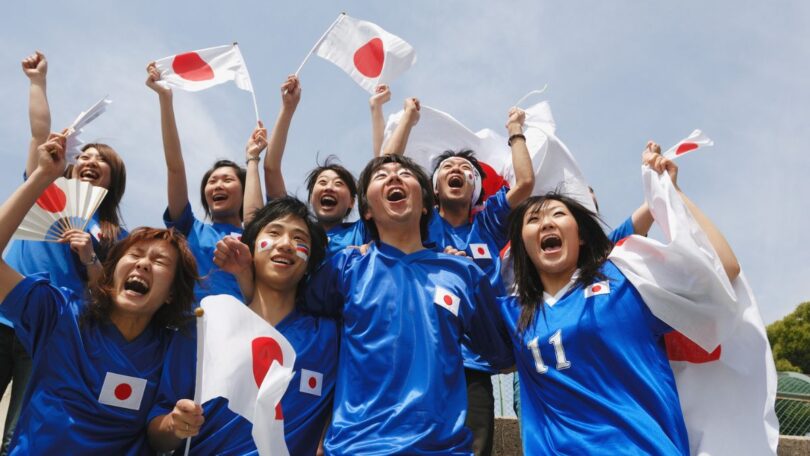

Japan have quietly and systematically become one of world football’s most respected and feared national teams. No longer the Asian curiosity of 1990s World Cups, Japan in 2026 are a team that every major nation in the tournament will have studied extensively — and for good reason. At Qatar 2022, they eliminated Germany and Spain from the group stage. They gave Croatia an extraordinary game in the Round of 16 before losing on penalties. Their blue-and-white strip has become associated with tactical precision, collective intensity, and the kind of organised pressing football that top European clubs spend millions to develop.
Japan are placed in Group F alongside Netherlands, Sweden, and Tunisia — their opening match against Netherlands on June 14 at AT&T Stadium in Dallas is one of the most anticipated clashes of the group stage’s first weekend. A Japan win there would send shock waves through the tournament and immediately establish the Blue Samurai as genuine dark horse contenders for the knockout rounds.
Can you name every Japan squad member by jersey number? The FIFA 2026 Jersey Quiz tests your knowledge of Japan and all 47 other nations. 10 questions, global leaderboard. Take the challenge!
Play the FIFA 2026 Jersey Quiz – Japan Edition!
Japan’s Remarkable World Cup Evolution
Japan’s football development over the past 30 years is one of the most impressive stories in international sport. From a nation with virtually no professional football infrastructure in the 1980s, Japan established the J-League in 1993 and has systematically built a footballing culture that now produces players capable of performing at the highest European levels. The percentage of Japan’s national team squad playing in top European leagues — primarily the Bundesliga and increasingly the Premier League — has grown dramatically with each World Cup cycle.
At Qatar 2022, Japan’s famous come-from-behind victories over Germany and Spain demonstrated that this is not a team that gets lucky. They are a team with a genuinely sophisticated tactical system, supreme physical conditioning, and the mental strength to perform under extreme pressure. Their coaching philosophy — intense pressing, structured defensive blocks, explosive transitions — has been refined and improved since Qatar. The team that arrives at FIFA World Cup 2026 is better than the one that surprised the world four years ago.
Japan’s Key Players
Wataru Endo — the Liverpool defensive midfielder who has established himself as one of the Premier League’s best midfield anchors — is Japan’s most important player in defensive terms. His reading of the game, his ability to intercept passes and win duels in central areas, and his leadership on the pitch provide the foundation that allows Japan’s more creative players to take risks in attack.
Japan’s wide players — drawn from the Bundesliga’s brightest young Japanese talents — bring the pace, directness, and pressing intensity that characterises the national team’s style. Multiple Japanese players at clubs like Bayer Leverkusen, Bayern Munich, Borussia Dortmund, and others have developed the tactical intelligence to play in systems that mirror Japan’s national team approach, making the transition from club to international football seamless.
Japan’s striker rotation blends mobile, pressing forwards with clever movement and the ability to finish composedly in one-on-one situations. They are not a team built around one prolific goalscorer — their goals tend to come from multiple contributors, which makes them difficult to defend against because there is no single threat to focus defensive attention on.
Japan’s Tactical System – The Press That Beats the World
Japan’s tactical approach is based on a high-intensity pressing game that has become their most identifiable and most feared characteristic. When Japan win the ball back in the opponent’s half — through organised pressing triggers that the entire team executes simultaneously — they can transition into attack within seconds, before defensive lines have re-organised. This is exactly how they scored against Germany and Spain in Qatar 2022 — not through overwhelming individual quality, but through the collective execution of a carefully designed pressing and counter-pressing system.
The defensive phase sees Japan drop into a compact 4-4-2 or 5-4-1 shape that makes them extremely difficult to break down through the centre. Opponents are funnelled into wide areas where Japan’s wide midfielders can recover and double up on attackers. The discipline required to execute this defensive shape for 90 minutes at World Cup intensity is significant, and Japan’s physical conditioning — developed through one of the most rigorous preparation programmes of any national team — enables this sustained intensity.
Against Netherlands, this system will be tested at the highest level. Netherlands’ fluid attacking movement, Gakpo’s central threat, and their full-backs’ ambition could stretch Japan’s defensive shape and find gaps. But Japan will be well-prepared. Their coaching staff will have detailed tactical plans for disrupting Netherlands’ build-up and launching the fast transitions that have produced their greatest World Cup moments.
Group F Analysis – Japan’s Route to Advancement
Japan’s Group F schedule presents two significant challenges (Netherlands and Sweden) and one more accessible match (Tunisia). Advancing from the group requires Japan to take points from at least one of the European nations or sweep Tunisia by a large margin while maintaining a strong goal difference.
Sweden, while physically imposing and tactically organised, plays a more direct style than Netherlands — long balls, set-piece danger, wide crosses. Japan’s second Group F match against Sweden (June 25 at AT&T Stadium, Dallas) will test their aerial defending but should present more transition opportunities than the Netherlands match.
Tunisia are technically capable and tactically disciplined — their African qualifying campaign showed a team that can defend resolutely and score on the counter. Japan must treat this match with the utmost seriousness. A victory against Tunisia combined with a result against Netherlands or Sweden should be enough for Group F advancement.
Japan’s Semi-Final Dream
Japan have reached the quarter-finals of a World Cup only once — in 2002 on home soil. Their Qatar 2022 campaign reached the Round of 16. The ambition for 2026, stated openly by the Japan Football Association, is a semi-final appearance. That would be the greatest achievement in Japanese football history and would confirm the Blue Samurai as a permanent member of the world’s football elite.
A semi-final run for Japan would require them to advance from Group F, then defeat a team in the Round of 32, win a potentially gruelling Round of 16 match, and survive a quarter-final against likely top-four quality opposition. Each hurdle is significant, but Japan’s organisational quality, tactical sophistication, and collective spirit give them a better chance than their FIFA ranking might suggest. Our prediction: Japan advance from Group F as runners-up and reach the Round of 16, where their tournament story will be decided.
Japan’s FIFA World Cup 2026 Schedule – Group F
- Match 1: Netherlands vs Japan – June 14, 4:00 PM ET | AT&T Stadium, Arlington, Texas | 9:00 PM BST / 1:30 AM IST June 15
- Match 2: Tunisia vs Japan – June 20, Midnight ET | Estadio BBVA, Monterrey, Mexico
- Match 3: Japan vs Sweden – June 25, 7:00 PM ET | AT&T Stadium, Arlington, Texas
Japan at the World Cup — can you name every Blue Samurai by their squad number? Take the FIFA 2026 Jersey Quiz and find out. Challenge other Japan football fans and share your score!
Play the FIFA 2026 Jersey Quiz Now!
Frequently Asked Questions
What is Japan’s best FIFA World Cup result?
Japan’s best World Cup result is reaching the quarter-finals in 2002 when they co-hosted the tournament with South Korea. In 2022, they advanced to the Round of 16 after defeating Germany and Spain in the group stage — one of the tournament’s greatest upsets.
Which group is Japan in at FIFA World Cup 2026?
Japan are in Group F alongside Netherlands, Sweden, and Tunisia.
How many Japanese players play in Europe’s top leagues?
Multiple Japanese players compete in Europe’s top leagues, particularly the Bundesliga (Germany) and the Premier League (England). This European club experience has been a major factor in Japan’s improved World Cup performances over the past decade.
Has Japan ever beaten Germany at a World Cup?
Yes. Japan famously defeated Germany 2-1 in the group stage of FIFA World Cup 2022 in Qatar. They came from a goal down to score twice in the second half in one of the tournament’s greatest upsets. They also defeated Spain 2-1 in the same group stage.
Who is Japan’s coach at FIFA World Cup 2026?
Japan’s national team coaching setup has continued to develop the tactical pressing philosophy that has defined their recent World Cup campaigns. Check the Japan Football Association’s official website for the confirmed head coach details for the 2026 tournament.
Follow Japan’s entire Group F and knockout campaign at FIFA World Cup 2026 on theOpenHandbook’s FIFA World Cup 2026 hub — updated every match day.